-
Monday morning musicals
A couple of barmy musicals to get your week off on the right foot. The agents of Improv.com have been staging such antics at various places for ages, and I have to say that the Grocery Store Musical
is an improvement in quality over last year’s Food Court Musical,
although, frankly, I would be delighted to witness either one of them in an establishment near me. Being the single minded creature that I am, though, I would have preferred some kind of clever statement about the toxic environments in which these two musicals are staged over the actual and frankly inane lyrics, however amusing. A wasted learning opportunity, the adult educator in me might whisper.
-
Climate Action, transgenic aubergines, chickens, food policy and CBC awards
Today is the International Day of Climate Action! To… er… celebrate it I’ll be attending a screening of A Sea Change, about the acidification of the earth’s oceans.
In Sweden, consumers are being offered new climate change food labelling in order to help them make climactically healthier decisions about what to eat.
Other interesting items to cross my vision include a story published in Nature about the Indian government’s having said no (for now) to transgenic aubergines (eggplants; aka Bt brinjal) on the grounds they can’t evaluate how likely (or not) the transgenic varieties are to cross with non-GM varieties, a well-worn concern that somehow keeps getting overlooked by biotechnology firms.
An article in the New York Times paints a cautionary picture about kind of issues that can result from overenthusiastic backyard chicken-rearing by people who haven’t quite thought the issues through carefully. It’s very much the sort of thing the SPCA argued would happen before bylaws were relaxed to allow it in Vancouver.
And if you want to put your oar in about Canadian food policy, the People’s Food Policy Project website is the place to go. Because Canada hasn’t got a food policy: although one was researched, discussed and proposed a few years ago, it fell into the cracks between elections and died, unknown and unloved on the mean streets of Ottawa. The people’s project is inviting stories and policy suggestions by December 1.
Other deadlines looming include the CBC Literary Awards, which I hadn’t – until last night – realized had tightened their terms to exclude any work that’s had a public reading. Which made me despair, for I have read a lot of my poems aloud and I really couldn’t tell you which ones. It also made me foresee ugly scenarios of literary whistle-blowing by disenfranchised contestant audience members. (Surely there’s a novel in that?)
-
Bye Bye Banff and WordFest
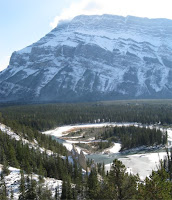
I left Banff on Monday morning, having spent much of the weekend dodging in and out of literary and visual arts events.
Saturday afternoon I slipped into and then fled screaming from the most bizarre and numbingly dull curatorial talk I’ve ever experienced. We heard scarcely a shred of information about the Laid Over to Cover: Photography and Weaving in the Salishan Landscape exhibition that we were all interested enough in to show up, and after an hour I couldn’t take it any more.
When I went to see the show on Sunday, its very point was a bit difficult to grasp (but then I had no curatorial context for it!) given the dearth of labelling – which was, according the one point I recall from the talk, a curatorial decision, though the reasoning for this eludes me, if the point of the show was to right an historical wrong of omission.
We were presented with some interesting archival photographs of the building of transportation infrastructure through BC and Alberta; and some rather lovely woven baskets dating from about 1900 through 2009. The baskets were numbered, with no contextual information, placed in apparently random order, and interspersed with modern ceremonial blankets. We ran into a textile artist who’d visited the show and who was galled and mystified as to why these blankets were there – as they were woven not from traditional materials (goat wool and cedar) nor using traditional plant dyes, nor even using traditional weaving methods (one weft she recognized from a loom in New Brunswick). Oh well.
On to literature, and another massively disappointing presentation, this time from Douglas Coupland who read in a manner that struck me as that of someone who had never before encountered the text in front of him.
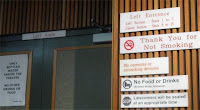
In a many-signed theatre that reminded me of Italy in its enthusiasm for public instruction,
a poetry cabaret followed, of which I would say Gregory Scofield gave the best reading, but which irritated me in the way that poetry cabarets always irritate me. Luckily I was able to vent my irritation on a hapless festival survey-monger who crossed my path the next day: why, I asked, can Canadian literary festivals not treat poets as writers? Why must the only way to include them in a litfest be to herd them in nines or twelves onto a single stage at a single event instead of including them in literary panels with the prose writers? The other irritant to that event had me asking why spoken word artists must be lumped in with page poets? It would be like pairing water-colourists with metal sculptors on the grounds that they are both visual artists.
Anyway. A talk and mini-readings by fiction writers on Sunday – Debra Adelaide, Jeanette Lynes, Thomas Trofimuk and Tom Wayman – was slightly better. Although to me the supposed theme of the event, “making the most of the hand you are dealt,” was somewhat mystifying in light of the very different themes of the four books. It is a difficult and sometimes impossible task to corral every writer into thematically coherent panels; too many square pegs in the creative realm.
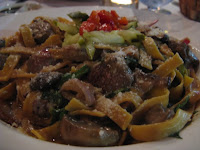
The winning finale to the weekend though was a visit to the Maple Leaf restaurant in Banff, where we dined happily and well on bison stroganoff.
And a parting view, first thing Monday morning, of a trio of antlered elk who posed heroically at the edge of town, seeing us off. Given the damage sustained by one writer’s vehicle during this, the rutting season, we deemed it unwise to linger for photographs, so I’m afraid you’ll just have to imagine them.


Latest Posts
- Sublime
- Good weather for reading
- The world, the world
- Sublime launch!
- Planet Earth Poetry – Readings by Volunteers, Victoria 2026
- Poetry at the Goldfinch
Aldeburgh Poetry Festival Barny Haughton BBC BC poets Berkswell blackberries Black Stilt Bologna book launch Borough Market Carlo Petrini Catalonia Cyrus Todiwala dairy Daunt's Books Dijon Fanny Bay Food and Morality food journalism food photography lardo Malahat Review Michael Pollan Okanagan olive oil tasting Omnivore's Dilemma Our Food Our Future Oxford Parmigiano-Reggiano persimmons Planet Earth Poetry poetry poetry readings Poetry videos prosciutto salumi sausage making Sean O'Brien Suffolk ticks tortelli di zucca Troubadour Wendy Morton Wired Writing Yvonne Blomer
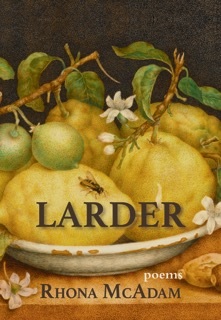
In her latest collection, Rhona McAdam navigates the dark places of human movement through the earth and the exquisite intricacies lingering in backyard gardens and farmlands populated by insects and pollinators, all the while returning to the body, to the tune of staccato beats and the newly discovered symmetries within the human heart.
“…A beautiful, filling collection, Larder is a set of poems to read at the change of the seasons, to appreciate alongside a good meal, and to remind yourself of the beauty in everything, even the things you may not appreciate before opening McAdam’s collection….”
Rhona McAdam is a writer, poet, editor, and Registered Holistic Nutritionist with a Master’s in Food Culture from Italy and a deep-rooted passion for ecology and urban agriculture. Her work spans corporate and technical writing to poetry and creative nonfiction, often exploring the vital links between what we eat and how we live. Based in Victoria, BC, and available via Zoom, Rhona is always open to new writing commissions, readings, or workshops on nutrition and the culinary arts.