-
Black beans and blind men
Read Full Post: Black beans and blind menNigella Lawson’s How to Eat is, I discovered, the subject of a blog along the lines of the Julie/Julia project. I had received the book last year and thought it was time I cracked the cover and tried something. I happened to have a bag of black beans in the cupboard so I made South Beach Black Bean Soup. It was very good, particularly after letting it sit for a day and then adding a squeeze of fresh lime, some chopped coriander (cilantro) and a dollop of sour cream. Didn’t have any red onion but might try it with that later. I did find myself yearning for heat, and the tabasco helped. But it seemed… wrong somehow to make black bean soup without chiles. Anyway, it’s a good one for vegetarians and coeliacs.
I spent a little time today browsing The Poem, a spare and readable site, which describes itself as “a taster of contemporary poetry in Britain and Ireland.” I enjoyed Christopher Logue’s “Rat O Rat” – one of the little beggars just strolled along my fence the other day and gave me a haughty look – but the one that follows it “from New Numbers” is an amazing narrative gem.
-
Slowing down in Victoria
Read Full Post: Slowing down in Victoria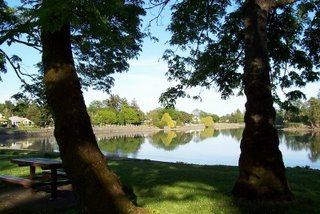
It’s been a busy and beautiful week in Victoria. Little actual reading or cooking going on.. although much thinking about food, many walks, anguished glances at dehydrating garden, and even a little fence painting happening — until the clouds gather just in time for the long weekend. Funny, I think this might be the first time I’ve been in Victoria for Victoria Day in four years.
In talking to various people about various things, I have been surprised at the number of those who’ve never heard of the Slow Food movement. Even here in Victoria we have a proponent, although it is a fact that not many of my circle dine regularly at Sooke Harbour House.
According to its website, the Slow Food movement
promotes food and wine culture, but also defends food and agricultural biodiversity worldwide. It opposes the standardisation of taste, defends the need for consumer information, protects cultural identities tied to food and gastronomic traditions, safeguards foods and cultivation and processing techniques inherited from tradition and defends domestic and wild animal and vegetable species.
All very topical on Vancouver Island, where small food producers are trying their best to promote local and artisan products through such vehicles as the Small Scale Food Processor Association, and where Victoria flogs culinary tourism even as our surrounding farmland is being diminished by pro-development municipal councils.
There’s a Slow Food blog in Washington State which gives a helpful primer, and there’s information on the Canadian arm (fork? table?) on its own website; Slow Food Vancouver also has a website.
-
More from the half read library, and turmeric
Read Full Post: More from the half read library, and turmericI was reading Adrienne Rich’s collection of essays, What Is Found There: Notebooks on Poetry and Politics. I thought she gave a very cogent summary of issues around form:
“Poetic forms – meters, rhyming patterns, the shaping of poems into symmetrical blocks of lines called couplets or stanzas – have existed since poetry was an oral activity. Such forms can easily become format, of course, where the dynamics of experience and desire are forced to fit a pattern to which they have no organic relationship. People are often taught in school to confuse closed poetic forms (or formulas) with poetry itself, the lifeblood of the poem. Or, that a poem consists merely in a series of sentences broken (formatted) into short lines called “free verse.” But a closed form like the sestina, the sonnet, the villanelle remains inert formula or format unless the “triggering subject,” as Richard Hugo called it, acts on the imagination to make the form evolve, become responsive, or works almost in resistance to the form. It’s a struggle not to let the form take over, lapse into format, assimilate the poetry; and that very struggle can produce a movement, a music, of its own.”
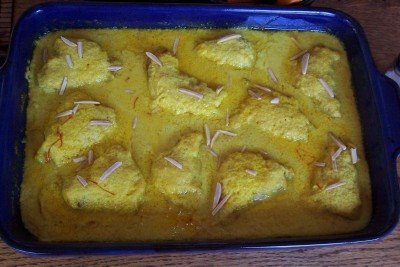
Last night’s dinner was Saffron Chicken. Very smooth, complex sauce, bright yellow from the turmeric, thickened, and slightly crunchy, with ground almonds. An excellent recipe which can be made well ahead of events and heated up when needed.
Turmeric may be the new snake oil. In recent years it has gained new currency as an anti-arthritis wonder food under the name of its active ingredient, curcumin. Long used as a food colourant and fabric dye (though it fades), it has been reported to be an anti-inflammatory and an anti-cancer agent; a cure for jaundice, indigestion, kidney stones, dysentery, sexually-transmitted diseases, cystic fibrosis, diabetes, stomach and liver ailments including Crohn’s and inflammatory bowel disease; even a preventative for Alzheimer’s disease and cardiovascular problems, and a treatment for poor vision. Externally it is used to heal sores and inflammations, including itching, Herpes, psoriasis, chickenpox and smallpox; as a depilatory, a cosmetic and to counteract aging processes. And as we saw in the movie Water, you can rub it on hotheads to cool them down!


Latest Posts
- (no title)
- Sublime and Twisted Readings coming up!
- Sublime
- Good weather for reading
- The world, the world
- Sublime launch!
Aldeburgh Poetry Festival Barny Haughton BBC BC poets Berkswell blackberries Black Stilt Bologna book launch Borough Market Carlo Petrini Catalonia Cyrus Todiwala dairy Daunt's Books Dijon Edinburgh Fanny Bay Feast of Fields Food and Morality food history food journalism Jenna Butler lardo Malahat Review Michael Pollan Okanagan olive oil tasting olive trees Omnivore's Dilemma Our Food Our Future Oxford Parmigiano-Reggiano Planet Earth Poetry poetry poetry readings Poetry videos prosciutto salumi Sean O'Brien Suffolk ticks Wendy Morton Wired Writing Yvonne Blomer
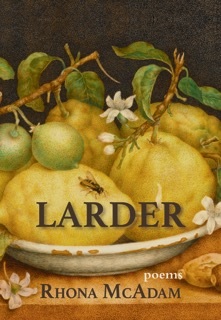
In her latest collection, Rhona McAdam navigates the dark places of human movement through the earth and the exquisite intricacies lingering in backyard gardens and farmlands populated by insects and pollinators, all the while returning to the body, to the tune of staccato beats and the newly discovered symmetries within the human heart.
“…A beautiful, filling collection, Larder is a set of poems to read at the change of the seasons, to appreciate alongside a good meal, and to remind yourself of the beauty in everything, even the things you may not appreciate before opening McAdam’s collection….”
Rhona McAdam is a writer, poet, editor, and Registered Holistic Nutritionist with a Master’s in Food Culture from Italy and a deep-rooted passion for ecology and urban agriculture. Her work spans corporate and technical writing to poetry and creative nonfiction, often exploring the vital links between what we eat and how we live. Based in Victoria, BC, and available via Zoom, Rhona is always open to new writing commissions, readings, or workshops on nutrition and the culinary arts.