-
More anthropology, and the décroissance finale
Read Full Post: More anthropology, and the décroissance finaleFriday morning’s lecture was based on a couple of readings we’d done: one on punk food culture in Seattle, and the other on fast food outlets in China (Of hamburger and social space: Consuming McDonalds in Beijing). A lot of interesting stuff came out of it. We started with Lévi-Strauss’s culinary triangle, which places the concepts of cooked, raw and rotten at its points; the discussion was about what those ideas represented in a counter-culture which had quite naturally (being counter-culture) adopted opposites, so was raw (vegan) instead of cooked (processed, industrialised, omnivorous) and included rotten (foods retrieved from supermarket dumpsters or stolen from markets). And for the second article we talked about it in the context of Sidney Mintz‘s observation that eating differently transforms you – so to eat like an American in Beijing provided a kind of local version of cultural transformation.
In the afternoon we had the second half of the décroissance lecture, and the theories and political actions needed to counteract it. It was a little disappointing to learn there were no simple, effective solutions to a problem that’s been growing since the industrial revolution. The complexity of the economic rat’s nest that holds it all together is not likely to be untangled with a single stroke. Too many vested interests, too many power relationships. A population too tied to the comforts, rules and products of a growth economy, and too unaware or unwilling to see our individual connection to the larger problem.
And an infrastructure that doesn’t support it. It may be possible to live – as I did for 13 years – without a car in a city with a large public transport system; but if you live in a small town, for example, how do you manage? There are towns in every country that have no public transportation, or transportation that runs once a day or less. So people who move to the country to live a healthier life or be greener often find they use their cars far more than they ever did in city life: they are likely to get less exercise than they would in a city where they had to walk between transport stops or were able to use bike lanes rather than risk their lives on narrow country roads. What does that do to the environmental balance I wonder.
And as for downshifting our lives: it all sounds good. We should be wasting less, polluting less, growing more of our own food. But do the people who live in tower blocks have that option or is it reserved for those who can afford the luxury of a house with a garden?
What do we do with all those people living in urban centres, who are there after all because there simply isn’t enough land for them to have their own patch?
Or with those who are a couple of generations beyond having learned to cook their own bread, sew their own clothes or repair furniture –which nowadays is made of self-destruct particle board? Who maybe have to hold two jobs just to pay the rent and feed their children and haven’t the luxury of stepping off the merry-go-round in order to learn how to cook anything from scratch instead of buying frozen pizzas and processed foods, let alone why it should matter to the rest of the world what and how they eat?
We received this interesting link from a Unisg alumnus: What the World Eats is somewhat terrifying when you look at the amount of processed and packaged foods on everyday tables around the world.
Well, on with the show. Today we have a first meeting with Barny Haughton, of Bordeaux Quay, Bristol, talking about culinary techniques; later in the week we’ll have the Austrian-born American physicist (author of The Tao of Physics) Fritjof Capra.
-
Back in the classroom: anthropology and décroissance
Read Full Post: Back in the classroom: anthropology and décroissanceReturning from stage is always a bit of a culture shock, but come Wednesday morning we had shaken off bus-lag and were back in our places (with bright shiny faces) at the University of Gastronomic Sciences. Everything was pretty shiny, in fact, as it was raining – bucketing down – and Torrente Parma was looking like a torrent of latte, not the sparse trickle we’d left behind only ten days earlier.
We met our new instructor of the week, Carole Counihan, who has us paddling swiftly down the byways of foodways, gender and the anthropology of food. We’re talking about the preservation of food cultures through anthropological methods, like interviews and observations. We’ll be trying an observation of our own in the next week.The other instructor this week was economist Serge Latouche, who came from Paris to tell us about décroissance, which argues that civilization can no longer be founded on infinite economic growth. He picked up the thread where An Inconvenient Truth left off.
Referring often to the ideas of Romanian economist Nicholas Georgescu-Roegen, he spoke at some length about the implications of unchecked growth on every aspect of our lives. Where food is concerned, a growth economy means the food industry is encouraged to force consumers to consume (or at least buy) more than they need so that profits can continue to grow, which of course requires industrialised food production and massive waste. You could take that to mean that if we buy into this pattern, we’re complicit in building populations of spiritual and physical obesity. And their harvests of waste, illness and pollution.
He spoke of three evils of the growth economy: advertising; programmed obsolescence; and credit.
Advertising’s crime is creating desire for products that are not needed; its job is to generate additional growth by nurturing a chronic sense of discontent and inadequacy in the target audience. A successful campaign will create cycles of insatiable demand and overproduction. The victims are vulnerable people who can be brainwashed into feeling inadequate, and the most vulnerable of those are children, already subject to excesses of advertising through television, but also through corporate sponsorship within their schools. He also singled out the mailshots that he says create up to 50kg of unwanted paper per household in Italy, with attendant issues of deforestation and pollution.
Programmed obsolescence forces consumers to replace items rather than repairing them. The lifespan of a computer is two years or so, and after that it simply stops working (or one year and one month in the case of my dead Acer laptop); the corporate solution – and the one that we consumers have implicitly consented to – is to dump these dead machines on foreign shores, all toxic chemicals and non-biodegradeable parts. Gone are the days when you could be self-reliant in your own home with a few good wrenches and screwdrivers; nowadays you can’t even diagnose the problems with most of our appliances and cars unless you have computer diagnostics. We will persuade people – shame them, mock them – that wearable clothes can no longer be worn because they are no longer fashionable. And what was I reading recently, that talked about the loss of the verb “darn” – that the very idea of repairing a hole in a sock had become passé in a culture that simply threw old clothes away because they were cheaper to replace?
Credit, he said, attacks consumers by encouraging them to consume even when they are unemployed or unable to afford what they are manipulated into wanting. He cited some depressing figures: in France, 80% of the population is indebted to the amount they will earn this year and next; Americans owe what they will earn until 2010. And, unsurprisingly, it seems that Canadians, too, owe more than they earn. It got me wondering who pays for the debt of the one in 53 American households that declare bankruptcy (and presumably go on to assume more debt as soon as they’re legally able, since credit helps to fund bank profits growth), and what implications that will have for all of us down the line if the debts are ever called in.
There was of course much more said, and I look forward to the next installment this afternoon, and some time to digest it all.
-
We bless the smoking piano of Dijon
Read Full Post: We bless the smoking piano of DijonCan you really get anything you want? Alas, they were closed when we passed by, so we will never know.

I have to confess I have never been awed by French food, having had in my short lifetime eaten better in Spain, Italy and indeed Holland and Germany than in France, where I’ve had some spectacularly bad food. And I wasn’t converted on this trip. We had a lot more mediocre meals than good ones, and it reminded me of London in that way: it’s easy to find a poor meal; finding a good one is a matter of luck and/or money.
Then again, if I may delve into thoughts inspired by this year’s studies in the culture of food, there is an art and a skill and a cultural knowledge involved in reading a country’s menus that should give you fair warning about which places to avoid; that coupled with a heavy purse can keep you safe from most bad food.
All of that having been said, Dijon’s Le Piano Qui Fume was a great find, and we simply stumbled upon it, and took a second look simply because of its name (does anyone know if that is an allusion to something, by the way? We forgot to ask).
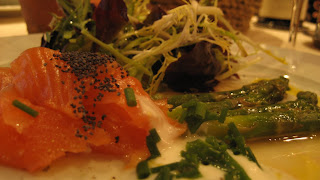
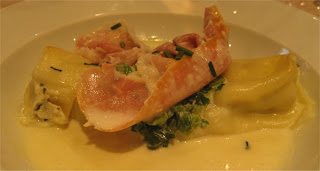
A former creperie, it has been operating for the past four years in a good central location of Dijon. We had the three course menu for a not unreasonable 27 euros per person (passed on the cheese course which I’m sure would have been stunning as well) which began with an amuse-bouche of vichyssoise. Our paths divided with the starters: the asparagus and smoked salmon salad was perfectly executed, but the cannelloni – which our generous dining companion shared – was even better, a tender family of escargot sleeping in a soft pasta bedroll. (So much more comfortable than a nasty old shell full of garlic butter.)
Then we all converged on the rabbit, which was exquisite; the diners around us who had the cod dish looked as happy as we.
Lapin: before…
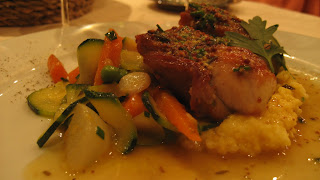
And after…

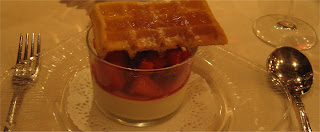
And then desserts of beautiful fresh strawberries (a little waffle with bitter orange marmalade was a perfect companion) and my clever fellow diners had the even more celestiale chocolate mousse with a surprise hidden puddle of white mint creammmmmmm lurking in its depths.
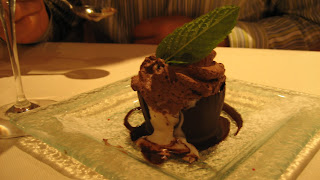
Even the darling little cakes that came with coffee were charming and clever.

And oh, happy day, there was a mix-up in our group’s final dinner reservation on our last night in Dijon, so we were able to return and try all the things we missed the first time.

The sweet, tangy ratatouille that came with the cod gave me a shock: so that’s how it’s supposed to taste? And I had been reading MFK Fisher’s amusing recipe for it only the night before. The one change to the delivery was substitution of mint ice-cream for mint cream in the dessert, but it was altogether a delightful encore and a welcome finale to our visit.


Latest Posts
- (no title)
- Sublime and Twisted Readings coming up!
- Sublime
- Good weather for reading
- The world, the world
- Sublime launch!
Aldeburgh Poetry Festival Barny Haughton BBC BC poets Berkswell blackberries Black Stilt Bologna book launch Borough Market Carlo Petrini Catalonia Cyrus Todiwala dairy Daunt's Books Dijon Edinburgh Fanny Bay Feast of Fields Food and Morality food history food journalism Jenna Butler lardo Malahat Review Michael Pollan Okanagan olive oil tasting olive trees Omnivore's Dilemma Our Food Our Future Oxford Parmigiano-Reggiano Planet Earth Poetry poetry poetry readings Poetry videos prosciutto salumi Sean O'Brien Suffolk ticks Wendy Morton Wired Writing Yvonne Blomer

In her latest collection, Rhona McAdam navigates the dark places of human movement through the earth and the exquisite intricacies lingering in backyard gardens and farmlands populated by insects and pollinators, all the while returning to the body, to the tune of staccato beats and the newly discovered symmetries within the human heart.
“…A beautiful, filling collection, Larder is a set of poems to read at the change of the seasons, to appreciate alongside a good meal, and to remind yourself of the beauty in everything, even the things you may not appreciate before opening McAdam’s collection….”
Rhona McAdam is a writer, poet, editor, and Registered Holistic Nutritionist with a Master’s in Food Culture from Italy and a deep-rooted passion for ecology and urban agriculture. Her work spans corporate and technical writing to poetry and creative nonfiction, often exploring the vital links between what we eat and how we live. Based in Victoria, BC, and available via Zoom, Rhona is always open to new writing commissions, readings, or workshops on nutrition and the culinary arts.
