-
Raw and milky
Read Full Post: Raw and milkyI’ve been easing off the dairy products lately, though my cheese drawer still groans with long-lived goodness. One of the items that will always remain there is a hefty chunk of Parmigiano-Reggiano, a staple in my kitchen, as in many others I’m sure. It would probably startle many North Americans to discover that this is a raw milk cheese. Our governments allow it because it’s been aged over 60 days. It’s also salt-cured, which is a preserving process in many food products that helps to ensure food is safe by driving out liquids that can harbour pathogens, and making a generally unpleasant living environment for them.
One of my classmates at Unisg was Australian and she shocked us by revealing that the Australian government allows no raw milk cheeses at all, including Parmigiano-Reggiano! This is still the case, and there are rumblings that the 60-day threshold in the US could change. Here in Canada only Quebec cheesemakers are allowed to make raw milk cheeses: I have not heard of reports of an increase in sudden deaths in that province since the regulations were changed in 2008.
In the Rest Of Canada, as we are known, we have watched a long and painful battle between Michael Schmidt, who wants to share the right of informed citizens to drink raw milk (or turn it in to cheese I suppose) and the government turn sour; he’s currently on a hunger strike to protest the reversal of his earlier court victory upon appeal by the province of Ontario, after heavy lobbying by the province’s milk marketing board.
Into the fray comes Slow Food. Although they do not seem to be following the Schmidt case, they are tracking developments in other countries, including Australia, and have set up a Raw Milk website to promote the cause, which they take up largely for the sake of cheesemaking. Slow Food is, after all, the champion of good food: raw milk cheeses are simply better than pasteurized in many ways, including flavour and texture.
Raw milk contains microflora and natural enzymes that allow for more complex flavours and textures in cheese. Pasteurization destroys these as well as vitamins A and D which must then be added back to milk products in artificial form. Minerals such as calcium and iron are altered by pasteurization, as are the fats, and the digestibility of the final product. One of the arguments against the findings of the China Study was that it failed to make a distinction between pasteurized and unpasteurized milk products.
For drinkers of raw milk, there seems no respite from the government ban. In order to drink raw milk you need to own your own cow, and tell nobody. For the immune-compromised, it’s probably not a good idea to drink it, but among the healthy adults who prefer it, there are many arguments in its favour (as long advocated by the Weston A. Price Foundation). I drank it while in Italy, where the law allows people to make their own choice, by filling the milk bottle themselves (in my case from a dispenser provided by a local dairy that also sold cheese and other food products in a shopping mall). Despite the official warning signs posted on the machine, I watched a heavily pregnant woman fill her bottle; the presence of a small child with her suggested she may have survived a raw-milk fuelled first pregnancy already.
It is, as raw milk supporters would say, a puzzle why raw milk should be targeted when so many government-approved toxic substances are already on our tables. There is no ban on fracked tapwater, for example, nor on processed foods high in salt, sugar and fats which are proven to cause catastrophic health problems.
-
Banff Finale
Read Full Post: Banff FinaleTwo weeks have slithered by in a sly and uncatchable manner. Seldom have I written so hard, eaten so much and slept so badly. The weather blessed us with sunshine for our last week, and I got a couple of gentle hikes in between meals and hours spent slumped over laptop.
The Hoodoos still stand, shrinking daily I guess. They started life with limestone hats but have apparently lost those along the way. And Tunnel Mountain (which has no tunnel) was busy with walkers, including a lot of young women with babies strapped to their backs; it must be one of the places that local new mothers go to retrieve their waistlines and catch some stunning views of Banff and the Bow Valley. Fortunately the path (and the trail we take to Banff townsite) has been free of cougars, although we have heard there are three of them in the area who are duking it out for supremacy. A grizzly was also seen not far away a few weeks ago.
The meals at the Banff Centre are something to experience, an endless buffet which tries to serve most diets, with dairy and oil-free vegetables and starch, both meat and vegetable-based soups and a pretty good salad bar. At the lunch and supper buffets, the vegetarian offering is often vegan, and for some reason usually does not appeal to me either visually or in taste. Possibly I’m just not a buffet person. Vegetable biryani, vegan lasagne and vegetarian chile have been among recent items. Here, like most places in the western world, it’s possible to eat plenty of meat three times away if that’s where your interests lie. The buffet also includes about half a dozen desserts for lunch and dinner. Fortunately for my waistline, after much careful sampling, I find I don’t care for most of the sweets though they look quite lovely.
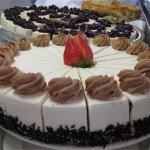
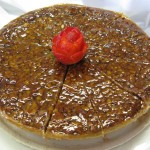

WordFest is on in Banff this weekend and we were privileged to see Douglas Gibson this afternoon, speaking delightfully on his long experience as an editor and publisher. His new memoir, Stories About Storytellers, includes back room tales about 21 of the hundreds of writers he nudged and coaxed into print as an editor and then publisher for Macmillan and McClelland & Stewart. He is finding life interesting “on the other side of the mirror” and finding comfort in his own words of warning to authors. He loves to tell amusing stories but between laughs dropped some grains of hard truth into his tales and generous responses to the Q&A: publishers are shrinking in number (mainly because of being swallowed by larger fish); Mavis Gallant (whose description of Gibson: “I’ll kill him” adorns his book cover) is a brilliant writer and owned the concept of Own the Podium before that was thought of; e-books are a force to reckon with – they are becoming a big part of every publisher’s repertoire, but if someone tells you how it’s going to be in ten years’ time, seek your advice elsewhere.
After which was a tribute to Robert Kroetsch who was killed in a car accident earlier this year. As he’d been booked to appear at WordFest it seemed only appropriate to honour him with a display of his books and a few words on his life by Fred Stenson, and a reading of one of his poems by Steven Ross Smith.
-
A taste for audiobooks and quesadillas
Read Full Post: A taste for audiobooks and quesadillasI’ve been focusing on food so much lately in this blog, and in my life and writing in general, it’s a pleasant change to be around writers here at Wired, and to have a chance to talk about writing as well as food. Because I meet most of my fellow scribes at mealtimes, as usual I’m mixing my interests. And as usual there is a lot on offer at the Vistas buffet, much of it delicious, greasing the wheels of conversation around the dinner table.
Something I haven’t yet raised at one of those meals is my passion for audiobooks. I’ve always loved being read to, and this summer I’ve taken a lot of audiobooks out of the library to accompany my jam-making, apple-peeling, blackberry-juicing, kale-chipping and general cooking and cleaning. Now I read it’s a trend in the wider world as well!
When I decided to drive to Banff, I was really looking forward to the many hours of being read to that would allow. But pleasant as it’s been, it’s not been perfect. In preparation for seeing the new film, whenever I’m able, I’m deep into the unabridged (11-cd) Tinker Tailor Soldier Spy, read by Frederick Davidson, whose voice seems to fall more than it rises as he nimbly switches characters and mood, so it’s been a challenge to hear, let alone follow, the convolutions of plot in this intricate novel. I wonder if this is a characteristic of British readers in general or if it’s particular to this one’s style.
I didn’t have so much trouble hearing Jared Diamond’s Guns, Germs and Steel but interrupted it halfway through when I found my attention wandering, and thought that a thriller would be better suited to driving, hence the le Carré. Haven’t yet started on Alain de Botton‘s Consolations of Philosophy but am even more keen to do so after watching his TED Talk (A kinder, gentler philosophy of success).
CBC has produced some fine listening for travellers,whether of the mind or road: I’ll probably start my return journey with a repeat listen to Anna Maria Tremonti‘s excellent 2008 series Diet for a Hungry Planet (with volumes 1 and 2 of Afghanada for backup).
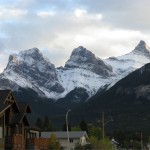
As my Thanksgiving treat today, I went into Canmore to meet Susan and Jennifer for lunch and lots of tea at Communitea. Here’s what the moderately wholesome black bean-avocado quesadilla, plus cup of broccoli soup, looked like on the one hand, and a couple of those OMG-we’re-in-the-mountains kinds of views on the other.
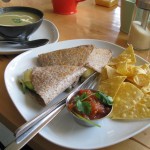
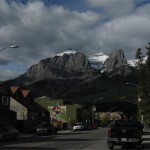
In poetry news, for those who haven’t heard, the deadline approaches for the £2,500 Fifth Annual Troubadour International Poetry Prize, judged by Susan Wicks & David Harsent (with both judges reading all poems). Prizes: 1st £2,500, 2nd £500, 3rd £250 & 20 prizes of £20 each plus a Spring 2012 Coffee-House-Poetry season-ticket and a prizewinners’ Coffee-House Poetry reading with Susan Wicks & David Harsent on Mon 28th Nov 2011 for all prize-winning poets. Deadline for entries: Mon 17th Oct 2011. More information and PayPal link at Coffee-House Poetry Prizes page.
Latest Posts
- Writers at Word!
- Sublime and Twisted Readings coming up!
- Sublime
- Good weather for reading
- The world, the world
- Sublime launch!
Aldeburgh Poetry Festival Barny Haughton BBC BC poets Berkswell blackberries Black Stilt Bologna book launch Borough Market Carlo Petrini Catalonia Cyrus Todiwala dairy Daunt's Books Dijon Edinburgh Fanny Bay Feast of Fields Food and Morality food history food journalism Jenna Butler lardo Malahat Review Michael Pollan Okanagan olive oil tasting olive trees Omnivore's Dilemma Our Food Our Future Oxford Parmigiano-Reggiano Planet Earth Poetry poetry poetry readings Poetry videos prosciutto salumi Sean O'Brien Suffolk ticks Wendy Morton Wired Writing Yvonne Blomer
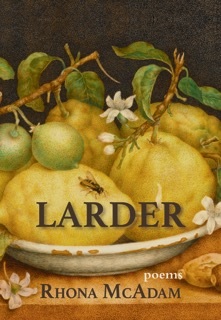
In her latest collection, Rhona McAdam navigates the dark places of human movement through the earth and the exquisite intricacies lingering in backyard gardens and farmlands populated by insects and pollinators, all the while returning to the body, to the tune of staccato beats and the newly discovered symmetries within the human heart.
“…A beautiful, filling collection, Larder is a set of poems to read at the change of the seasons, to appreciate alongside a good meal, and to remind yourself of the beauty in everything, even the things you may not appreciate before opening McAdam’s collection….”
Rhona McAdam is a writer, poet, editor, and Registered Holistic Nutritionist with a Master’s in Food Culture from Italy and a deep-rooted passion for ecology and urban agriculture. Her work spans corporate and technical writing to poetry and creative nonfiction, often exploring the vital links between what we eat and how we live. Based in Victoria, BC, and available via Zoom, Rhona is always open to new writing commissions, readings, or workshops on nutrition and the culinary arts.