-
Bonet and no doctor
A week ago, high up on Mt Washington, the view from the kitchen window looked like this:
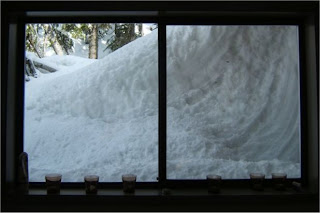
And down here at sea level this weekend, the view was more like this:

In other news, I got into a caramel crisis trying to make a version of bonet, but luckily found this tip sheet for caramel makers. Unluckily it didn’t save the caramel from solidifying into a solid mass. It did make me think about cajeta, though, which came into my life in my school days, thanks to kind fellow students from Mexico, and this variation, Dulce de Leche.
I had embarked on the bonet project because I have been reading Slow Food Revolution (very slowly) and was charmed by the amount of bonet consumed by the movers and shakers while they were forming the Slow Food movement. The book, naturally, lists the menus from important meetings during the movement’s early years, and enumerates as well some of the many, many fine wines consumed by what was from the outset a group of dedicated diners who were curious about wines, and evolved into eco-gastronomes along the way. And provides an early draft of the Slow Food Manifesto, which originally began:
The culture of our times rests on a false interpretation of industrial civilization: in the name of dynamism and acceleration, man invents machines to find relief from work but at the same time adopts the machine as a model of how to live his life. This leads to self-destruction; Homo sapiens is now so consumed by the cycle of production, consumption, and overconsumption that he has been reduced to the status of an endangered species… The fast life has been systematically proposed for or actually imposed on every kind of form and every attitude, as if in a risky attempt to culturally and genetically remodel the human animal…
Well, I’m doing what I can to live slowly. Unfortunately one of the things slowing me down is trying to replace my abruptly retired doctor with a new one, only this town is extremely short of doctors, and I’ve yet to find one who can take me on. Where can they all be? Why aren’t they flocking here? Evidently they are nowhere to be found in this country, as there are shortages of them across the country.
-
Bee here now
So yes, I started a bee-keeping class this week. I don’t have bees, have no immediate plans to get any, but was curious because although I have always eaten honey I didn’t really understand how it was produced. My classmates were a mixture of current and aspiring bee-keepers and honey-eaters like me.
We started things off right with a tasting (creamed, orange, mesquite, fireweed, salal & blackberry, plus a little jar of French honey– whose label said ‘product of Italy’) and then had a review of the equipment needed. Essential items include a smoker and a hive tool, for prying the lids off after the bees have sealed themselves inside with propolis. We admired different styles of veils and bee-wear (it’s white because the bees dislike anyone in animal colours – brown, black etc. – but don’t mind white or bright colours) and looked at different ways to configure and prepare the hives.
I found a bee blog to keep me interested between classes. And a blog that has photos of dogs in bee costumes (hey, is the internet useful or what?), and Bonnie passed along some information from Darryl Hannah’s website about Colony Collapse Disorder, which our instructor (a former hive inspector) thought had a lot to do with pesticide use in the US. It’s not as much a problem on Vancouver Island (though we’ll learn more about it later) which interestingly has had a bee quarantine in place since 1986, since this is a honeybee bee breeding stock area. (Incidentally, who knew that bees are currently the only insects that are artificially inseminated?)
Meanwhile, here on the Island, it’s nearly fruit blossom time, which means we need mason bees (honeybees don’t wake up round here till the end of May or whenever the temperature hits a steady 12.4c), also known as Blue Orchard bees. They are smaller, gentler and sleepier than honeybees; they do their thing with the fruit trees and then go for a long nap in a hole pre-drilled (by someone or something else) in some wood which they seal up like, well, masons! You can make their nests for them by drilling holes 5/16″ in diameter and 4″ deep, spaced ¾” apart in blocks of wood.
-
Food: let’s celebrate!
By now I am sure that you are all well into your own celebration of this the International Year of the Potato, but in case you haven’t got everything in place, here’s a handy list of world-wide events you can still catch. What to do after that? Well, it can be a busy year if you let it.
Europain 2008 is coming up 29 March-2 April; sounds uncomfortable but delicious. Maybe closer to home (for some of us) it would be worth checking out the Seattle Cheese Festival May 16-18. How about joining the Nicosians for their annual Cherry Festival in June? Or there’s also the Prague Food Festival June 20-26. Stavanger, Norway holds its annual Garlic Festival in April, and this year is also hosting the real life rather weird cooking competition, the Bocuse d’Or Europe July 1-2: real life meets reality television. July 4-13 it’s time for the Ledbury Poetry Festival, which has spawned a poetry trail in a Herefordshire Orchard.
One could then return to Canada and attend the South Cariboo Garlic Festival August 16-17. After that, go Really Wild in Wales 30-31 August, and then down to Chichester for the Totally Tomato Show Sept 6-7, and back up to Ludlow Sept 12-14 (unless you are going to the excellent Oxford Symposium on Food & Cookery) and across to Galway to celebrate some oysters September 25-28. Or round off the month with a visit to Sweden to catch Öland’s Harvest Festival 2008 September 25-28 and the Kivik Apple Market, September 29-30.
After that, you’ll want a little rest before Chocaday celebrations on October 12, and then make your plans for Eurochocolate 2008 in Perugia October 18-26, which should give you time to nip up to Torino to catch Salone del Gusto and Terra Madre which run concurrently from October 23 to 27. Then on to Austria for Salon Suisse des Gouts et Terroirs October 29-November 2. November 14-15 it’s the Clayoquot Oyster Festival in Tofino. On November 24 there’ll be tears before bedtime if you miss the Zibelemärit, the onion market in Berne.
In other news, giving some support to world-wide moves against bottled water, Venetians are giving up mineral water for Lent, which I guess won’t win them any friends in the Global Bottled Water Congress. Won’t bother the hibernating cod or dieting teenagers who’ve just been told again they can’t skip breakfast.


Latest Posts
- Sublime
- Good weather for reading
- The world, the world
- Sublime launch!
- Planet Earth Poetry – Readings by Volunteers, Victoria 2026
- Poetry at the Goldfinch
Aldeburgh Poetry Festival Barny Haughton BBC BC poets Berkswell blackberries Black Stilt Bologna book launch Borough Market Carlo Petrini Catalonia Cyrus Todiwala dairy Daunt's Books Dijon Edinburgh Fanny Bay Feast of Fields Food and Morality food history food journalism Jenna Butler lardo Malahat Review Michael Pollan Okanagan olive oil tasting olive trees Omnivore's Dilemma Our Food Our Future Oxford Parmigiano-Reggiano Planet Earth Poetry poetry poetry readings Poetry videos prosciutto salumi Sean O'Brien Suffolk ticks Wendy Morton Wired Writing Yvonne Blomer
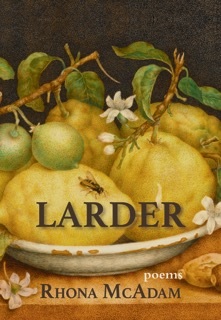
In her latest collection, Rhona McAdam navigates the dark places of human movement through the earth and the exquisite intricacies lingering in backyard gardens and farmlands populated by insects and pollinators, all the while returning to the body, to the tune of staccato beats and the newly discovered symmetries within the human heart.
“…A beautiful, filling collection, Larder is a set of poems to read at the change of the seasons, to appreciate alongside a good meal, and to remind yourself of the beauty in everything, even the things you may not appreciate before opening McAdam’s collection….”
Rhona McAdam is a writer, poet, editor, and Registered Holistic Nutritionist with a Master’s in Food Culture from Italy and a deep-rooted passion for ecology and urban agriculture. Her work spans corporate and technical writing to poetry and creative nonfiction, often exploring the vital links between what we eat and how we live. Based in Victoria, BC, and available via Zoom, Rhona is always open to new writing commissions, readings, or workshops on nutrition and the culinary arts.