-
Cholesterol numbers, and howd’ya like them eggs
Read Full Post: Cholesterol numbers, and howd’ya like them eggsGreetings from Saskatchewan where the weather is bright and not too cold for walks among the chickadees and nuthatches who have, we flatter ourselves to suppose, been waiting for us and our pockets full of peanuts since last winter’s colony.
A little while ago I was having one of my food-obsessed conversations with someone and struggled to remember something I’d read about cholesterol in Gina Mallet‘s Last Chance to Eat: The Fate of Taste in a Fast Food World. I tracked it down in her chapter on The Imperilled Egg.
Dr [Donald J.] McNamara explained that [in 1968] a group of food scientists got together and thrashed out the idea of setting a safe cholesterol standard. Some thought the whole idea unnecessary, but others were adamant. So the debate went back and forth and finally a compromise was reached. The average human intake of cholesterol is 580 mg (per litre of blood) a day, so let’s just halve that. Make it 300 mg. ‘There’s not one bit of scientific evaluation in that number,’ Dr McNamara added.
This was amazing to me; I’ve heard and read a lot about the egg debate but never seen the fundamental RDA numbers contested so simply. She continues, “Cholesterol is created by the way the body processes food, not by foods like eggs that contain cholesterol… So, overnight as it were, and on the basis of an arbitrary calculation the egg was in trouble, deep trouble.”
(Of course the source of your eggs is a whole other question. As with anything we consume, we need to be aware of what our food was fed on. Eggs from battery chickens – fed on Omega-6 rich grains – will not be as nutritionally sound as from pasture or organically fed free-run chickens who can glean nutrients from varied sources and live healthier lives.)
Cholesterol – and the case of the imperilled egg – is only one of those areas where we’ve been battered by contradictory scientific opinions till we’re not sure which way is up anymore. Mallet affirms the anti-nutritionism position for which Michael Pollan has been slammed by, of course, food scientists:
People today are blasé about food science because they have been frightened into changing their diets so many times only to be told later that the scientists were wrong. For years, people believed in food science and obediently ate fibre to stave off colon cancer. Then, suddenly, they were told fibre makes no difference. Margarine was briskly touted as an excellent, healthy substitute for butter, cheaper too: and even though margarine has a disagreeable taste and ruins any dish it is cooked with, people obediently used it, thinking they were lengthening their life span. Now, of course, margarine is ringed with red flags as a trans fat, the deadliest of fats.
-
Catching up on food news
Read Full Post: Catching up on food newsSome things dredged from my inbox.
My visit to Edmonton coincided, sadly without personal coincidence, with a visit by Michael Pollan. Elmarie kindly sent this interview between Pollan and Bill Myers which covers American food poverty and food-health issues the new president needs to address. The article referred to in this interview, An Open Letter to the Farmer in Chief, published in the New York Times back in October, also led to a new blog: the White House Farmer, where they’re trying to encourage the creation of a new post in the new White House.
Meanwhile, Bert sent me this bit of news from Italy, where ethnic eateries (actually non-Italian ‘foreign food’ which would include many fast food joints including one starting with M) have been banned from the Tuscan city of Lucca and are now being given the nudge from other municipalities including Milan. When in Rome, I guess, and that city is certainly plagued with more than its share of McDonalds outlets, including the one that sparked the Slow Food movement.
BBC Food has some seasonal vegetarian and vegan recipes up, in case you’re still rooting through a veg box.
And here’s some food-art Elizabeth sent me, which comments on food sources in a piece called Domestication.
All the ugly facts on the latest avian flu/mass slaughter of poultry in British Columbia are on the CFIA website.
And what sounds like a fabulous talk on a little-discussed fish is coming up, thanks to the Victoria Natural History Society, on Monday, February 23.
MARINE NIGHT: Are Lingcod Too Tasty for Their Own Good?
Lingcod are a common fish in our local waters, easily observed by scuba diving. They are also sought by many fishermen. Following methods developed by the Vancouver Aquarium, local divers have been conducting an annual survey of lingcod spawning in Gowlland Tod Park. Doug Biffard, a long time diver and member of SeaChange Marine Conservation Society, has compiled and summarized six years of spawning observations. The talk will cover aspects of lingcod biology, management, and population trends of the lingcod in Saanich Inlet. 7:30 p.m. Room 159, Fraser Building, University of Victoria. Everyone welcome. -
Alberta trails
Read Full Post: Alberta trailsHave been whistlin‘ through Alberta, helped along with the westerly wind that is blowing all the nice warm air over the mountains and into the prairies.


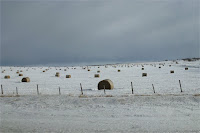
Last night it turned mean and whapped high speed salt and gravel in our faces when we stepped out into Jasper Ave
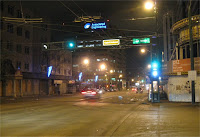
after the otherwise warm and cosy reading at Audrey’s Books, still an excellent independent bookstore in a shrinking universe of independent bookstores.
Thursday’s food day at Augustana was great: it began with one of my favourite speakers, Nettie Wiebe, who gave a splendid overview of the subject of food sovereignty, using to good advantage her multiple aspects as philosopher/ethicist, feminist, farmer, political candidate and ex-farmers’ union head. Starting with the theme of dis-integration, she gave a good overview of the unhealthy influence exerted by corporations, the loss of farmers’ cooperatives, failures in policy that removed the humanity from farming, the removal of accountability from wasteful and destructive means of food production, and much more.
And I was also very taken by the producers’ panel, presided over by the dean, Roger Epp
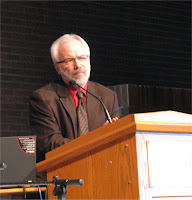
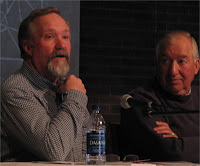
Representing grain and beef were Harold Warkentin and Wyatt Swanson
and dairy by Jan Slomp
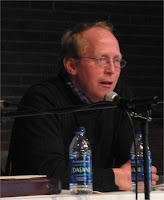
They gave their sobering views on the state of business for Alberta farmers today; they were all grim on the scale of today’s farming, which puts huge swaths of land in the hands of too few farmers. Swanson talked about the upheavals in the beef industry which have been radical over the past thirty years: from an epic high of production and sales in the seventies and eighties, to the advent of feed lots in the eighties and nineties and the transition to a beef export business to the US, the collapse of Alberta beef processing, to the death blows dealt by the first BSE case in 2003 and the credit crisis last year. His family is entering the fifth generation of farming and he’s not sure how long it will be able to continue on the land.
Slomp gave a more optimistic talk, about his evolution from conventional high-yield dairy producer to enlightened producer. He spoke of the damage the green revolution had done to the Netherlands, causing insane fertilizer use and insupportable requirements for feed and medication where once farms were self-sufficient and self-sustaining. He feels his milk yields are impressive despite his decision to top using agrichemicals on his fields and cattle; he’s worked wonders on the water system on his land by pasture management; and he’s thwarted veterinary wisdom by refusing to use prophylactic antibiotics (normally used to prevent the mastitis that is chronic among overtaxed dairy herds). The result he says, is that he lives on a pristine piece of land with healthy animals and a profitable business.
Warkentin spoke about the complexities of seed breeding and the joys of developing new varieties to meet the challenges of growing. He produces high quality seed for other seed breeders (he gave a helpful explanation of seed qualities, which are diffferent according to whether you are developing seed or sowing it for crops) and has enjoyed experimenting with different varieties along the way. He took a firm stand on the question of GM crops; said he’d tested some Roundup-ready canola once, and decided to stay away from it after that. The risk to human health, he says, is too unknown, and he could breed seed with better yields through traditional methods. He gave an interesting bit of information about Alberta’s rat-free status. I’d heard long ago about the rat patrol that kept the numbers down along the border; what I hadn’t realised is that government policy on weasel trapping had also played a part: weasels take care of the rest of the rat population.


Latest Posts
- Writers at Word!
- Sublime and Twisted Readings coming up!
- Sublime
- Good weather for reading
- The world, the world
- Sublime launch!
Aldeburgh Poetry Festival Barny Haughton BBC BC poets Berkswell blackberries Black Stilt Bologna book launch Borough Market Carlo Petrini Catalonia Cyrus Todiwala dairy Daunt's Books Dijon Edinburgh Fanny Bay Feast of Fields Food and Morality food history food journalism Jenna Butler lardo Malahat Review Michael Pollan Okanagan olive oil tasting olive trees Omnivore's Dilemma Our Food Our Future Oxford Parmigiano-Reggiano Planet Earth Poetry poetry poetry readings Poetry videos prosciutto salumi Sean O'Brien Suffolk ticks Wendy Morton Wired Writing Yvonne Blomer
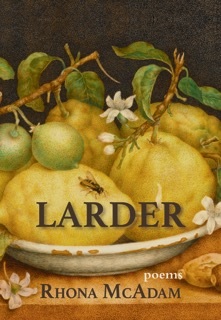
In her latest collection, Rhona McAdam navigates the dark places of human movement through the earth and the exquisite intricacies lingering in backyard gardens and farmlands populated by insects and pollinators, all the while returning to the body, to the tune of staccato beats and the newly discovered symmetries within the human heart.
“…A beautiful, filling collection, Larder is a set of poems to read at the change of the seasons, to appreciate alongside a good meal, and to remind yourself of the beauty in everything, even the things you may not appreciate before opening McAdam’s collection….”
Rhona McAdam is a writer, poet, editor, and Registered Holistic Nutritionist with a Master’s in Food Culture from Italy and a deep-rooted passion for ecology and urban agriculture. Her work spans corporate and technical writing to poetry and creative nonfiction, often exploring the vital links between what we eat and how we live. Based in Victoria, BC, and available via Zoom, Rhona is always open to new writing commissions, readings, or workshops on nutrition and the culinary arts.