-
Middle day
An easier pace yesterday; I only attended three sessions at the AWP conference, and had it not been for a regrettable lack of wisdom in touring the book fair when I had two hours to spare, I would have emerged with much lighter bags and heavier purse.
I started my morning with a panel on the Pros and Cons of Poetry and Fiction Contests. These are hugely important in American literary publishing: more than one panellist observed that there would be very little, if any, poetry published in the US without them, as contest income makes up a huge part of small press production costs. Scott Cairns, who runs the Vassar Miller Prize in Poetry, admitted to entering at least 100 competitions himself before having his first poetry collection published. He speculated that some 10,000 manuscripts hit the floors of American literary competitions each year, of which maybe 1000 are published. “The scandal and embarrassment,” he said, “is that those few who are published are subsidised by those thousands who’ll never win.”
Cairns’ judging process is instructive: he first reads the nearly 500 manuscripts entered in his competition for “style and linguistic density”: basic competence, really, which reduces the number by half. He then employs his own biases and preferences for lineation, which brings numbers down to about 100. He then looks for a narrative arc, or some coherence as a book, leaving him with 40-50 publishable manuscripts. These he must – somewhat arbitrarily – prune down to no more than 10-12 manuscripts to hand on to the judge.
Next stop was The Art of the Anthology. The editors of the now (in American poetry circles) notorious anthology, Legitimate Dangers: American Poets of the New Century, Cate Marvin and Michael Dumanis, did not explain to the cognoscenti present what I learned later, that their anthology had been the subject of anonymous vitriolic personal attacks on blogs. Kevin Prufer, whose The New Young American Poets anthology had inspired them, opined that “any good anthology will make people angry” – though of course what Marvin and Dumanis experienced sounds more like craziness than critical rage. An interesting group of editors made up the rest of the panel. Veteran anthologist Alan Michael Parker talked about his eccentric The Imaginary Poets project which required contributors to translate and gloss a poet they’d made up; Denise Duhamel was readying Saints of Hysteria anthology of collaborative poetry for launch; and Arielle Greenberg was looking for a new publisher for her anthology of essays about women poet mentors, written by women poets, after her first one backed out on the grounds it was not academic enough. They were surprisingly unified on the subject of paying minimal or no fees for including poets in their anthologies, on the grounds the poets would sell more books through the anthology’s promotion. They also pointed out that they were writers too, and were sacrificing a year or more of their own writing to put an anthology together.
Accidental Dominance: The State of Small Press Publishing was a panel of young publishers of independent, alternative presses – Fence Books, Nightboat Books, Ugly Duckling Press and Action Books. They talked about the collaborative nature of their work and the community they are building through publishing and cooperating.
After that, there was an excellent reading by American poetry stars Donald Hall and Jane Hirschfield, and we stepped back into the blasting early evening heat to find a restaurant. Today’s pick was Sol y Luna, a terrific Mexican restaurant on our favourite street, South Congress. My chicken chipotle plate was delectable, and so were Judy’s eggs with plantain. I’d had a sliced pork sandwich from my bbq mecca, Ironworks, for lunch, and I loved the pork as much as the beef I had on my first visit there: it was spicy, smoky and pepper-crusted.
But our biggest thrill of the day was being offered seats (ma’am!) on the bus by a chorus of young men who leapt to their feet at our burdensome approach. Too many’s the time I’ve watched Canadian and British beardless youths slump into their headsets when elderly or overwhelmed passengers get on public transport: nine times out of ten it’s the women who step up. But it’s no surprise here. All round, we’ve been absolutely knocked out by how friendly and helpful everyone we meet here is. These Texans are somethin’!
Off we go to start our third and final day at the races.
-
AWP: The madness begins
Day one of the conference over and already I feel limp as an old pile of carbon paper. Eight hours, five sessions… so much passed over, unseen, unheard, unread. A few Canadian writer friends emerging from the 4000 faces: Eunice Scarfe, Caterina Edwards and Aislinn Hunter.
My first session was Formal Play in Modern poetry, a group of young poets giving papers. Bryan Penberthy (or, oh lordy was it Brian Spears?) talked about attempting to harness persona for a book-length sequence of Robert Johnson poems. Listing Anne Carson’s Autobiography of Red and Michael Ondaatje’s Collected Works of Billy the Kid among his models, he explained how he eventually stopped trying because he felt he was imposing his voice or his idea of Johnson on his subject. “My voice is my voice,” he said, “and I have a hard enough time telling my own story without channelling someone else.”
I flew the considerable length of two considerably long buildings to find Bird-Witted: Birds in Modern Poetry, where there were many allusions to Elizabeth Bishop and readings of her poems “The Sandpiper” and “Little Exercise”. Michael Sowder explained some of the reasons genus corvus (crows, ravens) had populated his poetry for many years; for example because corvus is sacred to Apollo, god of poetry. The panel’s own eccentric poetry god Gerald Stern warbled his way to the podium on some old bird tunes, “Bye, Bye Blackbird” and “White Cliffs of Dover” among them. He read a couple of poems on his bird of choice, the cardinal.
Back I galloped to my original starting point, where I learned about the Academy of American Poets‘ survey of poetry reading in USA. The report has yet to be released, but we learned some surprising facts, for example that current readers of poetry are more involved in all leisure time activities except watching television than are readers of things other than poetry. They are also more socially engaged than non-poetry readers, so the myth of the poetry lover as lonely weirdo is incorrect (phew!). The man from the NEA told us about its survey on involvement in the arts (not just poetry) which found that less than half – 46% – of all US adults have read anything at all – poetry, fiction, drama – in the past year. There are some valiant attempts in the US to boost interest in poetry through programming such as Poetry Out Loud, a national program of poetry memorisation and recitation for students, and National Poetry Month (coming up quickly: April!).
Moving swiftly and decisively down the hall, I heard the editors of a clutch of the “monoliths” of American literary journals – the Missouri Review, the Virginia Quarterly Review, the Georgia Review, the Kenyon Review and the Southern Review – talk about some of their issues. Like why they were all white bearded men (four of five had goatees!) when their readers and contributors aren’t. But also about the importance of university funding to what is invariably a loss making enterprise, albeit a crucial part of the cultural life of American literature, and “one of the few art forms where the practitioners can be the patrons,” said one editor, urging us all to subscribe.
I managed the first half hour of The Poetry House at 20 reading before collapsing onto a bus and resting up for the evening speaker, Walter Mosley, who described his only previous experience of an AWP conference, back in 1989. He said he’d felt like a fraud as he was unpublished and not teaching writing, but he warmed to the sense of a community of writers that he found at that meeting. And, as in a good fairy tale, he returned home from the conference sporting that post-conference glow, got a helping hand from a fellow writer, and found an agent, a publisher and enduring fame. He had some fine words to say about the value of writing for writing’s sake, the great good fortune of writers who can turn their many obstacles into subjects for their writing – a true poetic justice, he said – and who can and must witness to the injustices of our time and place because we have the words and the voice to do it.
And food? We walked in the steps of Janis Joplin (and Frank Zappa, Waylon Jennings, Willie Nelson and a zillion others) to Threadgills for some home cookin’. Chicken and dumplings (with free second helpings) were on special, but we opted for fried catfish, which was right tasty.
-
Austin ABC
A is for Art: we ambled on up to AMOA where the Christo and Jeanne-Claude exhibition was running with an informative little documentary. We came out of there just itching to wrap something – anything – up in saffron fabric and a bit of old string…
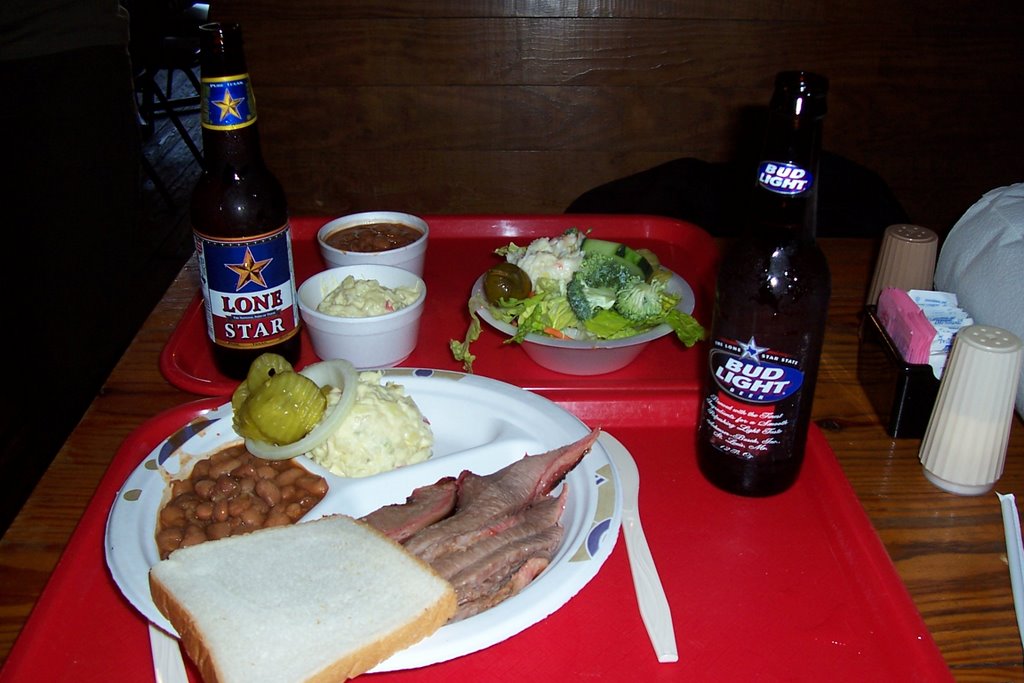
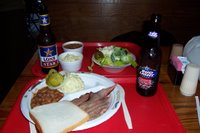 B is for Barbecue!At last! I have been initiated. On the recommendation of a local gal working the AWP registration desk, we walked behind the convention centre to the Ironworks, which provided authentic and delicious Texas barbecue with all the fixin’s. Perched over a creek (where we spotted a jumbo turtle – snapper? – and three smaller ones frolicking, or perhaps terrorizing one another) with plenty of autographed testimonials on the walls, it had lots of selection for carnivores and even a good little salad bar and tasty beans for the vegetarians.
  A couple of locals gave me some guidance for choosing my meat. “In the south-east,” she drawled, “they *think* that barbecue is pork. But in Texas, it’s beef.” And so it was.
C is for the fabulous, the legendary and the conveniently local Continental Club, where we attended happy hour and the musical stylings of blueser Gary Clark Jr. Lanky is one word for him. Limber of plectrum are a few more. To these old ears he proved that good things come in threes: “Shame, Shame, Shame” and “Mercy, Mercy, Mercy” were among his repertoire. Best of all, he was playing for tips at an hour we could manage (7pm). There are two late night shows, 10pm and midnight. If we have the stamina for a return visit post-conference one night, he’s playing again on Friday, and the Seatsniffers from Belgium (?) are on tomorrow.



Latest Posts
- Sublime
- Good weather for reading
- The world, the world
- Sublime launch!
- Planet Earth Poetry – Readings by Volunteers, Victoria 2026
- Poetry at the Goldfinch
Aldeburgh Poetry Festival Barny Haughton BBC BC poets Berkswell blackberries Black Stilt Bologna book launch Borough Market Caerphilly Carlo Petrini Catalonia culatello Cyrus Todiwala dairy Dijon Edinburgh Fanny Bay Feast of Fields ferries Food and Morality food journalism Michael Pollan olive oil tasting Omnivore's Dilemma Our Food Our Future Oxford Parmigiano-Reggiano persimmons Planet Earth Poetry poetry poetry readings Poetry videos prosciutto salumi Sean O'Brien sensory analysis Suffolk ticks tortelli di zucca Troubadour Wendell Berry Wendy Morton Yvonne Blomer
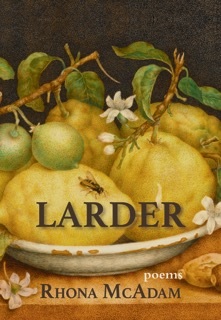
In her latest collection, Rhona McAdam navigates the dark places of human movement through the earth and the exquisite intricacies lingering in backyard gardens and farmlands populated by insects and pollinators, all the while returning to the body, to the tune of staccato beats and the newly discovered symmetries within the human heart.
“…A beautiful, filling collection, Larder is a set of poems to read at the change of the seasons, to appreciate alongside a good meal, and to remind yourself of the beauty in everything, even the things you may not appreciate before opening McAdam’s collection….”
Rhona McAdam is a writer, poet, editor, and Registered Holistic Nutritionist with a Master’s in Food Culture from Italy and a deep-rooted passion for ecology and urban agriculture. Her work spans corporate and technical writing to poetry and creative nonfiction, often exploring the vital links between what we eat and how we live. Based in Victoria, BC, and available via Zoom, Rhona is always open to new writing commissions, readings, or workshops on nutrition and the culinary arts.