-
Hazelnuts and poetry reviews
At the Feast of Fields the other weekend, we noticed a bowl of hazelnuts at the Dunsmuir Lodge stand. We paused, we tasted, we tasted again. They were amazing! We asked about them and were told they had been shelled the day before, then blanched in water, dusted with icing sugar and deep fried. Spectacular. Another (get thee behind me Satan) reason I’m so glad I don’t own a deep fryer…
I have been reading a book mentioned earlier on this blog, 101 Ways to Sell Poems and was struck by the sections (they are several) to do with reviewing. In my experience writers here spend almost as much time uselessly deploring the state of reviewing as dissing our teeny tiny publishers for not being more powerful marketing machines. This book answers both questions with the suggestion we just get off our duffs and wade in there to help.
Reviewing, as Chris Hamilton-Emery points out, needn’t be limited to the already limited space in newspapers. We can be both reviewers and reviewees, and both positions are helpful to our own literary presence. We have the power of the net behind us. Blogs, of course, are good places to air our allegiances to books that impress us (and hey — what am I doing now?); so are online bookseller review spaces (e.g. Amazon.ca); online journals and e-zines, listservs, our own web pages are also good places to do this. And there’s nothing to stop us from starting another online reviewing journal anytime we want. Implicit in his discussion is the suggestion not to waste time and newsprint/webspace trashing other writers’ works: you do more good by promoting your interests through positive action.
Some of the many remarks I found noteworthy came from the publisher side of Hamilton-Emery’s brain, where he addresses that question we get from our publishers: to whom should we send review copies? Hamilton-Emery tells you to stop and think carefully about that one, because it serves nobody’s interests to simply send copies to every newspaper and journal around. Profit margins on poetry are low enough, he observes; the last favour you want to do yourself and your publisher is to “flush their profits down the drain [by sending] too many unsolicited review copies to the benighted leagues of literary editors.” He urges poets to “Think of all the junk mail you have ever received and how delighted you were in opening it all up and reading it.”
He assures us that there is nothing untoward in cultivating reviewers to talk about our books. Other people are already doing this. All you are doing is helping out the journal by focusing their ability to match the right reviewer to the right book, instead of leaving them to wade through the accumulations and randomly assign, let’s say, absolutely the wrong book to the wrong reviewer.
-
WOTS happening
Spent last weekend across the water in Vancouver, a long way to go for a nine minute reading, but we do what we can to help the cause. Anyway I was lucky to be first and actually get my nine (and I did count ’em) minutes; as too often happens with multiple-reader events, those at the end of the program got squeezed for time. I was appearing with the Poets In Transit gang at the Word on the Street, and what a spectacular day we had for it. I read with Jen Currin, Marya Fiamengo, Kevin Roberts, Gena Thompson and finally Elise Partridge – who graciously but very sadly for us only read two poems. A wonderful thing this PIT program, and, we learned really only in existence thanks to the hard work of poet and anthologist Sandy Shreve, who introduced the event.
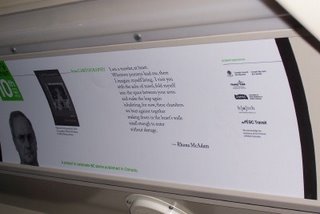
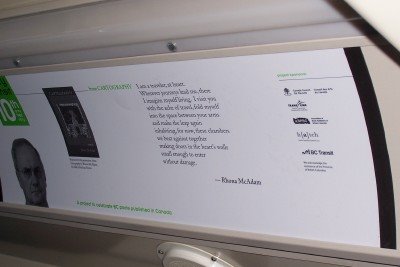
My poem as it will appear on better buses near (some of) you. Don’t know who is mr grumpy on the left or what he has to do with it all.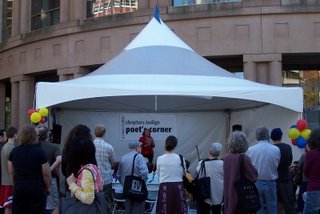
Packing them in at the Poet’s (sic) Corner (Lynne Truss, where are you?)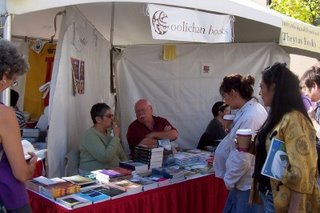
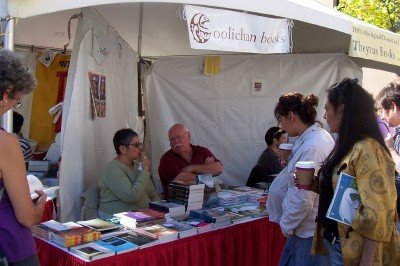
The Oolichaners (Hiro Boga and Ron Smith) brace themselves as another mob of book buyers approaches. I pushed my way to the front of the crowd and came away with a gorgeous new cookbook, Just Chicken: 100 Easy Recipes from India by Sharda Pargal.
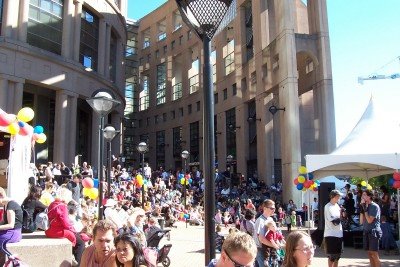
Lots and lots at WOTS. Cool library building, huh?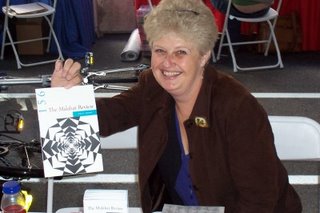
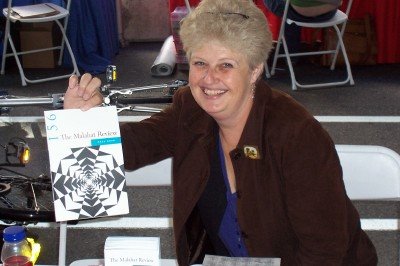
Rhonda Batchelor holding the latest – hot, hot, hot! – issue of Malahat Review.
A stylish Heidi Greco stars at the sub-Terrain stand with some local autumn foliage. Next door neighbour Anvil Press had wonderful news about the shockingly good novel Stolen, by Annette Lapointe: she has just been nominated for a Giller Prize. -
Garlic prawns and then apple lightning cake
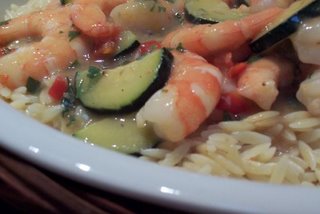
Last night’s chow was garlic prawns with orzo, that clever little pasta that imitates rice, with a few zucchini slices and slivers of red pepper so I wouldn’t have to make vegetables.Followed by yet another variation on our dear friend the Lightning Cake, this time featuring a sliced apple topping, sprinkled with juice of half a lemon, about half a cup of brown sugar and a pinch of cinnamon (I’ve made it with blueberries and ginger as well – terrific). I ladled into the cake batter about half a cup of raisins – which had wallowed some weeks in leftover hooch – sherry? brandy? who knows – until plump. The result was gooey and crispy and perfect with Udder Guys Ice Cream (maple walnut this time). And it held up well overnight: a delicious breakfast.








Latest Posts
- Sublime
- Good weather for reading
- The world, the world
- Sublime launch!
- Planet Earth Poetry – Readings by Volunteers, Victoria 2026
- Poetry at the Goldfinch
Aldeburgh Poetry Festival Barny Haughton BBC BC poets Berkswell blackberries Black Stilt Bologna book launch Borough Market Caerphilly Carlo Petrini Catalonia culatello Cyrus Todiwala dairy Dijon Edinburgh Fanny Bay Feast of Fields ferries Food and Morality food journalism Michael Pollan olive oil tasting Omnivore's Dilemma Our Food Our Future Oxford Parmigiano-Reggiano persimmons Planet Earth Poetry poetry poetry readings Poetry videos prosciutto salumi Sean O'Brien sensory analysis Suffolk ticks tortelli di zucca Troubadour Wendell Berry Wendy Morton Yvonne Blomer
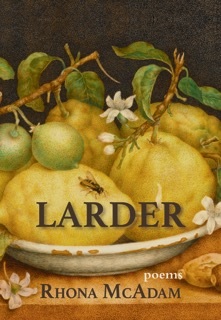
In her latest collection, Rhona McAdam navigates the dark places of human movement through the earth and the exquisite intricacies lingering in backyard gardens and farmlands populated by insects and pollinators, all the while returning to the body, to the tune of staccato beats and the newly discovered symmetries within the human heart.
“…A beautiful, filling collection, Larder is a set of poems to read at the change of the seasons, to appreciate alongside a good meal, and to remind yourself of the beauty in everything, even the things you may not appreciate before opening McAdam’s collection….”
Rhona McAdam is a writer, poet, editor, and Registered Holistic Nutritionist with a Master’s in Food Culture from Italy and a deep-rooted passion for ecology and urban agriculture. Her work spans corporate and technical writing to poetry and creative nonfiction, often exploring the vital links between what we eat and how we live. Based in Victoria, BC, and available via Zoom, Rhona is always open to new writing commissions, readings, or workshops on nutrition and the culinary arts.