-
Jolly good kick at bad food
Enjoyed this article about British comedian Alex Riley who gives food companies a kick in the pants about misleading labelling and unhealthy food practices.
In other news, anyone in the area is invited to Slow Food Vancouver Island’s winter veg potluck next weekend (Sunday 15th); details on the website. And Facebook. And Twitter. (We are wired!)
Also invited you are to my Friday 13th reading at the Black Stilt, reading with Wendy Donawa:
Friday November 13 starting at 7:30 PM, admission $3 at the door.
Planet Earth Poetry series
The Black Stilt Coffee House
#103-1633 Hillside Avenue
Victoria, BC V8T 2C4
250-370-2077And moving along the diary a bit further, on Saturday 21st Joel Salatin (as seen in Food, Inc. and described in the Omnivore’s Dilemma) will be paying a visit to Duncan, courtesy the Cowichan Agricultural Society.
-
Scary times
I visited Moss Street Market for its end of season finale, which happened to be on October 31, so there were some oddities around. Flash in the Pan was providing the music; sounded better than they looked!
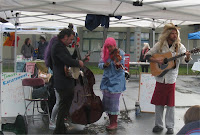
Poor farmer had to wear a potato sack…

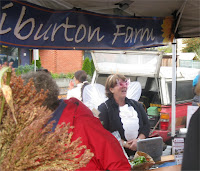
Some flies buzzing round the Haliburton stand
like beekeepers to the honey
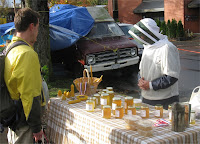
The last thing I thought I needed was more apples, but this selection

was too interesting, and I weakened upon tasting the surprising Grenadine, the perfect Halloween apple?

Other items of interest to cross my path of late include the Spanish Nun video, in which Benedictine nun Teresa Forcades i Vila discusses the H1N1 business in terms that don’t make one particularly eager to rush out and get the vaccine. (Assuming one could even do that!)
She makes mention of a largely unreported incident last February when Baxter released a flu vaccine to Austria, Czech Republic, Slovenia and Germany that was contaminated with live avian flu virus, offering the potential to spread a lethal virus very widely; Baxter is one of the companies now making the H1N1 vaccine.
And she has a number of concerns about unique aspects of this vaccine: the lack of legal redress for any people suffering side effects that has been built in by pharmaceuticals and governments; the different way it works from regular flu vaccines; and the effects of making H1N1 vaccination mandatory rather than voluntary.
She also explains that the WHO’s removal of the term “mortalities” from its definition of “pandemic” is why we are chasing our tails now over an infectious but not overly lethal flu instead of saving our international efforts for a pandemic that actually endangers the lives of high numbers of people.
It’s kind of long (about an hour) but worth watching just to hear some things you might not get elsewhere.
http://vimeo.com/moogaloop.swf?clip_id=7298827&server=vimeo.com&show_title=1&show_byline=1&show_portrait=0&color=&fullscreen=1
BELL TOLLING for the Swine Flu (CAMPANAS por la gripe A) subtitled from ALISH on Vimeo.
It is perhaps worth pointing out that Sr. Teresa is the author of Crimes & Abuses of the Pharmaceutical Industry, which I’d say is a booklet worth looking at, as it addresses issues to do with abuses of power by pharmaceutical companies on the lives of impoverished and vulnerable people.
-
The Cove and other animals
Went to see The Cove last night. Billed very accurately as an eco-thriller, it took on the Japanese dolphin trade in a clever and compelling way. It starred the director, Louie Psihoyos, and dolphin activist Ric O’Brien, better known as the trainer of Flipper, both appealing and articulate men, accompanied by an equally appealing handful of idealists and adrenaline junkies (including a couple of divers from Vancouver).
Well and imaginatively shot and scored, its aims were simple: to take viewers along as the team planted cameras and recorders in order to document the dolphin slaughter in the whaling village of Taiji, Japan which has seemingly been targeted by whale activists for some years, to judge by this statement dated 1994. Its annual kill as reported by the film is 23,000 dolphins, which are harpooned by local fishermen between September and March, after a number have first been selected to sell to aquariums, where the real money is.
The questionably less fortunate dolphins who are slaughtered for meat are sold for a pittance, despite the film’s assertion of breathtakingly high levels of mercury in their flesh (2000 ppm in dolphin vs the recommended Japanese limit of .4 ppm). Big carnivorous (piscivorous?) fish, at the top of the food chain, absorb all the mercury of the smaller ones they eat, so they are expected to be more toxic. Cheaper dolphin has for some time been fraudulently sold as whale meat (whale is less prone to mercury toxicity than dolphin due to the difference in diet between larger cetaceans and dolphins).
The film’s sharpest anger is reserved for the International Whaling Commission, which cannot seem to decide if it is interested in the smaller cetaceans (i.e. dolphins) or only the larger whales. The Cove paints the IWC as a lumbering, toothless body, which the Japanese have made a mockery of by vote-rigging: building useless seafood plants in impoverished countries and paying their representatives to come and vote with Japan.
It is difficult to have much sympathy for the fishermen of Taiji, when you see that to them a dolphin is just another fish to be speared, but then I am of a culture raised on affection for dolphins, and as squeamish as most urban eaters about the realities of killing my food.
The other side of the story – what happens to a whaling town if it’s not allowed to kill whales (of any size) – is one that will resonate with the other economic outcasts of our time, including forestry, cod, sealing and manufacturing communities, down the road and around the world. Not to mention the town centres and family farms and businesses that are being ruined and bankrupted by large scale retailers and industries.
Even those communities that choose to prostitute or lampoon themselves by taking up tourism are not winners in this; tourism is a fickle and usurious source of income with a short attention span and a great hunger for unsustainable practices.
As we use up our natural resources, or force ourselves out of the economic picture by voting for “efficiencies” and low prices rather than jobs, the ghost towns of our time will have many different faces, all left with that same big question: so what do we do now to make a living?


Latest Posts
- Sublime
- Good weather for reading
- The world, the world
- Sublime launch!
- Planet Earth Poetry – Readings by Volunteers, Victoria 2026
- Poetry at the Goldfinch
Aldeburgh Poetry Festival Barny Haughton BBC BC poets Berkswell blackberries Black Stilt Bologna book launch Borough Market Carlo Petrini Catalonia Cyrus Todiwala dairy Daunt's Books Dijon Edinburgh Fanny Bay Feast of Fields Food and Morality food history food journalism Jenna Butler lardo Malahat Review Michael Pollan Okanagan olive oil tasting olive trees Omnivore's Dilemma Our Food Our Future Oxford Parmigiano-Reggiano Planet Earth Poetry poetry poetry readings Poetry videos prosciutto salumi Sean O'Brien Suffolk ticks Wendy Morton Wired Writing Yvonne Blomer
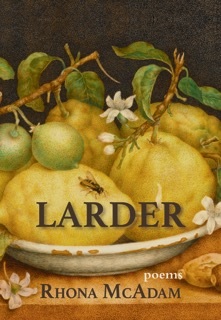
In her latest collection, Rhona McAdam navigates the dark places of human movement through the earth and the exquisite intricacies lingering in backyard gardens and farmlands populated by insects and pollinators, all the while returning to the body, to the tune of staccato beats and the newly discovered symmetries within the human heart.
“…A beautiful, filling collection, Larder is a set of poems to read at the change of the seasons, to appreciate alongside a good meal, and to remind yourself of the beauty in everything, even the things you may not appreciate before opening McAdam’s collection….”
Rhona McAdam is a writer, poet, editor, and Registered Holistic Nutritionist with a Master’s in Food Culture from Italy and a deep-rooted passion for ecology and urban agriculture. Her work spans corporate and technical writing to poetry and creative nonfiction, often exploring the vital links between what we eat and how we live. Based in Victoria, BC, and available via Zoom, Rhona is always open to new writing commissions, readings, or workshops on nutrition and the culinary arts.