-
Terra Madre Day at the cidery
The Slow Food Vancouver Island & Gulf Islands is as slow as its name is long.. we celebrated Terra Madre Day – really December 10 – on December 13, with a Christmas potluck and book exchange at Merridale Cidery.
As might be expected, it was a well above average selection of winter foods which we thought we’d better tuck into before they got cool – a definite issue in the chilly confines of the distilling room
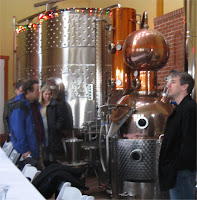
where we gathered and managed to warm with many bodies, excellent food and beautiful music.
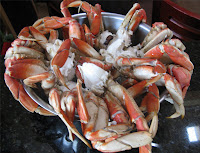
Many fine foods, including local Dungeness crab,
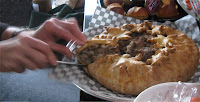
local prawns

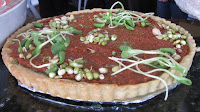
an amazingly delicious chard tart,
and Hilary’s Cheese:

A convivium, demonstrating what is meant by the name:

After the food, we had a short film about Terra Madre and some short talks by people who’d attended the event as delegates in previous years. Then there was the traditional (to this convivium) cookbook exchange which involved a fair amount of thievery as people were allowed to steal previously opened books before opening one from the pile. The most-stolen book: Alice Waters – Chez Panisse Cookbook.


-
Climate Change & Google Books
Here’s a bit of 60’s style prescience that Gabe passed along, which might have been a more weirdly entertaining warm-up (ha ha) viewing for all at Copenhagen than what they got. Have you ever seen anything so strange?
I also love this take on Cap & Trade, which explains the notion in words of few syllables but with great passion. Maybe they need to see this in Copenhagen as well.
As for the rest of my life, I’ve been preoccupied with a sick laptop followed by a sick dog followed by a sick me, compounded by general busyness and the near audible crunch of deadlines…
Sat in on a Google Book Settlement webinar with Access Copyright today, which was enlightening. The new and revised settlement has some encouraging improvements, from Canadian writers’ perspective. One key change is the settlement is limited to works published in Canada, the US, the UK and Australia, making 50% fewer works included than previously. That Google has already violated the copyright of everyone else is up to them, unfortunately, to sort out separately.
Another interesting point we discussed is that opted-in writers can ask to have their books removed from Google Book Search, and the request will be honoured (though Google still gets to keep a copy of your book). However, if you are opted out, you can ask to have your books removed, and Google says it will honour the request, but if it doesn’t, it will be up to you to chase them for copyright infringement.
The arguments for remaining in the settlement – and claiming the settlement fee for having your copyright so publicly violated – are that if you are in, you have more control over what Google does with your books; you can negotiate to have better fees (than the current 63% author/37% Google split) going forward; you are no longer precluded from seeking and making better deals with new digitizing operations; and you can withdraw your book or change the size of the “snippet” (one of the most contentious aspects since some books are presented almost in their entirety at present). But the question of how your new books – published since January 2009 – will be handled remains an unknown; we got no advice on that score other than to monitor Google Book Search. You can’t, apparently, demand that your new and future books be excluded from future digitization.
-
Joel Salatin – Man of many hyphens
The Cowichan Agriculture Association managed to lure farmer-speaker-activist Joel Salatin (he actually prefers the label Christian-Libertarian-Environmentalist-Capitalist-Farmer) to come and spend the day speaking in Duncan last rainy Saturday. The house was packed – I’d guess around 200 folk, mostly farmers, many of them young – and he put on a good show, commencing with a slideshow talk about Polyface Farm.
From this we learned about his ways with cattle bedding, which were surprisingly complex. He keeps the cattle in a shed, roofed but mostly open, and lays down whatever wood chips (=carbon!) he can get hold of. This absorbs the cowpies and urine so that conditions are reasonably sanitary (any farm that smells bad is a badly managed farm, according to Salatin). He scatters corn into the chips every so often. And keeps layering like that until winter’s over, by which time the bedding could be up to four feet deep. He has devised supports to keep the cows from toppling over, and cantilevers to keep their hay at mouth-level. Once the cattle are out in the fields again, he brings in the pigs, who root for the fermented corn and in the process turn over the compost, aerating it and making it ready to spread on the fields to grow the forage for his cattle. So pigs, cattle and farmer = all happy.
From there we go to the fields where the pasturing is similarly well thought out and involves chickens and a lot of mobile fencing. In fact mobile equipment is big in Salatin’s vision: he doesn’t believe in single-purpose equipment and he really likes to be able to move his animals around the fields – and woods – so that he can manage their feeding and the fertility of his soil at the same time.

He is truly a libertarian, wanting freedom from the shackles of government regulations which, he couldn’t say forcefully enough, are intended for the industrial farming practices that have crippled farmers’ ability to make a living, severed the eaters from knowledge of what they eat, and poisoned our food.
He was generous with his time answering questions and sharing opinions on everything from the timing of hog slaughter to how to cook grass-fed beef to why he likes hobby farms. He recommended many books, including New Rules for the New Economy by Kevin Kelly; Guns, Germs & Steel by Jared Diamond; and City Chicks by Patricia Foreman (whose husband Andy Lee wrote Chicken Tractor). As well, of course, as his own books, most notably Everything I Want to do Is Illegal.
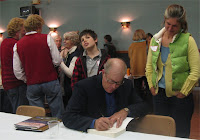
And he described some of the innovations he’s come across – evidently a pleasing sideline for him in his extensive travels – that are helping to save “embedded heritage local food systems from the machinations of large scale industrial food systems.” Some examples: The Urban Farm Store in Portland, Oregon; the New Roots Urban Farm in St Louis, Missouri; and the Local Food Hub in Charlottesville, Virginia.
While he advocates the “just say no” approach to the enforcement of unreasonable regulations wherever possible, he also has a simple suggestion for all of us: learn to cook from scratch. “Opting out of processed food is the ultimate mark of independence.”
And if that ain’t enough, here’s the man himself, talking food safety in Portland Oregon last summer.
http://vimeo.com/moogaloop.swf?clip_id=6168497&server=vimeo.com&show_title=1&show_byline=1&show_portrait=0&color=&fullscreen=1
Farmer Joel Salatin Talks Food Safety in Portland from Mayor Sam Adams on Vimeo.


Latest Posts
- Sublime
- Good weather for reading
- The world, the world
- Sublime launch!
- Planet Earth Poetry – Readings by Volunteers, Victoria 2026
- Poetry at the Goldfinch
Aldeburgh Poetry Festival Barny Haughton BBC BC poets Berkswell blackberries Black Stilt Bologna book launch Borough Market Carlo Petrini Catalonia Cyrus Todiwala dairy Daunt's Books Dijon Edinburgh Fanny Bay Feast of Fields Food and Morality food history food journalism Jenna Butler lardo Malahat Review Michael Pollan Okanagan olive oil tasting olive trees Omnivore's Dilemma Our Food Our Future Oxford Parmigiano-Reggiano Planet Earth Poetry poetry poetry readings Poetry videos prosciutto salumi Sean O'Brien Suffolk ticks Wendy Morton Wired Writing Yvonne Blomer
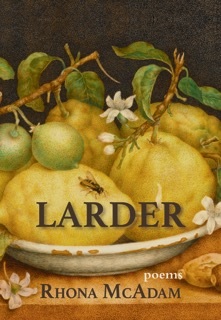
In her latest collection, Rhona McAdam navigates the dark places of human movement through the earth and the exquisite intricacies lingering in backyard gardens and farmlands populated by insects and pollinators, all the while returning to the body, to the tune of staccato beats and the newly discovered symmetries within the human heart.
“…A beautiful, filling collection, Larder is a set of poems to read at the change of the seasons, to appreciate alongside a good meal, and to remind yourself of the beauty in everything, even the things you may not appreciate before opening McAdam’s collection….”
Rhona McAdam is a writer, poet, editor, and Registered Holistic Nutritionist with a Master’s in Food Culture from Italy and a deep-rooted passion for ecology and urban agriculture. Her work spans corporate and technical writing to poetry and creative nonfiction, often exploring the vital links between what we eat and how we live. Based in Victoria, BC, and available via Zoom, Rhona is always open to new writing commissions, readings, or workshops on nutrition and the culinary arts.