-
Milky justice
Last week’s Ontario court case decision on the Michael Schmidt/raw milk issue – which has been dragging on since Schmidt had his farm raided in 2006 – has lactivores bubbling over with questions. Schmidt had been charged with illegally selling unpasteurized milk to people who chose to drink it, and exercised their choice by the only means legally open to them, by subscribing to a ‘cow share‘ enterprise. This means buying a share of a cow and contributing to its upkeep, in return for which receiving a quantity of raw milk. There is a similar system – Home on the Range Dairy – in BC which has been subjected to a sustained attack by our own public health buttinskis in recent weeks.
One part of the public health attack has been to publish a misleading press release that mentions the presence of fecal matter in the dairy’s milk. What the release fails to mention is that fecal matter is present in just about everything we eat, drink and touch, including soft drinks, spinach, government-inspected beef, and public health-approved pasteurized milk and milk products. It can certainly cause serious health problems, but the important distinction where testing is concerned is the fecal count, not the mere presence of fecal matter, and the press release is curiously shy of mentioning this. Nor do the public health officials claim to have tested for or found E. coli, which is, according to the Food Safety Network, the best way of testing for fecal contamination. In fact the whole manner of testing in this instance is considered highly biased.
Raw milk is a murky subject, much debated. It is hard to separate the views of the pro-pasteurization side from their vested interests in industrial scale production – which can by their very nature cause so many health problems that some kind of public protection is certainly called for. Most of the pro-raw milk defense comes from the Weston A. Price Foundation, which is not universally revered, but does have many sane and healthy supporters. There are genuine causes for concern about raw milk, as there are for production of any animal food likely to be consumed by people with delicate immune systems.
My personal experience with raw milk was in Italy, where the law allowed me to purchase raw milk from a machine in a shopping mall – the provision being I had to fill the bottle myself. There was a large sign posted on the machine warning pregnant women that raw milk could be dangerous, but I saw at least one near-term consumer ignore this. The milk was fabulous, rich and flavourful and made impressive custards and puddings. When we visited Epoisse producers in France, we were given a tasting and demonstration at which it was explained that the runniness of a ripe Epoisse is due to EU and North American market requirements that they use pasteurized milk. When the cheese is properly and traditionally made with raw milk, the paste shouldn’t collapse, but be soft and firm. Pasteurization also kills off many of the microflora that give any artisanal cheese depth, texture and flavour.
So. Canadian raw milk consumers are rejoicing in what seems like a great victory in the Schmidt case, but is in fact only a local affirmation by the Ontario Court of Justice that he operated within the law in Ontario. It’s unlikely the ruling will give strength to either side of the pasteurization argument, as the presiding judge made clear in his closing remarks:
I wish to make it perfectly clear that my decision to acquit the defendant on all charges-
* In no way stands for the proposition that henceforth it is legal to market unpasteurized milk and milk products in the Province of Ontario;
* In no way purports to undermine or invalidate the milk marketing legislation in this Province, which has been held to be valid legislation byt he Ontario Divisional Court in Allan v. Ontario (Attorney General) (supra);
* In no way supports either side of the debate on whether the consumption of unpasteurized milk or milk products is healthy or constitutes a health hazardCBC has a poll you can take to share your opinion on whether or not people should be allowed to drink raw milk. Take it here.
-
GM Alfalfa… again
An issue that may affect any of us who like to buy organic food is rearing its head south of the border. In Canada, a large percentage of our organic foods are imported from the US, so anything they do affects us directly as consumers. In the last (failed) attempt to get GE labelling on our foods in this country, our own politicians told us that if we wanted to buy GE-free products, we should buy organic.
In 2007, Monsanto was blocked temporarily and nationally from introducing genetically engineered alfalfa into the US, because they had failed to do an environmental impact study proving no harm to other farmers (etc.). They have fought this ruling up to the American supreme court, which expects to rule on the matter by the end of June, and reapplied to the USDA to introduce their GE substance again. The matter is to be decided by mid-February when the USDA releases its environmental impact statement. Because favourable USDA rulings usually mean subsequent rubber-stamping in Canada, this puts us at risk too.
The reason we should all be concerned is because alfalfa is a widely used rotation crop – in both conventional and organic agriculture – and is also a hugely important animal feed, for livestock and dairy producers among others. And it is consumed directly, as alfalfa sprouts, juice or teas. Importantly, alfalfa is a perennial, unlike all other licensed GE crops in this country.
If GE alfalfa is planted, non-participating farmers are at high risk of cross contamination, and ending up, like Canadian canola farmers have done, with an almost entirely contaminated product. Once cross-contamination happens, organics go out the window, because no organic farmer who uses alfalfa can claim to be GE-free as the certification requires, and even conventional exports suffer because many countries don’t want to import or eat GE foods. This would mean Canadian milk and cheese products as well as meat would be unexportable to those countries. (More information on the organic trade arguments here)
Here, from The True Food Network (who helpfully offers a handy downloadable GE-free shopping guide on its website), is the US campaign, which includes a template for a lobbying letter you might like to customize and send to the USDA and to your favourite Canadian politicians. They need to know we care.
-
A little more on beef and climate change
Think it and it shall be published. Time magazine features an article this week called “Save the planet: Eat more beef” which offers much the same arguments that Joel Salatin gives: feed ruminants what they are designed to eat, manage them properly and they will replenish the soil that produces their own feed.
The basic message about environmental damage caused by eating beef remains the same, of course, when that beef has been fed grain instead of grass, raised industrially in feedlots, and slaughtered inhumanely. And as long as meat production is in the hands of industrialists instead of small scale farmers, it will be treated as an industry – subject to economies of scale, cost and corner-cutting – rather than a virtuous circle.


Latest Posts
- Sublime
- Good weather for reading
- The world, the world
- Sublime launch!
- Planet Earth Poetry – Readings by Volunteers, Victoria 2026
- Poetry at the Goldfinch
Aldeburgh Poetry Festival Barny Haughton BBC BC poets Berkswell blackberries Black Stilt Bologna book launch Borough Market Carlo Petrini Catalonia Cyrus Todiwala dairy Dijon Erin Mouré Fanny Bay Feast of Fields Food and Morality food journalism food photography Malahat Review Marlene Creates Michael Pollan Monsanto Okanagan olive oil tasting Omnivore's Dilemma Our Food Our Future Oxford Parmigiano-Reggiano persimmons Planet Earth Poetry poetry poetry readings Poetry videos prosciutto salumi sausage making Sean O'Brien Suffolk ticks Wendy Morton Wired Writing Yvonne Blomer
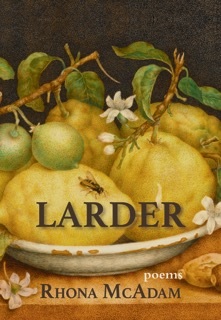
In her latest collection, Rhona McAdam navigates the dark places of human movement through the earth and the exquisite intricacies lingering in backyard gardens and farmlands populated by insects and pollinators, all the while returning to the body, to the tune of staccato beats and the newly discovered symmetries within the human heart.
“…A beautiful, filling collection, Larder is a set of poems to read at the change of the seasons, to appreciate alongside a good meal, and to remind yourself of the beauty in everything, even the things you may not appreciate before opening McAdam’s collection….”
Rhona McAdam is a writer, poet, editor, and Registered Holistic Nutritionist with a Master’s in Food Culture from Italy and a deep-rooted passion for ecology and urban agriculture. Her work spans corporate and technical writing to poetry and creative nonfiction, often exploring the vital links between what we eat and how we live. Based in Victoria, BC, and available via Zoom, Rhona is always open to new writing commissions, readings, or workshops on nutrition and the culinary arts.