-
Mason bees in the summer
Read Full Post: Mason bees in the summer By now all my Blue Orchard Mason Bees (Osmia lignaria) are finished: this year’s adults have gone to the great flower garden in the sky and the next generation is tucked up in its nesting tubes waiting for spring.
It seemed to me there were not as many this year as in previous years, perhaps because of the cool damp spring, and perhaps because I removed the popular block-style bee homes. These were a quick fix for the first couple of years, when I began trying to attract the bees to my garden, but I was persuaded that it would be better to switch to cleanable versions. These were pretty much impossible to clean because as soon as a tube was vacated, someone else came and filled it up again. I tried putting the house under a cardboard box with a hole in it, the theory being they’d leave and be unable to find their way back, but I was also told the tubes can provide homes to parasitic wasps and other insects with different life cycles than the mason bees, so you never know who might be sleeping in there when you dunk it in bleach solution (as I’d been advised to do).


I kept my tube home (made from a plastic pipe with an angled front to provide some protection from rain) up on the fence, adding fresh tubes rolled out of advertising flyers, and moved my Hutchings Bee Condo to the woodpile where it would be protected from the elements.
I’d read that the houses were best positioned on an east-facing wall where sunlight could warm them, but my bees seemed perfectly happy to populate the west-facing, shaded condo next door to the Bombus (bumblebee) house (where a tribe of feisty Bombus vosnesenskii have settled in for the season)
but a gratifying number of tubes have been filled and I’m going to look after these guys for next year.


Given the handy viewing panes that cover the laying tubes in a Hutchings Bee Condo, I’ve been peeking every so often to see how things are progressing and was fascinated to see the eggs had mostly hatched and the larvae were busy pupating.


They’ll live in their cocoons until next spring. I missed the boat last year, but this year I’ll be joining the many other gardeners who wash the cocoons in the winter – some use water, some use water and bleach, and some use sand – to free them of mold, bee turds and mites (Krombein’s Hairy-Footed Mite is the enemy of this wild bee; a different sort of mite from the one that plagues honeybees).
-
Time of the stinking rose – with rust
Read Full Post: Time of the stinking rose – with rust I was looking forward to my garlic crop this year: I’d followed farmer Ray’s advice (plant deep, mulch well) and my plants seemed to be thriving. They also appeared to be rust-free, which surprised me since I’d had rust the last couple of years, and we’d heard at a recent GTUF talk by Linda Gilkeson that our area has been infected by a new strain of rust which affects garlic, leeks and other members of the allium family, and that “rust-resistant” leeks are not resistant to this one. So last Sunday, there were the first tell-tale spots, and I decided to go ahead and pull it anyway, as it was only a couple of weeks away from harvest.
At a potluck last weekend, Kate had been demonstrating how to harvest, peel,
and braid garlic:
Even hardneck garlic can be braided, if it’s done when the garlic is fresh from the ground, as it takes a bit of time for the neck to dry and stiffen. The idea is to place the bulbs, as far as possible, so they aren’t touching. After braiding the garlic should be hung in a dry, airy place out of the sun for at least two weeks to cure for long storage. Any damaged bulbs – or ones where too much of the protective wrapping was removed, can be eaten fresh, without curing. I’ll try curing the insect-damaged ones, but those I clipped with my digging fork (the hazards of deep planting in compacted soil!) will be most welcome in a bowl of delicious garlic soup.


I found rust spots (as well as insect damage – slugs, leatherjackets and wireworm run rampant in my beds which are next to grass) on the stems and bulbs of some of mine, even where it wasn’t showing in the leaves. Fingers crossed for my winter leeks, which are growing in a raised bed nearby.
To reduce the spread of garlic rust, infected leaves should be snipped off – whether live or harvested plants – and disposed of in the garbage, not composted. Rust won’t affect the taste of the garlic and in most cases won’t reach the bulb,
 but if it does it looks unsightly and garlic producers can’t sell it. If you let it go, it will affect the size of the bulb and eventually cause it to rot. It’s a particular hazard in community gardens where it can spread quickly from bed to bed, so community gardeners need to have agreements in place to control it. I saw this lot in a James Bay garden last year and suspect all the garlic there will be infected this year.
 -
Ecovillage tour & Canada Day
Read Full Post: Ecovillage tour & Canada Day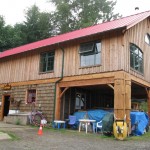 Another place I’d long wanted to see was O.U.R. Ecovillage, near Shawnigan Lake on Vancouver Island. A haven for green builders, permaculture designers, and people in search of collaborative and sustainable lifestyles, it’s a half-finished dream with a population that ebbs and flows through the seasons.
The root cellar was the subject of a green building workshop last year, and progress was documented on this Youtube video. Like many of the other buildings it uses recycled materials in its construction: car tires and styrofoam blocks are part of its structure. Like everything that happens at the Ecovillage, the decision to use these materials was taken after lengthy thought and discussion, and the feeling is that it’s better to put them into a structure where they have a purpose and are contained than into a landfill (at best). The styrofoam blocks they use are discarded tree plug trays – available by their millions, an otherwise useless and unsustainable byproduct of reforestation by the lumber industry. The community is also working its way through some 15 truckloads of reclaimed lumber – windfall timber that would otherwise have been sold as firewood or burned as slash.
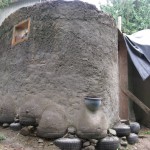
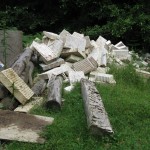
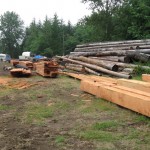
Permaculture has always been part of the ideals of the Ecovillage; the Permaculture Design courses that are offered here result in projects of many kinds – garden, water reclamation and food forestry among others.
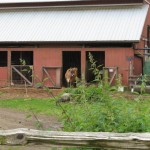
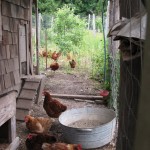
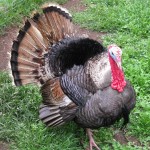
Food is a major preoccupation – it grows in various ways and places: in a deer-fenced garden and a new food forest that’s under development around the property; pigs, chickens, cows and a rather majestic turkey are part of the scene, producing food and fertilizer. This greenhouse recirculates water, heating it for a shower stall that’s in the greenhouse itself.
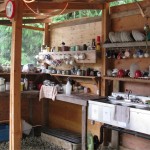
The kitchen has been recently expanded so that it could accommodate the large and small mealtimes. During our visit a Zimbabwean music camp – Nhemamusasa North – was on, and there were 130 people for meals… all of them washing their own dishes in the wash station. Grey water gets filtered and reused, of course.
After that it was time for Canada Day celebrations. Here on the Gorge we have a street party that this year was graced by the queen, who also deigned to have her picture taken with neighbourhood dogs, and was then whisked away by canoe. There was of course food, music and a little dancing.






Latest Posts
- Sublime
- Good weather for reading
- The world, the world
- Sublime launch!
- Planet Earth Poetry – Readings by Volunteers, Victoria 2026
- Poetry at the Goldfinch
Aldeburgh Poetry Festival Barny Haughton BBC BC poets Berkswell blackberries Black Stilt Bologna book launch Borough Market Carlo Petrini Catalonia Cyrus Todiwala dairy Daunt's Books Dijon Edinburgh Fanny Bay Feast of Fields Food and Morality food history food journalism Jenna Butler lardo Malahat Review Michael Pollan Okanagan olive oil tasting olive trees Omnivore's Dilemma Our Food Our Future Oxford Parmigiano-Reggiano Planet Earth Poetry poetry poetry readings Poetry videos prosciutto salumi Sean O'Brien Suffolk ticks Wendy Morton Wired Writing Yvonne Blomer
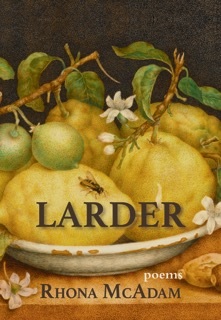
In her latest collection, Rhona McAdam navigates the dark places of human movement through the earth and the exquisite intricacies lingering in backyard gardens and farmlands populated by insects and pollinators, all the while returning to the body, to the tune of staccato beats and the newly discovered symmetries within the human heart.
“…A beautiful, filling collection, Larder is a set of poems to read at the change of the seasons, to appreciate alongside a good meal, and to remind yourself of the beauty in everything, even the things you may not appreciate before opening McAdam’s collection….”
Rhona McAdam is a writer, poet, editor, and Registered Holistic Nutritionist with a Master’s in Food Culture from Italy and a deep-rooted passion for ecology and urban agriculture. Her work spans corporate and technical writing to poetry and creative nonfiction, often exploring the vital links between what we eat and how we live. Based in Victoria, BC, and available via Zoom, Rhona is always open to new writing commissions, readings, or workshops on nutrition and the culinary arts.