-
Meatlessness
After seeing Forks Over Knives, I tracked down an audio copy of The China Study, which was excellent listening material while I peeled and juiced a zillion apples earlier this month. And then I had occasion to watch the film again last weekend. Food for thought, as they say. Vegan food.
I’m always a little skeptical of dogmatists, and the book and film are very dogmatic in their condemnation of casein (milk, cheese, yogurt, butter.. ) and other animal proteins. They do present facts and figures to back up their assertions; and the case does seem overwhelming even on a superficial comparison between Western and Eastern diets, for example. Obesity and food-related illnesses are unquestionably out of control in countries that have adopted the Western diet, and rare in those that have stuck to simpler, vegetable-based fare.
The film showed a very dramatic chart from Norway before, during and after the Nazi occupation, which marked a dramatic drop in fatal heart attacks during the war and a steep climb afterwards, and we were told this was due to the population’s having been deprived of animal protein during this time. But that’s not all they were deprived of: cigarettes were also unavailable. The authors of a study reported last March took a more well-rounded view, observing instead that during the Occupation, “Norwegians ate less fat, smoked less and were more physically active.” (The study compared recent improvements in Norway’s fatal heart attack figures with numbers last seen during the Occupation.)
Veganism is certainly not going to hurt you, which is more than can be said for the Western diet. But is it going to take off? I’m guessing not. Firstly, as a lifestyle it has a bad reputation (see how Anthony Bourdain shat upon it for example) for attracting dogmatists, animal rights extremists, and nutritional puritans. It can be hard for moderate, health-oriented eaters to self-identify with the term (although Bill Clinton’s entry into the fold has probably helped ease the way for others). And, as many of us have witnessed first-hand with vegan dining companions, it becomes really hard to eat [well] in restaurants – or in the homes of nonbelievers.
Secondly, it takes a lot longer to cook vegan food. Unless you plan to live entirely on salads or steamed vegetables, it can take a lot more planning. Whole foods (I’m assuming we’re talking whole food veganism rather than junk food veganism) take longer to cook (think brown rice vs white); dried beans or the seeds and nuts that raw food vegans use need hours of soaking. Fresh fruit and vegetables take chopping, paring and preparation. And we live in the age of convenience when half an hour’s cooking per day is fairly typical. Per day! (Statistics Canada’s 2005 census said .7 to 1.1 hours, including washing up)
Thirdly it’s just mostly not very interesting food. How I wish the film-makers had sprung for a food stylist instead of trotting out grey platters of rice and beans and less than vivid salads, and then showing the eaters oohing and ahhing over them. The book and film say this food is delicious as well as healthful. But I’m sorry, it’s just not inherently better tasting, or even anywhere as good in most cases. The China Study‘s directions are no added oil; whole grains only; no meat proteins. But oil is what carries flavours and lets them wallow in your tastebuds. Chefs and cooks of all nationalities have spent centuries developing recipes to please the human palate (not talking Western diet here, of course, although that has been developed to create a kind of addiction that can be mistaken for pleasure). And that food was designed for pleasure, for flavour, for texture and appearance. Not for health-giving benefits alone. As Bourdain also says, his body is not a temple, but a playground.
So we have a fundamental division of purpose. I don’t mind being pointed towards a healthier diet, but I do mind being told it’s delicious when it looks horrible, and too often tastes awful. I know that’s a sweeping generalization. And I also know there are some delicious foods in the vegan repertoire (kale chips! Green Cuisine‘s lasagna! Ottolenghi’s green bean salad!) and more to discover and experiment with, which I’m happy to do after a lifetime of meat-based cooking. I know it’s possible to eat really delicious Indian food that is vegan – but very far from fat-free.
And I also know there are lots of good reasons not to eat meat, and certainly not every day. Just in time, the Meatless Monday campaign has a new video:
-
Kneading Conference West – over and out
 How fast can three days go? Pretty darn fast when you’re soaking up as much information as we did. The last day of the conference – Saturday – had an escalating number of “next year”s punctuating the proceedings as the weekend wore on, and even a sprinkling of rain as the formal events ended was not enough to damp the enthusiasm of the Western kneaders.
Our morning’s plenary was a capsule review of Jeffrey Hamelman‘s
 career – which started with a baking apprenticeship in the mid-seventies, under the eccentric tutelage of both German and French bakers. He shared some of his guiding principles, gleaned from the likes of David Pye’s The Nature and Art of Workmanship, who talked about the workmanship of certainty and the workmanship of risk; the latter being as applicable I’d say to poetry as to artisanal baking, where “we celebrate the fact we cannot make an identical product time after time”. He quoted Pablo Neruda’s Nobel speech, excerpting the concluding words from this passage held dearest by bakers (and vintners and poets of course):
I have often maintained that the best poet is he who prepares our daily bread: the nearest baker who does not imagine himself to be a god. He does his majestic and unpretentious work of kneading the dough, consigning it to the oven, baking it in golden colours and handing us our daily bread as a duty of fellowship. And, if the poet succeeds in achieving this simple consciousness, this too will be transformed into an element in an immense activity, in a simple or complicated structure which constitutes the building of a community, the changing of the conditions which surround mankind, the handing over of mankind’s products: bread, truth, wine, dreams.
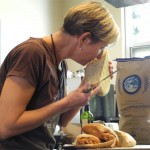
After that, it was a day of impossible choices. I decided to learn about baking with barley, since that was an idea that had never crossed my mind. Two impeccably qualified bakers showed us some tricks and discussed the challenges of working with a flour that is flavourful and high in beta glucan, but pretty much completely lacking in tensile strength, so it needs to be paired with a high gluten flour. Leslie Mackie, of Macrina Bakery, had used barley flour in her Monkey Bread and gave us a firsthand view of how a recipe is developed. Here she checks the crumb of two sample batches of a barley Pugliese loaf, which is made with 20-30% barley flour.
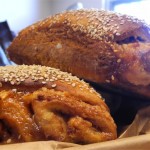

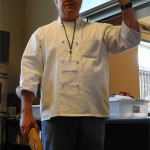
Andrew Ross, who teaches Crop & Food Science at Oregon State University but has a background as a baker, showed us some 50% barley bread, a 10% barley levain and then proceeded to make barley pita breads and lye-dipped barley pretzels.


I scooted into a panel I’d wanted to hear – Growing the grain is just the start: Connecting farmers, millers and bakers – and caught the end of an animated discussion about commodity pricing vs buying/selling locally and setting a price that allows farmers, millers and bakers to pay their staff living wages and offer them benefits, including healthcare. One farmer, whose farm’s motto is “Grown while you watch by people you know”talked about differentiating small, quality-driven operations from the cheaper, profit-driven ones. There was discussion around flavour of local products; one farmer remarked this is less magical than it seems, and more to do with the six week age difference between fresh dug carrot and one bought in grocery store. “When your name is on the package, accountability and care goes up” remarked another. Near the end, the elephant in the room was named. Stephen Jones was asked about genetically modified wheat, and he replied that his research centre has a moratorium on GM research; Monsanto was doing a lot of work on Roundup-ready wheat but stopped seven years ago when Japan and other countries said they would not import it (he did question whether the research actually stopped). But as far as he knows it’s ready to go and Monsanto will be reshaping the sales pitch around higher nutritional value. All it will take is the political will (or weakness, more accurately) to let it through the gates.
Then it was lunch and on to the finale: tours of a local mill, farm and bakery. Fairhaven Organic Flour Mill was our first stop, where owner Kevin Christenson told us about his experiences since taking over the mill in 2007. He went into the question of gluten-free milling and explained some of the difficulties around that, where there’s limited equipment and more demand for other flours. They clean their equipment as best they can but it’s not a perfect system.


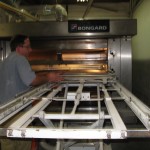
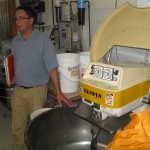
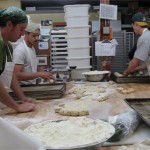
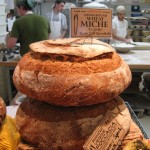
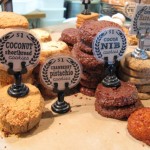
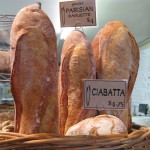
Then on to the Breadfarm, which had been providing us with some delectable treats over the weekend. Owner Scott Mangold showed us his mixer, his ovens and his methods while his bakers toiled away in the background. His shop is open from the counter to the back of the preparation area so that customers can see what’s happening while they buy their bread; a nice touch, but Scott added, a rather dusty one.
The last tour of the day was to Hedlin Farms, where fourth generation farmer Kai Ottesen showed us round this family farm. The scion had left it in shares to his offspring – meaning the farm could not be parcelled off without the consent of all concerned. And so it goes on today, with some innovations. The hothouse tomatoes are a relatively small operation, geared to supply farmers markets and restaurants, from about May each year. The twining of the stems (string supports are moved along as the stems grow) is a fairly standard arrangement in greenhouses, as are the biological controls which are bought in. It’s hard to get organic certification for greenhouses – you have to have an organic fertilizer that will work with irrigation systems that are notoriously finicky, so Hedlin has spray-free greenhouse tomatoes as well as certified organic tomatoes grown in earth in a polytunnel.


They also have a heck of a farm dog. She makes up for her size in sheer persistence: can dribble and fetch her ball till the cows come home.


-
Kneading Conference West – day 2
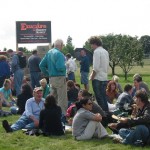 Sun broke out on day 2, causing some basking on the grass at lunchtime.
We began the day with a PowerPoint tour of local and small scale wheat producers from non-wheat areas; wheat breeder and conference organizer Stephen Jones showed maps revealing the transition to commodity scale production, which has redrawn the country’s pattern of wheat production. While almost every state in the US used to produce wheat, now the focus is on large scale production – nothing less than 1000 acres shows on the maps. But there’s a welcome resurgence across the board with small producers from Whidbey Island – where Ebey’s Prairie farmers once held the world record for productivity (119 bushels/acre in 1919 – a figure that dwarfs today’s industrial scale yields of around 45 bushels/acre) to Vermont – where farmer Jack Lazor has dealt with the loss of infrastructure by building his own grain elevator. Here at the Mount Vernon Research & Extension Centre (where the conference is being held) Jones is working on developing varieties that are resistant to local problems – notably rust – and has been working closely with local producers and bakers.
Starting to get hard to choose between sessions. I stopped for a few minutes at various points to watch Seattle baker George DePasquale on Artisan Sourdough for Home Bakers where he had some smooth moves for shaping boules, batards and baguettes,
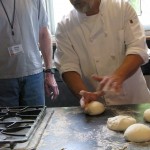
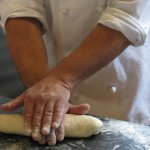
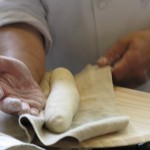
and offered advice on setting each on the couche, as well as transferring from the couche to the peel. He also took his scissors to
 a baguette to demonstrate the making of an épi de blé – remarking it was a tricky one to get in and out of the oven in one piece.
On to a panel discussion: A Question of Scale, where farmers and bakers talked through some issues to do wtih ethics and economics of producing local and organic.
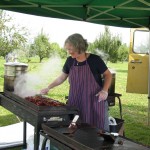
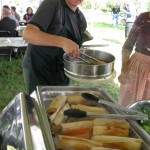
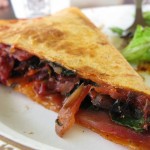
Lunch beckoned aromatically from the tent where the Patty Pan Grill folk were preparing the innards of our meal, which, alongside an excellent salad and three kinds of tamales, offered a spectacular discovery for me: it is possible to enjoy a quesadilla, if it is prepared from beets and other nicely turned veg together with some good cheese.
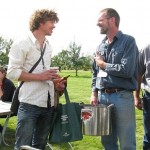
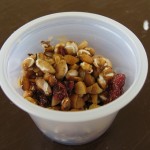
Some Vancouver Island talent: Fol Epi baker/owner Cliff Leir with “beer farmer” Mike Doehnel. Mike walked us through the barley malting process, after an introduction to barley breeding by Patrick Hayes, who set us loose on samples of hull-less and hulled barley, perled barley and even an incredibly good toasted barley snack (with local hazelnuts and cranberries) that’s soon to be marketed.
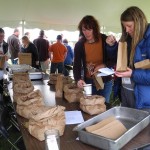
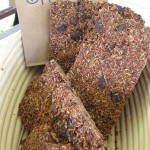
There was also discussion of something called Bappir, an ancient trail food made with barley, honey and dates which served a dual purpose: it could be soaked in water where it would be colonized by wild yeasts and serve as the foundation to early beers. We were also encouraged to try a barley head thresher – a basic manual model or an automated version – and a barley perler.
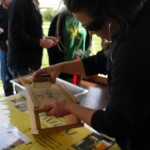
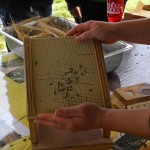
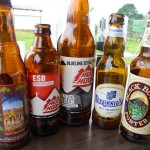
Some beer tasting ensued while Mike managed a demonstration barley mash in the background, eventually offering sips of the wort (if I followed the process correctly) which is the sweet dregs of the washed mash. It can be cooked down into malt extract for baking, or carried through the process and combined with hops to make beer. Of which we’d sampled five versions – four of them local, and some quite excellent. Thus fortified we wandered off to wait for… a beer and cheese tasting.
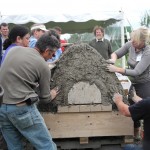
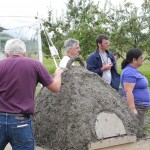
Behind us there was a small commotion of slapping and patting, which was the wood fired oven workshop group putting the finishing touches on their labour of love, which was to be silently auctioned off later in the evening, with proceeds to go towards the next Kneading Conference West – a worthy cause in my view. All you needed was the means to take it home with you…

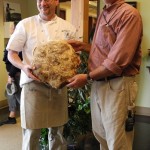
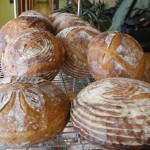
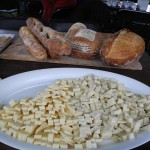
Elsewhere I happened upon Michael Eggebrecht and Stephen Jones wrangling a giant loaf from the Professional Baking workshop – came off a large rack of loaves that were on the way to the food tents where we covered them in more local cheese – a dill/garlic herbed number and an aged gouda style – before settling in to a dinner of barbequed chicken, corn and beans. And that was our Friday.
I retire with trepidation, for tomorrow’s schedule is too tempting and I cannot decide between four simultaneous sessions…
épi de blé
Latest Posts
- Sublime
- Good weather for reading
- The world, the world
- Sublime launch!
- Planet Earth Poetry – Readings by Volunteers, Victoria 2026
- Poetry at the Goldfinch
Aldeburgh Poetry Festival Barny Haughton BBC BC poets Berkswell blackberries Black Stilt Bologna book launch Borough Market Carlo Petrini Catalonia Cyrus Todiwala dairy Daunt's Books Dijon Edinburgh Fanny Bay Feast of Fields Food and Morality food history food journalism Jenna Butler lardo Malahat Review Michael Pollan Okanagan olive oil tasting olive trees Omnivore's Dilemma Our Food Our Future Oxford Parmigiano-Reggiano Planet Earth Poetry poetry poetry readings Poetry videos prosciutto salumi Sean O'Brien Suffolk ticks Wendy Morton Wired Writing Yvonne Blomer
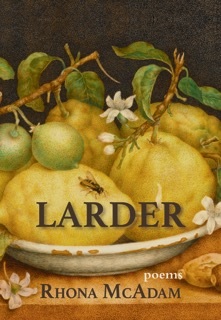
In her latest collection, Rhona McAdam navigates the dark places of human movement through the earth and the exquisite intricacies lingering in backyard gardens and farmlands populated by insects and pollinators, all the while returning to the body, to the tune of staccato beats and the newly discovered symmetries within the human heart.
“…A beautiful, filling collection, Larder is a set of poems to read at the change of the seasons, to appreciate alongside a good meal, and to remind yourself of the beauty in everything, even the things you may not appreciate before opening McAdam’s collection….”
Rhona McAdam is a writer, poet, editor, and Registered Holistic Nutritionist with a Master’s in Food Culture from Italy and a deep-rooted passion for ecology and urban agriculture. Her work spans corporate and technical writing to poetry and creative nonfiction, often exploring the vital links between what we eat and how we live. Based in Victoria, BC, and available via Zoom, Rhona is always open to new writing commissions, readings, or workshops on nutrition and the culinary arts.