-
Villanelle
Read Full Post: VillanelleBlues-oriented form fiends may like to check out the latest Paul Reddick cd, Villanelle. I heard him interviewed a while back, but wasn’t paying full attention at the time; it seems to me he said that many (all?) of the songs on the album incorporated formal elements from poetry, but I haven’t been able to find that interview or any corroborating evidence.
And that somewhat predictably brings me to Dylan Thomas, whose Do Not Go Gentle Into That Good Night, for his dying father, remains the most stunning villanelle I’ve ever heard.
Two years ago today – it was the morning of Easter Monday – my own dad passed away. Here he is, sailing for London.

-
Purdy, Pinsent, prosody and apostles
Read Full Post: Purdy, Pinsent, prosody and apostlesAl Purdy’s very topical just now. Not only is his Rooms for Rent in the Outer Planets: Selected Poems, 1962-1996 up for Canada Reads , the CBC is airing a documentary about him called “Yours, Al” this coming Thursday, April 13, on CBC Television’s Opening Night. The show stars Gordon Pinsent as Al Purdy and is on at 8 pm local time across Canada.
Meanwhile, I’ve wantonly picked up yet another book to browse. The house is pretty well carpeted with half-read books on prosody and form these days. Annie Finch, in her new collection of essays, The Body of Poetry: Essays on Women, Form and the Poetic Self , kicks off and out with a chapter on metric diversity, arguing against the championing of iambic pentameter as the premier English meter. “The use of the single label ‘iambic’ to include lines in other meters, she says, “…may prove to erase what it assumes to include, just as the generic use of the pronoun ‘he’ – said to include females – arguably erases female presence.”
With Easter coming, English cooks are busy making Simnel Cake, pretty much just a fruit cake with marzipan topping, but something virtually unknown on this side of the Atlantic. Apparently its roots lie in another English holiday, Mothering Sunday, which takes place in March. Serving girls were permitted to visit their mothers on this day and the practice was to bring a simnel cake to prove how clever they were (if they made a good one, it would stay moist and tasty till Easter). Its presence at the Easter meal has to do with the 11 marzipan balls that decorate the top, representing all the Apostles except Judas. Perhaps with the new evidence that surfaced last week we can bring the numbers back to an even 12…
-
The poetry of job loss
Read Full Post: The poetry of job lossOne more note on “luminous” as a poetry cliché: I would like to plead special exemption for Edward Lear, who wins my prize for the best use of luminous in a poem title: The Dong With the Luminous Nose.
A little more comment on Canada House, from the Guardian. I’ve been thinking about why I feel it so personally? Not only are the cuts harmful to the eternally under-funded world of Canadian culture, and not only is it tiresome to see what appears to be yet another new government thinking cultural funding is a conveniently disposable column in the spreadsheet – when as the Guardian article demonstrates, it benefits Canada’s cultural reputation in ways that go beyond the simply fiscal. But firing people to save money is also just a bad thing for those left behind, forced to try to do more with less, after having just witnessed the disposal of their colleagues.
I was really struck by a CBC Sunday Edition interview with Henry Mintzberg a couple of months ago. He talked about how the heads of organizations are axing not just people but corporate culture and corporate loyalty when they impose economic efficiency without regard for the long term health of the organization. While the big guys cycle through the corporate stratosphere collecting their multi-figure salaries and fiscal incentives, those beneath them are left picking up the pieces and selling themselves on to the highest bidder, because rounds of cost-cutting firings have taught them their experience and their knowledge of their organizations are no longer valued.
When you lose your job, you will be appalled by the swiftness with which a judgment can be made between your years of company-specific experience and skills on the one hand, and your salary on the other. More than that, you discover the obscene vocabulary that has been invented to mask the cruelty and destructiveness of the process. I actually heard someone remark – after the first unannounced round of firings in our company – that it had been a necessary and positive move, because it had eliminated “deadwood”. This person had actually hired some of the people who lost their jobs, after a dozen years of service or more. That remark showed me in a single sentence how the company I joined had ceased to be.
…
Call them
deadwood, downsized or first ones out;
right-sized, rationalized and repositioned;
call them someone we used to work with,
yesterday’s friends bent over their desks
filling shopping bags with coffee mugs
and office tat.Computer screens gone blind, they are
erased already from the network, relieved
of their keys and shown the exit: dehired,
excessed, and made redundant…
from Survivors, in Cartography)All fired up now? Canadian poet-workers might like to check out the poetry competition at Living Work.


Latest Posts
- Writers at Word!
- Sublime and Twisted Readings coming up!
- Sublime
- Good weather for reading
- The world, the world
- Sublime launch!
Aldeburgh Poetry Festival Barny Haughton BBC BC poets Berkswell blackberries Black Stilt Bologna book launch Borough Market Carlo Petrini Catalonia Cyrus Todiwala dairy Daunt's Books Dijon Edinburgh Fanny Bay Feast of Fields Food and Morality food history food journalism Jenna Butler lardo Malahat Review Michael Pollan Okanagan olive oil tasting olive trees Omnivore's Dilemma Our Food Our Future Oxford Parmigiano-Reggiano Planet Earth Poetry poetry poetry readings Poetry videos prosciutto salumi Sean O'Brien Suffolk ticks Wendy Morton Wired Writing Yvonne Blomer
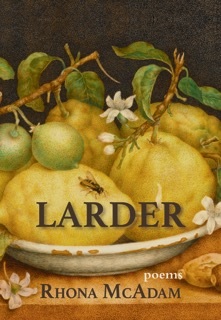
In her latest collection, Rhona McAdam navigates the dark places of human movement through the earth and the exquisite intricacies lingering in backyard gardens and farmlands populated by insects and pollinators, all the while returning to the body, to the tune of staccato beats and the newly discovered symmetries within the human heart.
“…A beautiful, filling collection, Larder is a set of poems to read at the change of the seasons, to appreciate alongside a good meal, and to remind yourself of the beauty in everything, even the things you may not appreciate before opening McAdam’s collection….”
Rhona McAdam is a writer, poet, editor, and Registered Holistic Nutritionist with a Master’s in Food Culture from Italy and a deep-rooted passion for ecology and urban agriculture. Her work spans corporate and technical writing to poetry and creative nonfiction, often exploring the vital links between what we eat and how we live. Based in Victoria, BC, and available via Zoom, Rhona is always open to new writing commissions, readings, or workshops on nutrition and the culinary arts.