-
Rhubarb rhubarb rhubarb
Read Full Post: Rhubarb rhubarb rhubarbI have a pair of rhubarb plants that despite my neglectful stewardship manage to rouse themselves every year to give me a couple of batches of fruit. Not enough to do too much with, but at the very least I like stewed rhubarb: it is transformed with a bit of grated orange zest and the juice of half or a quarter of an orange. And sugar of course. Nice with plain yogurt for breakfast. If you have lots on hand, try a rhubarb custard pie sometime: my my my my my but it’s good. More orange zest called for there, and maybe a dollop of nice vanilla ice cream if the pie is still warm when you get to it.
My cousin Shirley had an old newspaper recipe for Rhubarb Marmalade which sounds a lot like one I had a few years ago and still dream about, and which kindly expects that you may not have an abundance growing in your garden when the mood strikes.
2 oranges
2 lb frozen rhubarb
1/2 cup water
3-1/2 cups sugar
1 cup golden raisins
Cut oranges in half lengthwise. Place them cut side down and slice paper thin, discarding seeds. Cut slices in half, and put them with rhubarb and water in a large saucepan. Bring to the boil, turn down to medium and boil 10 minutes, stirring often. Add sugar and cook slowly until thick, about 20 minutes. Stir often. Add raisins and boil 1 minute. Ladle into hot sterilized jars and seal. Makes about 48 ounces.The February 2006 issue of Poetry Magazine surfaced during a night table re-engineering exercise, and I read The Bowl of Diogenes, an entertaining article about poetry criticism by William Logan, who sits on both sides of the critical fence.
“In most arts… there is a guild rule against writing criticism. One looks in vain for the ballet reviews of Twyla Tharp and the film reviews of Angelina Jolie. In poetry, as in few other arts (fiction is a partial exception), the critics are the artists themselves — even though many poets, and wise poets they are, have sworn an oath of omerta, never to breathe a word of criticism against a fellow of the guild.”
He explains his position and his passion for crossing over anyway:
“I turned to criticism myself, not out of a messianic instinct or the will to martyrdom, but out of the terrible knowledge that I was a better reader when I read for hire, that I read more intently when driven by necessity.
…criticism has forced me to read books I would otherwise have ignored. I’ve read far more contemporary poetry than most people, and far more than I would have if left to my own devices. I’ve probably read more dreary and ordinary books of verse than is healthy… Yet, on a rare occasion, I’ve felt like Balboa staring out across an unknown sea or Herschel seeing Uranus swim before his telescope… I’ve found a book that reminds me, not just why I write criticism, but why I write poetry.”He argues firmly against accessibility as the primary goal of contemporary poetry:
“There are, even now, publishers and readers and even poets who think poetry far too obscure, who think poetry ought to be so simple it hardly needs to be read at all… The best poetry has often been difficult, has often been so obscure that readers have fought passionately over it…
For two centuries, well-meaning vandals have been trying to dumb down Shakespeare, wanting to make him common enough for the common reader, in the doltish belief that, introduced to poetry this way, the common reader will turn to the original. Yet the reader almost never does. He’s satisfied with a poor simulacrum of poetry, never realizing that Shakespeare without the poetry isn’t Shakespeare at all. The beauty of poetry is in the difficulty, in the refusal of the words to make the plain sense immediately plain, in the dark magic and profound mistrust of words themselves…
Surely we read poetry because it gives us a sense of the depths of language, meaning nudging meaning, then darting away, down to the unfathomed and muddy bottom. Critics, generations of critics, have devoted themselves to revealing how those words work, to showing that each sense depends on other senses. Not every poem has to be as devious and shimmering as Shakespeare (there is room for plain speaking, too); but the best poetry depends on the subtlety and suggestiveness of its language. If we demand that poetry be so plain that plain readers can drink it the whole plain day, we will have lost whatever makes poetry poetry.” -
Saltines, literary prodigies and poet laureates
Read Full Post: Saltines, literary prodigies and poet laureatesYesterday I was thinking about saltine crackers, which I could not find for some reason in my grocery store (needed for the crust of the Artichoke and Mushroom Quiche). And that of course led me to think about young Daisy Ashford and her incomparable novel, The Young Visiters; or Mr Salteena’s Plan, which is now available online in full from Stone Soup, the magazine for young writers and artists. I also discovered it had been made into a TV movie in Britain, starring the amply talented Jim Broadbent as Mr Salteena, the admirably grumpy Hugh Laurie as Lord Bernard Clark, and the weirdly adorable Bill Nighy as the Earl of Clincham, among others.
The City of Victoria, in partnership with the Greater Victoria Public Library, is accepting applications between April 18 and May 15, 2006 for the inaugural two and a half year appointment of a Poet Laureate. The position serves as a cultural and literary ambassador for the City of Victoria and supports the literary community as a whole. Don’t quit your day job: the position pays $1,500 a year.
-
Back to poetry
Read Full Post: Back to poetryI’ve been preoccupied with food lately so time to think a bit more about poetry. My cyber scouts have been sending me interesting things to read, so I thought I’d share.
Mary felt I needed to know about the not-quite-yet-born Quarterly Journal of Food and Car Poems, from Washington state, which is seeking form poems for its first issue, and provides a nicely photographed sonnet to a steak for inspiration, as well as a handy list of links to Wikipedia definitions of allowable forms.
And Nancy has been reading the well-endowed (in the most fully figured meaning of that phrase) website of the Poetry Foundation, which is an excellent site and one I hadn’t visited before. She also found an online version of the article on rhyme, meter, stanza and pattern that appeared in a recent issue Poetry Magazine, by George Szirtes.
And as for me tucked up with my million books on poetry, I was reading again a few comforting passages from my heroine Maxine Kumin’s delightfully readable and charming collection of Essays on a Life in Poetry, Always Beginning. In a 1996 interview included in the collection, she was asked about the process of writing a novel on a typewriter, which she began using a very literal cut and paste method, so she had the first page scrolling across the room before she inserted her second page. She was asked if she thought computers had changed the surface or shape of prose, and she replied
“Oh I know it has…It’s dangerous! It corrupts you in midpage because it’s so easy to insert and delete that you take a lot of wrong turns… I’m not really comfortable yet with the computer. I use it for prose, a little warily, and then I print things out and make a lot of changes by hand, and then I go back and put them in.”
Just so. I like to print poems out and write on them (with dates!!) so that I don’t lose those speculative changes. I rarely go back to previous versions, but it can be helpful to have them if I get myself completely messed up. I find the Version Control feature in Word cumbersome and not really workable for me, but on the other hand, just pressing the Save button pretty much obliterates your editing history. Literary researchers of the future should have an interesting time of it.
Have a look at this site if you’re interested in editing history; it shows four manuscript versions of Wilfred Owen’s Dulce Et Decorum Est, and I seem to recall reading we don’t know which was his own finished version, so in anthologies etc. you will find one or some variation on these. To view each draft full-screen, choose right-click a manuscript “button” (A, B, C, D) and choose Open Link in New Window.
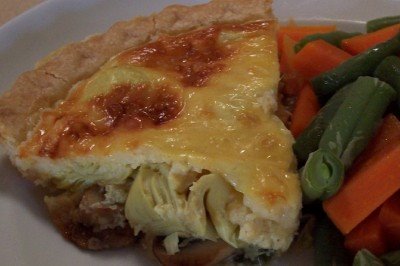
Mary wanted to see what I was having for supper last night. It was a mushroom and artichoke quiche from the Steinbeck House cookbook. The crust is supposed to be made with crushed saltines and sauteed mushrooms and butter (chilled till firm), and then you put lightly cooked green onion and chopped canned (not marinated) artichoke hearts on the base, cover with monterey jack cheese and pour on the filling, made with eggs, cream and cottage cheese, pureed with cayenne and paprika.



Latest Posts
- Writers at Word!
- Sublime and Twisted Readings coming up!
- Sublime
- Good weather for reading
- The world, the world
- Sublime launch!
Aldeburgh Poetry Festival Barny Haughton BBC BC poets Berkswell blackberries Black Stilt Bologna book launch Borough Market Carlo Petrini Catalonia Cyrus Todiwala dairy Daunt's Books Dijon Edinburgh Fanny Bay Feast of Fields Food and Morality food history food journalism Jenna Butler lardo Malahat Review Michael Pollan Okanagan olive oil tasting olive trees Omnivore's Dilemma Our Food Our Future Oxford Parmigiano-Reggiano Planet Earth Poetry poetry poetry readings Poetry videos prosciutto salumi Sean O'Brien Suffolk ticks Wendy Morton Wired Writing Yvonne Blomer
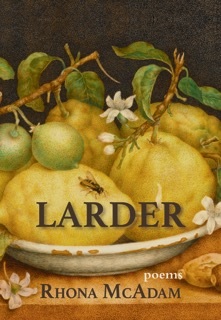
In her latest collection, Rhona McAdam navigates the dark places of human movement through the earth and the exquisite intricacies lingering in backyard gardens and farmlands populated by insects and pollinators, all the while returning to the body, to the tune of staccato beats and the newly discovered symmetries within the human heart.
“…A beautiful, filling collection, Larder is a set of poems to read at the change of the seasons, to appreciate alongside a good meal, and to remind yourself of the beauty in everything, even the things you may not appreciate before opening McAdam’s collection….”
Rhona McAdam is a writer, poet, editor, and Registered Holistic Nutritionist with a Master’s in Food Culture from Italy and a deep-rooted passion for ecology and urban agriculture. Her work spans corporate and technical writing to poetry and creative nonfiction, often exploring the vital links between what we eat and how we live. Based in Victoria, BC, and available via Zoom, Rhona is always open to new writing commissions, readings, or workshops on nutrition and the culinary arts.