-
Compost, Nettie Wiebe, Handmaid’s Tale and bird pests
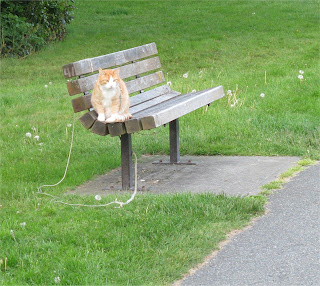
Read Full Post: Compost, Nettie Wiebe, Handmaid’s Tale and bird pestsWeirdness on the Gorge. Who leaves a tethered cat on a walkway frequented by dog-walkers?
 Operating as I do from a position of smug complacency atop my composter, I was comforted by this article about composting, and its assertion that “every time you cook…you’re not finished until you compost.”
Nettie Wiebe was speaking at the conference where I read in February, and a wonderful speaker she was. Bernadette passed along a great article about her by Penney Kome; a terrific opening sentence:
“If it is true that we are what we eat,” said Nettie Wiebe, “then most of us are like those stuffed animals that you get from vending machines with labels that say, ‘100 percent unknown fiber’.”
Meanwhile, this morning’s junk mail folder held a personal message from Awotwi Alden who promised that Women Will Be my Resigned Slaves. Alas, I did not find out how this could be before kissing the message goodbye, but it reminded me to catch the last episode (aired Friday) of The Handmaid’s Tale, broadcast on BBC Radio 7 every day this past week. A book I loved and it made me think of Natasha Richardson in the film version, which I wasn’t overwhelmed by. If you’re quick you can catch the last four episodes here.
Our urban farming group talked about the plague of birds that is upon us. Many in our neighbourhood have had seedlings uprooted or bitten off
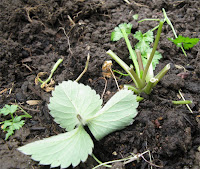
by birds – Peg and Tom watched a pair of robins work their seedlings, while I witnessed sparrows eating my chard leaves – and there was talk about why this should be so. We wondered if there is a bigger problem for them; that they seem to be eating things they didn’t eat before: apples and chard for example. A hard winter, ongoing urbanisation and destruction of habitat and natural food sources and – maybe? – people cutting back on bird seed, or who knows what other factors – are making them hungry.
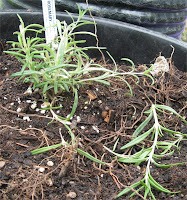
Perhaps all that bird seed in the past helped to boost their numbers beyond sustainable limits? So instead of cleaning up on the pests in our gardens they are searching harder for food and making a royal mess of things.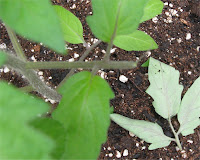
Which is forcing us to cover our plantings, which might give the wireworms and cutworms and other crawlies free reign on our vegetables. The ongoing battle between gardener and nature continues.
-
E-rights, Slow Food Youth, Farmers’ Markets and a poetry reading in a book fair
Read Full Post: E-rights, Slow Food Youth, Farmers’ Markets and a poetry reading in a book fairOne of those cases that has dragged on for years is an interesting study in evolving technologies. When freelance writer Heather Robertson launched her case against the then Thomson news corporation in 1996, it was early days in data management. Newspapers were racing to put their wares online but left the agreements with writers behind; they reproduced articles without permission or payment and sold them through online databases for a fee that they did not share with the writers of those articles. It was the forerunner of Google’s “disregard copyright now pay later” approach to electronic publishing.
And it marked, in Canada, the beginning of the long slide downward for writers’ earnings. In a world where consumers of words are as guilty as consumers of food in making our decisions on the basis of price alone, we are all implicated in wanting something for nothing. But food, like words and music, is not created from air by air; the living beings who make these things also need to eat, and read.
Hence, in the wake of the Google Book Settlement (with its newly postponed opt-out date moved to September) a recent warning to Canadian writers from the Writers Union of Canada against accepting paltry payment clauses for electronic rights in book contracts:
It has come to the attention of the Contracts Committee that a number of publishers have been launching electronic book and print-on-demand initiatives. These publishers are encouraging writers to participate in their projects and are offering royalties for e-book sales at rates from as low as 10% of net sale price.
The Contracts Committee thinks that 15% or 25% of net or even of retail is unacceptable.
The Committee’s additional concern is that these initiatives may lock up both your electronic and print rights for your book with the publisher more or less forever.
The Robertson vs Thomson case has ended well for writers, and is heading for a settlement hearing on the 16th of June, in Toronto, to ask for court approval of the $11 million tentative settlement. The results could affect a great many writers, not just those in Canada.
The Slow Food Youth Movement has just launched an online newsletter. The first edition includes coverage of Pangea (Ark of Knowledge apprenticeships), Slow Food on Campus, Eat-Ins and more.
There’s a new place to shop: Farmers’ Market Online has links to Canadian producers who are selling food and other products online. Here’s a little pep talk on why people like to shop at non-virtual farmers’ markets in Britain. Here in BC, we have a healthy looking list of farmers’ markets; in Victoria, we have a good selection of mini-farmers’ markets, which we call Pocket Markets, available thanks to the work of a group called FoodRoots. Here’s a Pocket Market toolkit for setting up your own.
And if you want it to be right in your own garden, perhaps you were one of those seen mobbing the Compost Education Centre‘s annual organic plant sale,

where seedlings of many stripes were finding new homes on a perfect day for planting. Not so perfect for attending a book festival; in a scenario wearily familiar to all published writers, Dvora Levin,
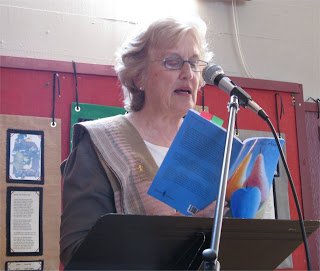

and I read to two audience members (both of whom I believe were related to Walter). So we simply broadcast our poems a bit more forcefully out into the roomful of booksellers and publishers who were chatting amongst themselves or with visitors. A couple of them gave in and listened appreciatively. Better a captive audience than none at all – though that might not be the captives’ perspective.
Though I’m always happy to give readings, in this case I’d only been invited on Wednesday, and the program was being changed on the fly (the readings lineup was different on the day’s printed program than what had been up on the festival’s website the night before). Poetry readings are always a difficult sell, and some are undoubtedly promoted better than others. Having more than two days’ lead time to publicize this event might have helped. But a sunny Saturday afternoon was always going to be a tough one.
-
Toxic produce and the Pacific Festival of the Book
Read Full Post: Toxic produce and the Pacific Festival of the BookThe Environmental Working Group’s Shopper’s Guide to Pesticides is available in wallet-sized pdf and iphone versions. Kind of a helpful thing to keep in mind as you plan your summer garden!
To save you the click, the “Dirty Dozen” (avoid non-organic versions) are:
- Peach
- Apple
- Bell Pepper
- Celery
- Nectarine
- Strawberries
- Cherries
- Kale
- Lettuce
- Grapes (Imported)
- Carrot
- Pear
while the “Clean 15” (lowest in pesticides) are:
- Onion
- Avocado
- Sweet Corn
- Pineapple
- Mango
- Asparagus
- Sweet Peas
- Kiwi
- Cabbage
- Eggplant
- Papaya
- Watermelon
- Broccoli
- Tomato
- Sweet Potato
Meanwhile, back in the poetry world, this Saturday at 11am, I’ll be appearing in a panel called The Writer and Responsibility at the Pacific Festival of the Book, and then reading my poetry between 2-3pm together with Janet Rogers and Walter Hildebrandt (who are also on the panel, as is Gary Geddes, Stephen Henighan and Trevor Carolan). This takes place at the Church of St John the Divine, on Quadra/Balmoral; where long ago in another lifetime my mother sang in the choir.


Latest Posts
- Writers at Word!
- Sublime and Twisted Readings coming up!
- Sublime
- Good weather for reading
- The world, the world
- Sublime launch!
Aldeburgh Poetry Festival Barny Haughton BBC BC poets Berkswell blackberries Black Stilt Bologna book launch Borough Market Carlo Petrini Catalonia Cyrus Todiwala dairy Daunt's Books Dijon Edinburgh Fanny Bay Feast of Fields Food and Morality food history food journalism Jenna Butler lardo Malahat Review Michael Pollan Okanagan olive oil tasting olive trees Omnivore's Dilemma Our Food Our Future Oxford Parmigiano-Reggiano Planet Earth Poetry poetry poetry readings Poetry videos prosciutto salumi Sean O'Brien Suffolk ticks Wendy Morton Wired Writing Yvonne Blomer

In her latest collection, Rhona McAdam navigates the dark places of human movement through the earth and the exquisite intricacies lingering in backyard gardens and farmlands populated by insects and pollinators, all the while returning to the body, to the tune of staccato beats and the newly discovered symmetries within the human heart.
“…A beautiful, filling collection, Larder is a set of poems to read at the change of the seasons, to appreciate alongside a good meal, and to remind yourself of the beauty in everything, even the things you may not appreciate before opening McAdam’s collection….”
Rhona McAdam is a writer, poet, editor, and Registered Holistic Nutritionist with a Master’s in Food Culture from Italy and a deep-rooted passion for ecology and urban agriculture. Her work spans corporate and technical writing to poetry and creative nonfiction, often exploring the vital links between what we eat and how we live. Based in Victoria, BC, and available via Zoom, Rhona is always open to new writing commissions, readings, or workshops on nutrition and the culinary arts.
