-
Last of the Solstice Poets
Happy new year!
I was among the Solstice poets featured in the paper this season, and my poem appeared today. It’s a great series to be part of and the Times-Colonist is to be commended for its boldness in publishing (gasp) poetry.
But… in the online version, my stanza and line breaks were gone (which is part of the problem about ebooks and poetry, by the way), so for the purists, and my fellow “line-making creatures” – as Billy Collins calls us – out there, I give you the poem as it was supposed to look.
Solstice RhonaMcAdam http://d1.scribdassets.com/ScribdViewer.swf
-
Litmag report cards & BC animal health regulations
Duotrope’s Digest is just about the coolest thing (aside from Marcel the Shell of course) that I’ve come upon in this virtual world. It’s a report card for literary mags: you can search for information about poetry or fiction submissions at almost every journal in the English-speaking world, and find out what their speed of response is, whether they accept electronic submissions, their acceptance rate, whether they pay, and many other useful details.
The information provided comes from writers who submit work to the journals, rather than their editors and publishers, and the file on each magazine shows how many reports the information is based upon. Writers register, enter the title and submission details for each piece of work, and then report back when the piece has been accepted or rejected.
This is doubly useful, because writers can use it to track their own submissions while performing a public service to others. And because it tracks individual pieces, a writer can see – on the record for each magazine – where else contributors have submitted the same work. Which is helpful if you’re trying to figure out your plan B for a rejected piece, or tap new markets for similar writing.
Meanwhile, the BC government is reviewing its animal health regulations and seeking public input, which I’d say is a *very* good thing, particularly if you look at the way the underlying principles are presented:
A sound BC animal health policy framework (including legislation, regulation and policy) should:
- Protect human health.
- Minimize the negative economic impact of animal disease outbreaks.
- Support the continued productivity and competiveness of livestock operations.
- Strengthen the confidence of interprovincial and international trading partners.
You will look in vain here for any mention of animal welfare. Our health and financial gain seem to be the only reasons for keeping animals healthy.
Given that the government wishes to extend its definition of “animal” to include pets, wildlife, fish and other aquatic animals, for purposes of “managing health” I’d think the wider public would find it in their personal interests – and those of their non-humanoid friends and family members – to elbow in on the consultation.
It’s unclear to me, having read through the consultation document only once, whether a revised policy would be able to make crucial distinctions between the concerns created by factory farming vs small-scale farming vs pet ownership, for example. And whether they would protect farmers from excessive zeal by regulators, such as the needless slaughter of a water buffalo herd in 2002 (all the animals killed tested negative for BSE, as had been predicted).
-
Happy Christmas!




Latest Posts
- Sublime
- Good weather for reading
- The world, the world
- Sublime launch!
- Planet Earth Poetry – Readings by Volunteers, Victoria 2026
- Poetry at the Goldfinch
Aldeburgh Poetry Festival Barny Haughton BBC BC poets Berkswell blackberries Black Stilt Bologna book launch Borough Market Caerphilly Carlo Petrini Catalonia culatello Cyrus Todiwala dairy Dijon Edinburgh Fanny Bay Feast of Fields ferries Food and Morality food journalism Michael Pollan olive oil tasting Omnivore's Dilemma Our Food Our Future Oxford Parmigiano-Reggiano persimmons Planet Earth Poetry poetry poetry readings Poetry videos prosciutto salumi Sean O'Brien sensory analysis Suffolk ticks tortelli di zucca Troubadour Wendell Berry Wendy Morton Yvonne Blomer
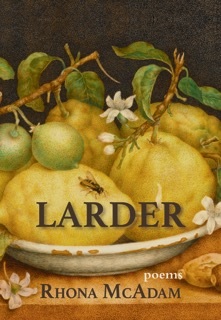
In her latest collection, Rhona McAdam navigates the dark places of human movement through the earth and the exquisite intricacies lingering in backyard gardens and farmlands populated by insects and pollinators, all the while returning to the body, to the tune of staccato beats and the newly discovered symmetries within the human heart.
“…A beautiful, filling collection, Larder is a set of poems to read at the change of the seasons, to appreciate alongside a good meal, and to remind yourself of the beauty in everything, even the things you may not appreciate before opening McAdam’s collection….”
Rhona McAdam is a writer, poet, editor, and Registered Holistic Nutritionist with a Master’s in Food Culture from Italy and a deep-rooted passion for ecology and urban agriculture. Her work spans corporate and technical writing to poetry and creative nonfiction, often exploring the vital links between what we eat and how we live. Based in Victoria, BC, and available via Zoom, Rhona is always open to new writing commissions, readings, or workshops on nutrition and the culinary arts.