-
Fruit Tree Project strikes again
 I spent a fruitful morning yesterday with a dozen teens from the CISV Peace Bus out at Island View Beach on my first pick of the year for the Fruit Tree Project. As part of their cross-Canada tour, the teens involve themselves in community projects, aiming to make the trip carbon neutral. Picking local fruit fits the bill because it means less imported fruit is needed to feed the communities and enterprises where the unwanted urban fruit is distributed.
We were picking from trees that had been planted in a beachside campsite that the CRD took
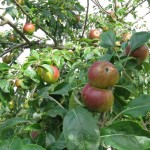 over a few years ago. Because the irrigation that had watered the trees had to be taken out (not up to code, apparently) there hasn’t been any watering since then, so the fruits tend to be small while the trees adapt to their new micro climate.
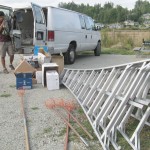
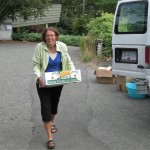
The Fruit Tree Project van holds all the ladders and picking equipment, together with weigh scales and as many sturdy boxes as can be found. Jesse, one of the program coordinators, lays it all out ready for the arrival of the bus, and gets everyone started, while a local TV cameraman covered the event.

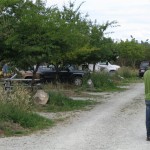
A peaceful period of picking passes
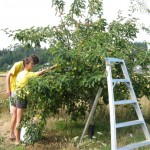
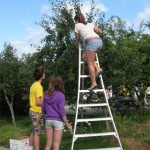
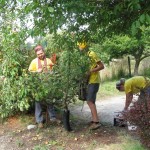
and then it’s time to weigh and load the fruit in the van, clean up the fallen fruit, and head off to store it.

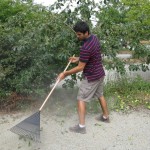
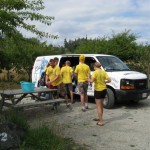
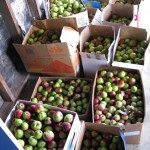
The cooler at Fruit Tree Project’s HQ – LifeCycles – where it’s normally kept is full to bursting while the team works on distributing the seasonal bounty to community groups and local food processors. So, with the help of Fruit Tree Project co-coordinators Renate and Jesse, we park nearly 500 lbs of apples in a trusted garage while the smaller quantity of pears and plums goes back to LifeCycles.
-
Heirloom schmeirloom
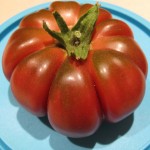 The LA Times has a good article on heirloom fruits and vegetables. The word “heirloom” is one that’s widely abused, but one that’s also treasured by many farmers and gardeners in these days of hybrids and genetic engineering.
There is much to commend, for example, the complex flavour and charming fissures of an heirloom tomato over its supermarket version, round and hard and bland as a tennis ball. Here’s one of mine, as discussed on my gardening blog recently.
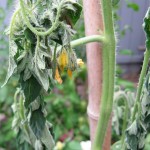 But woe, or perhaps that should be more woe, has befallen my tomato kingdom. I’ve had to pull up one of my beloved Auriga plants as it suffered sudden and catastrophic wilt. Was fine one day and flopping over the next. Because it perked up at night before flopping out again the next morning, and because the stem cross-
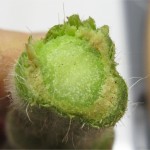 section revealed the tell-tale dark ring that shows fungal damage to its vascular tissues, I assume it was vascular wilt – which apparently means either Fusarium or Verticillium… although the plant didn’t show any yellowing of the leaves which is said to be a symptom of both these fungal diseases.
So I don’t know for sure, but I had to pull it up to be on the safe side. My tomato garden will have to move to a new location next year in any case, since several of the plants were infected with early blight (Alternaria solani). Aside from not growing in the (now contaminated) soil for several years, the main suggested procedure for controlling vascular wilt is to buy seed that has been bred for disease resistance. In the words of one source of advice, “The incidence of these diseases has increased with the growing popularity of heirloom, non-resistant, varieties.”
Well that’s the problem, isn’t it? The old conflict between taste and functionality. We may complain mightily that new food plant varieties are bred for longevity in shipping containers and on supermarket shelves rather than for taste or texture, but they are bred for other useful purposes as well. Disease resistance and other useful qualities like drought tolerance are key objectives in many plant breeding programs. Good breeding should aim to keep those most important qualities, the ones that made us love a food – flavour, nutritional content – while secondarily working on other aspects. But in a world that seems to have forsaken its tastebuds if a cheaper product can be had, this doesn’t always happen.
And maybe it’s not possible. If it’s not, then it means urban (and other) farmers who want to grow heirloom varieties need to be skilled and knowledgeable about avoiding the risks that can do in their crops. Gaining that skill and knowledge is the tricky bit in a busy world.
Meanwhile, I will have to look into wilt-resistant varieties that grow around here (apparently the resistance has to be localized as there are so many variations of the wilt fungi). Perhaps tempt fate and see how well they fare in the same garden bed. And how they taste!
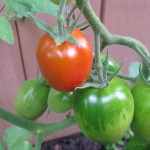 There are ambiguities around the term “disease-resistance” too; this was a term used about one of the tomatoes I’m growing this year, the Bearo plum. In fact it was said to b
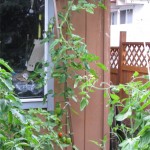 e highly resistant to blight, but I’ve managed to prove that its resistance hasn’t extended to early blight, unfortunately, as it’s one of the plants affected in my garden this year (so far only the leaves). But its enthusiastic growth and ample fruits make me want to try it again, and next time somewhere it can have room to reach for the skies.
 -
Farm tour: salad greens and looong greenhouses
The COG-VI tour this month was to 30-acre Kildara Farms, organic since 1994 and run by Brian and Daphne Hughes. They started off with an apple orchard; went into strawberries but tired of feeding the deer, and are now supplying year round organic greens to local supermarkets.
They rinse the greens, then wash them in food grade hydrogen peroxide solution (1:1000) and then rinse again and spin them dry (equipment and surfaces are sterilized with 1:25 solution). When asked why they use this rather than bleach, which many organic suppliers in the US use, Brian replied, “One word: chlorine.” He says there’s always chlorine residue regardless of rinsing. For two years they have used a strict testing protocol, to avoid any issues with food-borne illnesses. As many travellers have found, salad greens, because they are eaten raw, are particularly vulnerable to these – if birds or other wildlife come into contact with them while growing in the fields or in open greenhouses. So Brian has the greens tested twice weekly for peace of mind, and provides test results to the retailers as well.
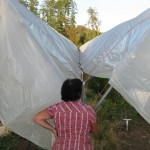
We looked at two different sets of greenhouses. The first were designed by British farmers whose company – Haygrove – quickly cornered the polytunnel market. They’re immense structures which can be extended to cover acres of ground, and use y-shaped posts that allow them to be extended efficiently in rows. They’re also simple to construct and inexpensive (by greenhouse standards) to erect, using legs which can be screwed into the ground and hold fast to clay soil. You can add deer fencing around the perimeter, which is open for better ventilation. Because the plastic is lashed in place by ropes rather than clipped, it is simpler and quicker to put up and take down. Any greenhouse is vulnerable to bad weather and these are no exceptions: during one particularly bad storm the plastic came loose twice in the same day. But they are otherwise working very well and are easy to ventilate further in hot weather, by just lifting and clipping the plastic as needed.
Next we looked into some Harnois greenhouses, made in Quebec. Fancier and more expensive, and full of winter greens – in this case Mizuna – which can grow unheated, or be covered by row cover if it get very cold. The watering system mists from overhead: more efficient than watering tapes, according to Brian, but in need of constant checking as the heads get clogged very easily.


The greehouse sides are enclosed so need to be ventilated during hot and sunny days. Pickers were at work while we were there, taking advantage of the evening cool (the greens start wilting by about 11 am). They chill the greens overnight before washing, sorting, weighing and bagging them. Kildara uses biodegradable bags – they used to use plastic clamshells but discovered that people were failing to recycle these and sending them to the landfill, so opted to change to bags for environmental reasons.


Kildara is one of a number of farms and food places on the North Saanich Flavour Trail this weekend.





Latest Posts
- Sublime
- Good weather for reading
- The world, the world
- Sublime launch!
- Planet Earth Poetry – Readings by Volunteers, Victoria 2026
- Poetry at the Goldfinch
Aldeburgh Poetry Festival Barny Haughton BBC BC poets Berkswell blackberries Black Stilt Bologna book launch Borough Market Caerphilly Carlo Petrini Catalonia culatello Cyrus Todiwala dairy Dijon Edinburgh Fanny Bay Feast of Fields ferries Food and Morality food journalism Michael Pollan olive oil tasting Omnivore's Dilemma Our Food Our Future Oxford Parmigiano-Reggiano persimmons Planet Earth Poetry poetry poetry readings Poetry videos prosciutto salumi Sean O'Brien sensory analysis Suffolk ticks tortelli di zucca Troubadour Wendell Berry Wendy Morton Yvonne Blomer

In her latest collection, Rhona McAdam navigates the dark places of human movement through the earth and the exquisite intricacies lingering in backyard gardens and farmlands populated by insects and pollinators, all the while returning to the body, to the tune of staccato beats and the newly discovered symmetries within the human heart.
“…A beautiful, filling collection, Larder is a set of poems to read at the change of the seasons, to appreciate alongside a good meal, and to remind yourself of the beauty in everything, even the things you may not appreciate before opening McAdam’s collection….”
Rhona McAdam is a writer, poet, editor, and Registered Holistic Nutritionist with a Master’s in Food Culture from Italy and a deep-rooted passion for ecology and urban agriculture. Her work spans corporate and technical writing to poetry and creative nonfiction, often exploring the vital links between what we eat and how we live. Based in Victoria, BC, and available via Zoom, Rhona is always open to new writing commissions, readings, or workshops on nutrition and the culinary arts.