-
A small gastro-tour
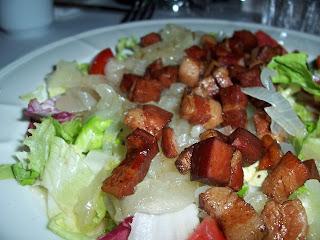
Read Full Post: A small gastro-tourI’d visited Tribunale on Friday, though it has since closed for hols, and had a very tasty and interesting insalata rustica, made with warm cooked onions, slightly pickled, and pancetta.
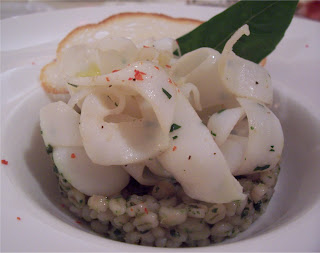
Tammy and Sue came to visit on the weekend and we did our best to eat our way through the local offerings – what was left of them, as many places have already shut for summer holidays. We were enticed into Osteria del Gesso by fond memories, air conditioning (it was 38 degrees on Friday) and an “open” sign. Always good and often unusual food. Here’s my starter which was a salad of strips of something from the octopus family on a bed of farro (aka spelt or, I have read, more accurately emmer)
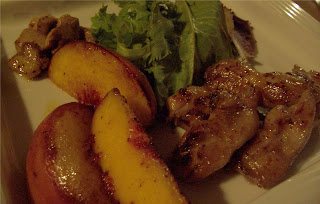
Next course for me was a nice bit of lamb with an apple marmelade. My companions had excellent tortelli di erbette – some of the best I’ve tasted.
Ombre Rosse has often served the uni crowd well; it seems to be open when all else is closed, and its 1,500 item wine list is entertaining reading. They have an unusual menu, from which I chose the quail salad with peaches and foie gras – an odd but pleasing combination:
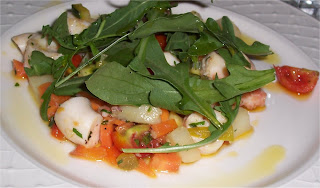
Gatta Matta is always excellent, and we had some wonderful food there. I’ve become a huge fan of tepid octopus salads, and got to have a bit of that here
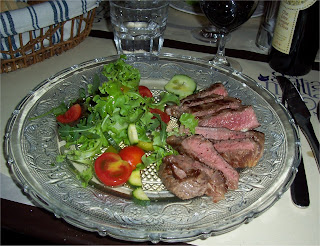
followed by some lovely steak
and some very boozy zabaglione – I think they’d emptied the Marsala bottle into it (and the effect was not unpleasant, though perhaps I didn’t need a delightful glass of passito on top) served with some excellent quaresimale (almond biscotti)

We finished our weekend with a second lunch at Sorelle Picchi, where my visitors made sure that the tortelli di zucca was in fact as delicious the second time as it had been the first (it was), and I had the triple-barrelled combination of tortelli – zucca, erbette and patate con funghi. All excellent. We washed it down with some inky cold frothy lambrusco. As you do.
-
We can’t believe…
Read Full Post: We can’t believe…How did it happen? A year flits by and all of a sudden it’s tearful farewells and no more pig farms, Unisg cheers, bus rides, charter airlines, wine tastings… how will we cope in the months to come?
The final week shaped up kind of like last week’s, commencing with an exam and then moving swiftly through food marketing, journalism and a great big party. We had lunch on a riverboat on the Po
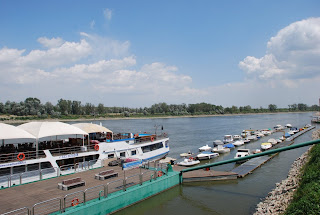
(photo from Andy)with Carlo Petrini and our university staff and dignitaries.

After the food we had a little wisdom from the brow of Petrini,
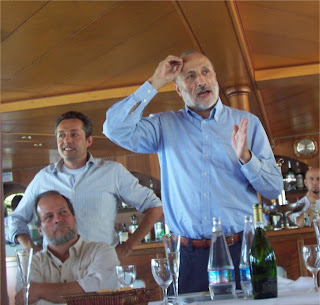
and then some goofy awards and another gem of a slideshow (so there WAS a reason for taking those – must be literally millions of frames – cameras everywhere we turned all year) by our animators Don and Marta.

Next stop was Polesine Parmense, where we revisited the scene of last winter’s visit when we learned about culatello di zibello.

(Photo from Andy)We were attending the annual Spigaroli Awards (to local food heroes of various kinds) at the beautifully refurbished Antica Corte Pallavicina, which was about half finished on our last visit. It’s now ready to roll as a swanky agriturismo for visitors who want a short and scenic walk to their dinner at Al Cavallino Bianco.

But on Wednesday tables had been set up around the perimeter of the courtyard and the Spigaroli brothers, Massimo and Luciano, were busy seeing to the comfort of their hundreds of guests. The hay bale corral in the middle holds a flock of black piglets who made up part of the award, one for each recipient: the Spigarolis would raise, slaughter and cure them, so the prize – in good Slow Food form – would be years in the making. We had some wonderful culatello, of course, including two kinds made from white and black pigs, each culatello aged 36 months.

And a wonderful tortelli in brodo with some exquisite cheese filled pastas in a light and warming broth – bliss to be in the cooling air eating such things. Fortified, the guests then enjoyed the awards ceremony, which included a special prize for Carlo Petrini.
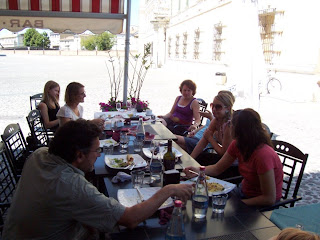
And then it was the last couple of classes – marketing and wine tasting from Matteo Baldi, journalism from Clodagh McKenna, the last lunch together,
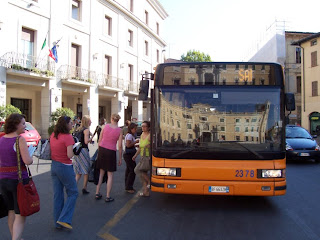
the last bus home,
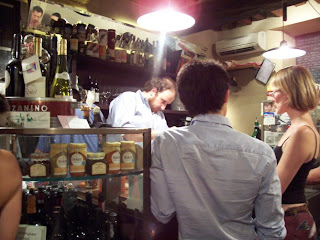
the last visit to Tabarro,
rounds of signings (our brand new copies of Slow Food Nation, serving as school autograph albums)
and some emotional farewells…
-
Bergamagnifico
Read Full Post: BergamagnificoI managed to get myself to Bergamo last Friday on a trip of two trains. The first, from Parma to Milan was air conditioned (just) and equipped with curtains to keep out the worst of the heat on a day when the temperature was predicted to reach 41 celsius.
By the time we got to Milan it was, well, very warm out there, and I took my cue from the locals who were huddled in the coolish shelter of the underground passageway beneath the platform, swatting Milanese mosquitoes and waiting until the last moment to rush the trains as they arrived.
When one did, alas it was not air conditioned and you could choose either to pull down the shade or enjoy the hot rush of air from the opened windows, More cruel plastic seats. Fortunately the misery only lasted half an hour or so and then we were in Bergamo, and I fell gratefully into the hospitality of Nancy and Mike who met me at the station and escorted me to my hotel.
They would have helped me to my room as well but when the front desk clerk saw us heading for the elevators, she blanched and demanded to see their passports. I explained they were not staying, but helping me with my bags. After some further officious to-ing and fro-ing she said she simply could not allow three people to occupy a single room even temporarily, it was the law. Ah, Italian rules, How endless, peculiar and insane they are!
We then hopped on a bus and ascended to the citta alta: the prettiest, oldest and highest part of town, with excellent views and lots of wandering streets. We ambled through the pretty piazza with its Venetian fountain
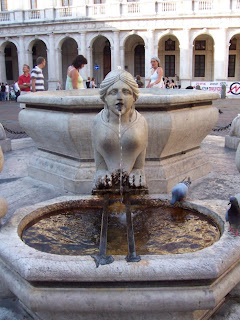
and lions watching us from atop the colonnade of the public library, where Nancy writes on warm days looking out at the hills behind the city. We peered in at a couple of food shops and admired the local specialties on offer, and then sat ourselves down for a cooling beverage on the piazza. We supped at the Agnello d’Oro, including some casonsei, the Bergamo ravioli:

Saturday we ascended by funiculare, which was short but pleasant and had another amble through the warming streets before taking shelter in the church which houses the remarkable Tarsias by Lorenzo Lotto and Donizetti`s tomb with its weeping cherubs:

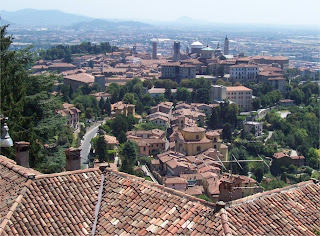
Then a second funiculare, way up to the top, where we tripped over a very fine lunch, lured in by the red water glasses and the stunning view.
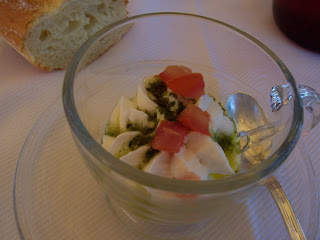


Back down the mountain we went and found ourselves at the Galleria d’Arte Moderna e Contemporanea di Bergamo where one of the featured artists was the very relevant Vanessa Beecroft, whose food diary, The Book of Food, was represented visually; she had somehow found the time to document everything she ate between 1983 and 1993. We also enjoyed a film whose name and author I forgot to write down, but which was a bit of visual poetry, white-garbed people creating fire on a disused airstrip in Essex, if memory serves.
Then back up the hill for some sups in a beautifully located but somewhat disappointing place, Antica Trattoria Colombina, recently given a thumbs-up by the Guardian which maybe spoiled it. Or maybe the chef was on hols. Or who knows. Anyway we enjoyed being out under the arbour of grapes and long beans…

Then it was Sunday and we managed a tour of Accademia Carrara, after which we were overcome by art, heat, sloth and hunger, and retired to casa Nancy e Mike where we lunched, napped, supped and slept. Before supper we had a reviving stroll in the cooling air and looked back at the citta alta in the sunset. The next morning I woke at 5.30 and began my journey back to Parma, which took till nearly 11 because of train problems. The problem, according the man sitting next to me and frowning into a fat book of train timetables, was that all the trains were late: the hot temperatures had deformed the rails. (Did it have anything to do with Sunday’s train strike? We will never know.)


Latest Posts
- Writers at Word!
- Sublime and Twisted Readings coming up!
- Sublime
- Good weather for reading
- The world, the world
- Sublime launch!
Aldeburgh Poetry Festival Barny Haughton BBC BC poets Berkswell blackberries Black Stilt Bologna book launch Borough Market Carlo Petrini Catalonia Cyrus Todiwala dairy Daunt's Books Dijon Edinburgh Fanny Bay Feast of Fields Food and Morality food history food journalism Jenna Butler lardo Malahat Review Michael Pollan Okanagan olive oil tasting olive trees Omnivore's Dilemma Our Food Our Future Oxford Parmigiano-Reggiano Planet Earth Poetry poetry poetry readings Poetry videos prosciutto salumi Sean O'Brien Suffolk ticks Wendy Morton Wired Writing Yvonne Blomer
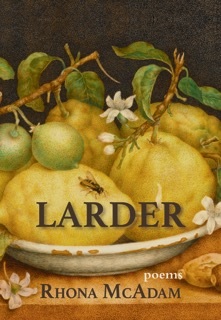
In her latest collection, Rhona McAdam navigates the dark places of human movement through the earth and the exquisite intricacies lingering in backyard gardens and farmlands populated by insects and pollinators, all the while returning to the body, to the tune of staccato beats and the newly discovered symmetries within the human heart.
“…A beautiful, filling collection, Larder is a set of poems to read at the change of the seasons, to appreciate alongside a good meal, and to remind yourself of the beauty in everything, even the things you may not appreciate before opening McAdam’s collection….”
Rhona McAdam is a writer, poet, editor, and Registered Holistic Nutritionist with a Master’s in Food Culture from Italy and a deep-rooted passion for ecology and urban agriculture. Her work spans corporate and technical writing to poetry and creative nonfiction, often exploring the vital links between what we eat and how we live. Based in Victoria, BC, and available via Zoom, Rhona is always open to new writing commissions, readings, or workshops on nutrition and the culinary arts.