-
Quiche ‘n fruit ‘n meat
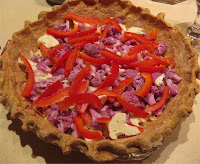
Read Full Post: Quiche ‘n fruit ‘n meatMy favourite food at my favourite vegetarian eating place in London is quiche, so I attempted a version of one from their cookbook, using some of Farmer Dan’s purple cauliflower. Looks like food for the colour blind, doesn’t it? (It looked – and tasted – just fine after I finished filling it)
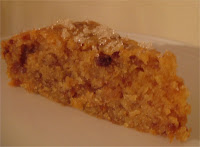
Followed by the apricot and almond cake from Nigel Slater‘s book Appetite…
Had a great visit on Wednesday to Fruit Trees and More, having a tour of the demonstration orchard with Bob Duncan. He has been growing oranges, lemons, limes, olives, figs, pomegranates, persimmons, medlars,
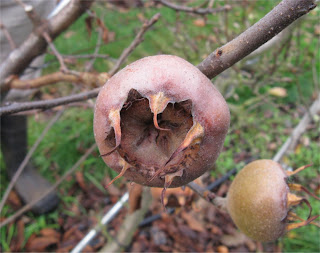
tea
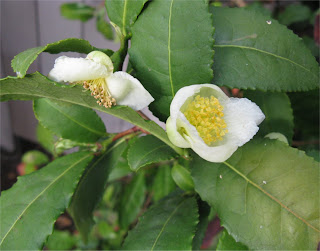
and lots of other things. His orange trees are in an unheated greenhouse, but everything else is outside. The lemons and a few other things are growing against a south-facing wall with a short glass roof to protect them from rain, and strings of old fashioned Christmas lights rigged to a thermostat set to kick in if the weather goes much below freezing.
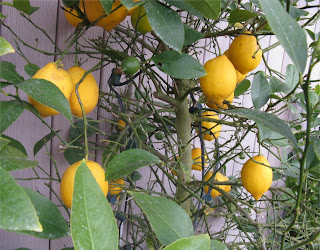
He’s testing the avocado tree to see if he can get fruit from it as he doesn’t want to sell anything until he’s proven to himself it will produce.
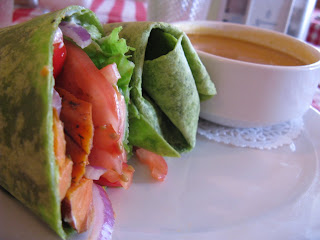
Afterwards it was lunch at The Roost, where we had some sweet potato/yam soup which tasted of honey, and vegetable wraps, with more sweet potato/yam inside.
Then I wandered into town to see the Village Butcher. When I looked in the phone book I counted a total of 6 independent butchers listed for Victoria and area, which says a lot about how dependent we are on supermarkets for our meat. No wonder we are out of touch with the source of our meat and the cuts that might exist beyond what supermarkets sell to us. The Village Butcher knows the source of all the meat on sale and specialises in free-range and naturally raised products. They sell a selection of frozen game and will do specialty cuts on request. And they make their own sausages (including Merguez, which excited me).
-
The future of fish
Read Full Post: The future of fishSeafood is as confusing a topic as any these days. Trying to get to the bottom of what is and isn’t a good choice of seafood is baffling and contradictory. Here’s an attractive guide for Europeans from The Guardian; and here’s some information from the Suzuki Foundation, complete with informative videos and links to sustainable seafood lists, adapted to different geographies.
But is it as simple as eating only this or that fish, when they do not exist in isolation? Humans are persistent in choosing to believe they can pick and choose from nature with no effect on its complex interrelationships. There is a whole aquatic food chain involved, and deeply affected by our choices; eating our way through multiple links in it is bound to cause unknown effects on all the ocean’s stocks.
Today I listened to a report on NPR about a study of acidity in the coastal waters just south of Victoria. It seems CO2 emissions are being absorbed at such a rate by our oceans that they are turning acidic much faster than supposed, bad news for acid-sensitive marine life like mussels, while ideal for acid-friendly life forms like algae; and down the line will corrode the shells and kill off other vulnerable shellfish including coral and plankton, way down at the bottom of the food chain – and what more important place is there? (Lots more on this in a 2006 report called Impacts of ocean acidification on coral reefs and other marine calcifiers)
Meanwhile, the Canadian Food Inspection Agency has published a new and interesting page of information for people wishing to peddle so-called “novel fish and fish products” in this country. Novelty is not so cosy a word as it used to be; nowadays this is food-regulation-speak for genetically modified and otherwise oddly manipulated food items. (A list of the “novel food decisions” going back to 1994 makes for uneasy reading.)
This led me down some time consuming side-tracks… I find myself wondering if the appearance of this information sheet might herald some potential movement on Canada’s part in allowing genetically engineered fish to be farmed here, just as the FDA has offered up some procedures for companies wanting to market genetically modified animal products in the US; and what happens next door usually spills across our border without a fight or much delay at all.
The 2008 March Status Report of the Commissioner of the Environment and Sustainable Development hints that this might be coming, even as it states that this country has no intention of developing a policy on transgenic aquatic organisms because it feels that the Canadian Environmental Protection Act, 1999 (with its Animate products of biotechnology section, and the Domestic Substances List (DSL)) covers the matter nicely thank you. Lots of reading there for interested parties.
And the complexity of all of that regulatory verbage explains why most of us haven’t a clue what genetically modified foodstuffs are and aren’t being fed to us; unfortunately for us, the politicians are as confused as the rest of us. And this CBC story from 2002 is as mercilessly true today as it was when it was broadcast. Beans and rice for supper, I think…
Anyway. Nancy Willard has written a great tribute to seafood in A Wreath to the Fish.
-
Where has the week gone
Read Full Post: Where has the week goneStarted off the week with a rather dispiriting set of facts from speakers at BCSEA’s monthly meeting, where the subject was peak oil. The first speaker was Ron Smyth (provincial government’s Chief Science Officer, Offshore Oil and Gas Branch and member of ASPO-USA) who ticked through the list of oil-producing countries, showing graphs that tracked the declining production of oil world-wide, and enumerated the percentage of GDP that oil represents for those countries, leaving us to imagine for ourselves the repercussions to national fiscal policies of the increasing loss of significant revenue over the next few years.
The impact, he predicted, would come in the next 5-10 years. It seems likely that instead of pouring money and research into developing sustainable energy sources, today’s short-sighted humans will keep looking for oil and turn back to carbon-unfriendly coal for the near term.
OPEC was at the heart of his presentation (with reference to Twilight in the Desert); he explained that these countries are madly developing infrastructure to secure their non-oil-rich futures: which – aluminum smelters, copper refineries and the like – require a lot of oil to build and run, and so will divert a lot of what would otherwise have been oil exports into increasing internal use. Leaving the non-OPEC world suddenly and dramatically short of oil. Again. With huge question marks dangling about self-sufficiency and living standards world-wide, given the seeming general lack of preparedness in this oil-happy era.
Consoled myself with some dim sum on Thursday, which I hadn’t eaten for quite a while. I was, in my tedious way, struck again by the perils of restaurant menus to the pure of palate. Where had these shrimp, this pork, that rice come from? Unlikely, at those prices, to have been organic or sustainably raised. Free associating now into visual feasts, note to self: must watch Eat Drink Man Woman again one of these days.
Thursday night I managed to get to the art gallery to catch the Rice is Life show, which closes today, and a talk by the curator, Paula Swart (Curator of Asian Studies at the Vancouver Museum) who showed some slides of pieces in the exhibit and photos of her travels around rice-producing nations, and recommended the book Seductions of Rice for the beauty of its photos and the range of its information and recipes. She talked about some of the religious and cultural aspects of rice: Inari shrines in Japan, Dewi Sri in Bali, Mae Phosop in Thailand. As always where food is concerned, ancient methods – sustainable and back-breaking human labour – are eclipsed by the production possibilities of mechanisation and chemical and biotech research. California’s rice growers sow their seed by plane, which is faster but costs more – unless you have a plane and an endless supply of oil, I guess. If all you have is hungry people and lots of land, traditional methods work too. And as always you get what you pay for: cheap rice carries that inevitable deferred price tag of chemical contamination of the product, the soil and the water supply; poorly-paid labour; and declining nutritional value.
Friday was Fred Stenson‘s
reading in Sidney; his co-star was not Rachel Wyatt as originally billed, but Jo-Ann Dionne who read from Little Emperors, her memoir about teaching English in China. Fred was reading from his latest, The Great Karoo, about Canadian soldiers in the Boer War.
And last night I had friends to dinner, for which I made a welcome journey out the Saanich Peninsula visiting my favourite farm shops — and saw this handsome display at Farmer Dan’s:

and served a seasonal and mostly local meal, finishing with this dessert which I’d been wanting to try for some time: pumpkin kheer, for which I used a combination of butternut and sweet mama squashes, seasoned with cardamom and topped with toasted cashews.
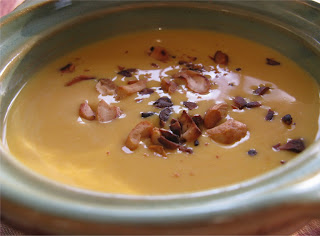
It was good; basically a cold, sweet soup to finish on, surprisingly filling.
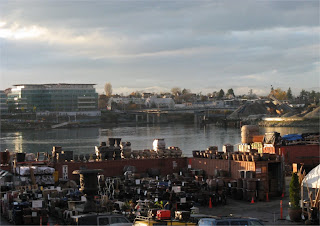
Here’s a photo of an afternoon view across the parking lot of my favourite Victoria store: Capital Iron, long may it continue.


Latest Posts
- Writers at Word!
- Sublime and Twisted Readings coming up!
- Sublime
- Good weather for reading
- The world, the world
- Sublime launch!
Aldeburgh Poetry Festival Barny Haughton BBC BC poets Berkswell blackberries Black Stilt Bologna book launch Borough Market Carlo Petrini Catalonia Cyrus Todiwala dairy Daunt's Books Dijon Edinburgh Fanny Bay Feast of Fields Food and Morality food history food journalism Jenna Butler lardo Malahat Review Michael Pollan Okanagan olive oil tasting olive trees Omnivore's Dilemma Our Food Our Future Oxford Parmigiano-Reggiano Planet Earth Poetry poetry poetry readings Poetry videos prosciutto salumi Sean O'Brien Suffolk ticks Wendy Morton Wired Writing Yvonne Blomer
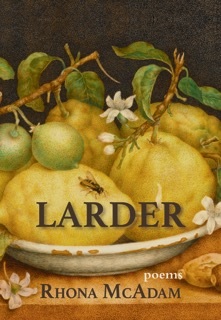
In her latest collection, Rhona McAdam navigates the dark places of human movement through the earth and the exquisite intricacies lingering in backyard gardens and farmlands populated by insects and pollinators, all the while returning to the body, to the tune of staccato beats and the newly discovered symmetries within the human heart.
“…A beautiful, filling collection, Larder is a set of poems to read at the change of the seasons, to appreciate alongside a good meal, and to remind yourself of the beauty in everything, even the things you may not appreciate before opening McAdam’s collection….”
Rhona McAdam is a writer, poet, editor, and Registered Holistic Nutritionist with a Master’s in Food Culture from Italy and a deep-rooted passion for ecology and urban agriculture. Her work spans corporate and technical writing to poetry and creative nonfiction, often exploring the vital links between what we eat and how we live. Based in Victoria, BC, and available via Zoom, Rhona is always open to new writing commissions, readings, or workshops on nutrition and the culinary arts.