-
On the ground in England
Read Full Post: On the ground in EnglandSafely in England once more where I arrived on a windy, sunny day, and where it’s been the quintessential English weather ever since: cloudy with sunny periods and a chance of rain.
Only a couple of days on the ground, I’ve had a nice bowl of lentil and coriander soup at my dear old wine bar, but otherwise not eaten out. And why should I when the food at home is so good? Tina made us an excellent supper
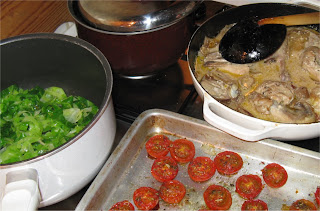
of guinea fowl in wine sauce last night, with roasted cherry tomato halves, boiled new potatoes and sweetheart cabbage,
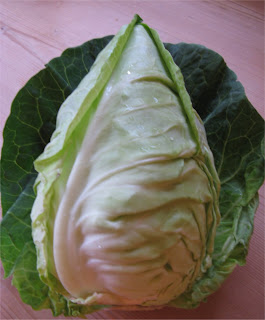
which looked pretty cool but didn’t offer anything wildly different in terms of flavour.
Just before I left, Mary kindly sent me this link to an excellent article about the state of fruit these days. I thought this bit said its piece neatly:
..the supermarkets demand that fruit is picked long before it ripens: it doesn’t soften until it rots. This makes great commercial sense. It also ensures that no one in his right mind would want to eat it. But, happily for the retailers, we have forgotten what fruit should taste like.
And vegetables, too, and I’m sure I’m not the only one who’s noticed. One of those attending the food issues town hall meeting told us that if you pick your fruits and vegetables before they’re ripe (to allow them to be transported and stored by supermarkets) you are also losing the nutritional value they would have if allowed to ripen naturally. So we are at double nutritional risk: picking today’s worsening quality fruits and vegetables (bred for higher yields and durability rather than flavour and nutrition) at less than their peak nutritional stage of ripeness.
I’ve also made a first irresponsible visit to the Oxfam Bookshop where I found a copy of So Shall We Reap, by Colin Tudge who I’ve heard speaking well about food issues on Radio 4. Much to think about in these pages, like:
…at bottom, the problems of humanity as a whole are those of biology. If we really want to survive in the long term (and ten thousand years is ‘the long term’; not the thirty year projections of conventional economics) then we have to begin by thinking of ourselves as a biological species, Homo sapiens, and the earth as our habitat; not simply a stage, or a tabula rasa, on which we can impose any manner of fantasy and whim. We need to see that farming must march to its own drum – that of ‘good husbandry’, founded in sound biology, and steered by respect for human values; and that this in many practical ways runs totally counter to the modern mantra which says, in the chill phrase I have heard so often these past three decades, that ‘agriculture is just a business like any other’.
Which reminded me of the chill phrase that I have heard too often, that poetry or literary publishing should also be seen ‘as just a business like any other’ – which is not and has never been true: there is and always will be a need for subsidy and public support if we want to see Canadian culture survive. The writers of Canada, and other artists, are taking action against recent well-publicised culture cuts by the country’s conservative government, which is about to announce an election. There’s a new website, Department of Culture, to help promote cultural causes in the electoral battle.
Looking ahead, I’m going to a food poetry reading tonight, and on Monday I will disappear off to Shropshire for the week, to attend a food writing workshop.
-
Not all Zoom & gloom
Read Full Post: Not all Zoom & gloom… though I was not happy to learn the airline on which I was booked to fly next Friday had gone the way of the fairies. Still, I’m rebooked now and looking forward to kissing the English ground once more in a week or so.
It’s been busy busy here – blackberries to jam, tomatoes racing against time to ripen for me before I leave, potatoes growing… berries! I know I am berry-obsessed but even I was a little startled to see these peeking out of the tater patch
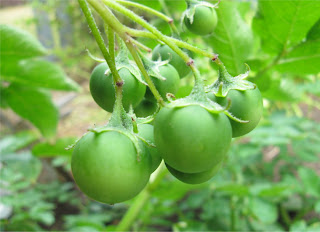
but a little swift research told me potato berries are nothing to be alarmed about and are part of the natural cycle of spuds, but the plants are usually dug up before they fruit. The fruits can be saved for seed much like a tomato plant, apparently.
Other entertainments include a town hall meeting last week in Victoria, at the invitation of Victoria’s one and only NDP member of parliament, Denise Savoie
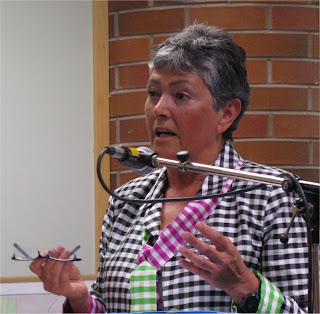
with NDP agriculture critic Alex Atamanenko, where a room packed to the ceiling with farmers and foodies

rocked and rolled and got excited about food security issues that affect an island like ours. There was a lot of talk about the potential effects of a food crisis on an island that imports 95% of its food, and about the very interesting observation that here, where 90% of the population say they garden, only 10% of those gardeners grow any food. I had also heard earlier that there are only 5 or 6 full time farmers on the Saanich Peninsula’s dozens of farms. One organic farmer, David Chambers

spoke forcefully on the desperate need to inspire and reward young aspiring farmers so that there is someone to carry the growing and farming knowledge into the next generation.
Writer/editor/farmer Tom Henry
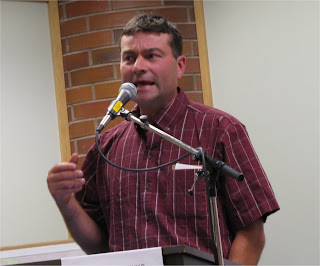
was representing small farmers and talked about the difficulties small producers have in meeting the stringent requirements of national grocery chains: they are not growing in sufficient volume to be able to produce only those perfect fruits and vegetables picky shoppers have been encouraged to demand. Which is only one reason you don’t find more local food in your local supermarket.
Other speakers talked about community gardens and the need to introduce bylaws to allow the growing of food on every available piece of common land. As Carolyn Herriot said, if there’s a food crisis on the mainland, do you really think anyone’s going to stop and put food on a boat for us? A model of self-sufficiency (she achieved it in five years), her proposals include planting edible ornamentals, saving seeds, and acquiring the skills to grow food all year round.
Doing my small part this special year, here are my first ever spuds, and I think they’re beautiful:

Sunday saw a lot of rain, and a lunchtime visit to Merridale Cidery
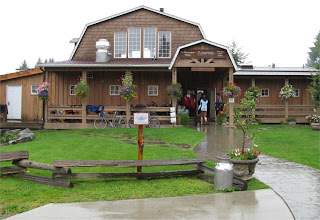
where the wood fired oven was making its presence a little too obvious
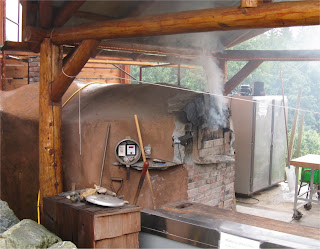
right into the dining room. We didn’t pause for a tasting
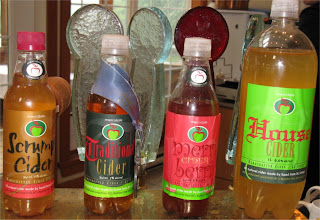
as we’d done that a couple of years ago, but we did settle down for a lovely lamb burger
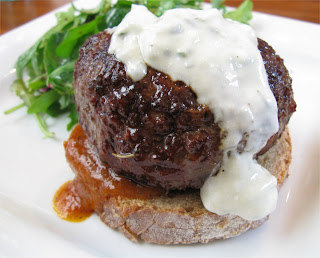
before the drive back over a more than misty Malahat.
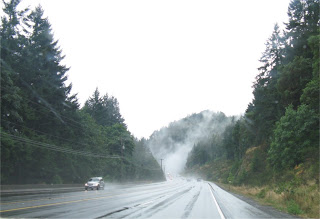
Yesterday was dry and fine and perfect for driving to Duncan to visit the dentist. After which, a little lunch with Shirley in Maple Bay where her potentially prize-winning succulents were blooming
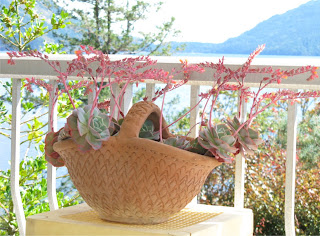
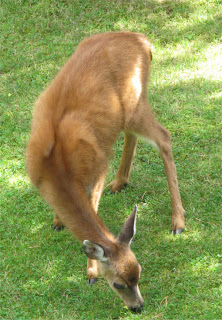
safely out of reach of the chief garden pest, looking a little thin we thought, as it trimmed the clover.
-
The pit
Read Full Post: The pitSpent last Sunday learning about pit cooking – and many other things – from the wondrously encyclopaedic Nancy Turner. It was a Slow Food Vancouver Island event, and about 20 of us made the schlep out to Sooke Harbour House where the sun shone while we shivered on the shore, grateful in the end for fire.
Although the pit had been dug for us (phew) by some Wwoofers, it was apparently too big, so had to be filled in a bit.

The next point of business was to find some smaller rocks for cooking: the large rocks were deemed suitable for lining the pit, but the food itself had to sit on smaller rocks, preferably lava, and without any cracks.
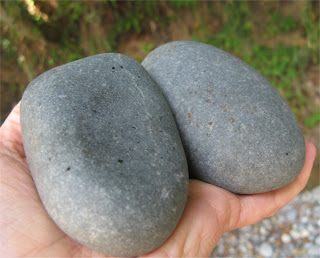
We lined the pit

and started the fire with some of Nancy’s fuzz sticks which made light work of kindling.
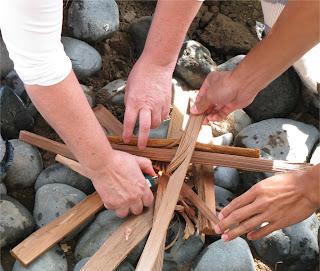
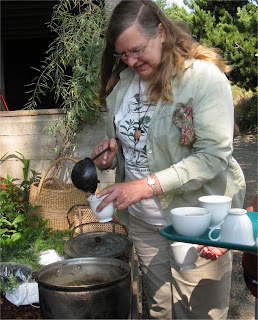
While the fire gathered heat and warmed up the rocks to cooking temperature, Nancy entertained us with some interesting foods. She brewed us a nice pot of Labrador tea, which also included other local delicacies like nootka rose, stinging nettle, yerba buena, subalpine fir, liquorice fern root (a powerful sweetener), dried saskatoons and dried yarrow.

Onto the fire it went.
And it simmered away while we had a nice snack of bannock, molded onto green sticks
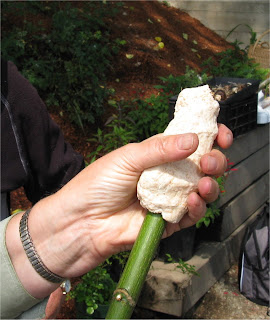
and toasted over what was now getting to be a very hot fire.
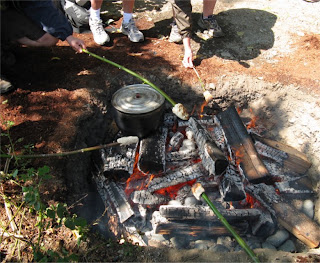
Tea time.
Then there was a nice snack of porphyra, a near relative of nori, which had been harvested in the Broughton Archipelago and then dried

and was particularly tasty toasted on the bannock sticks.
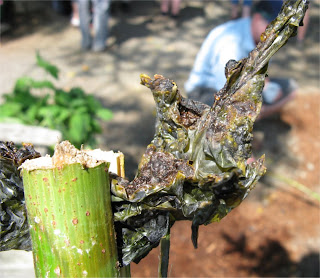
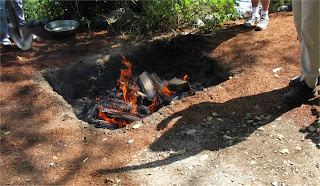
Eventually all was ready,
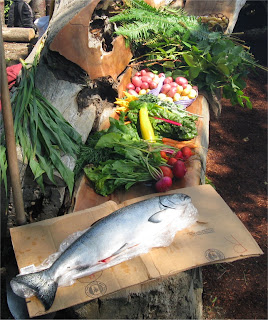
the fire was hot enough,

and Nancy gave us a thorough briefing, as the pit and food have to be assembled quickly and in sequence.
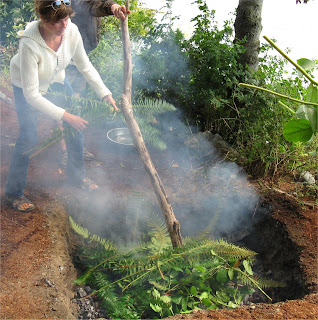
With a pole to guide the laying of food, the rocks are covered with ferns and salal branches…
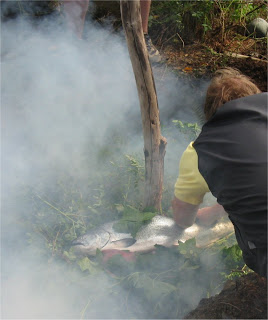
the salmon goes on…
add some shellfish, veg
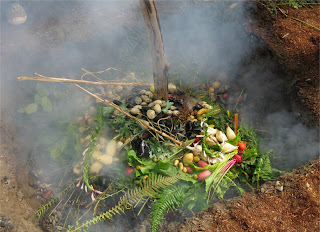
and a bowl of water (the cooking method has more to do with steam than fire)

cover it all up with more ferns, more salal branches, and top with soaked burlap
then shovel dirt over all
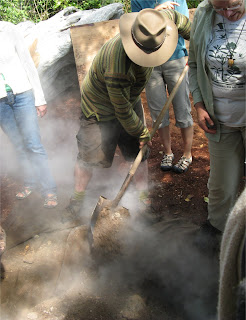
until it’s completely covered.
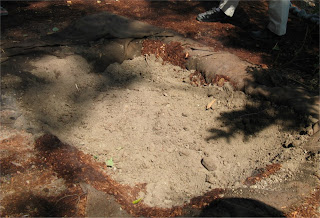
At the end of the cooking time (in our case a somewhat excessive 4 hours or so, but in large traditional pits as much as 24 hours), uncover — carefully
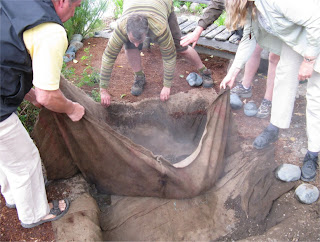

and decant the food onto platters
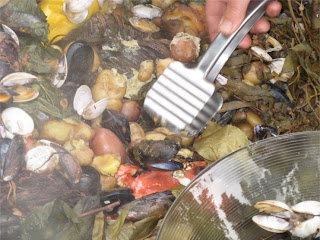
and lay it out
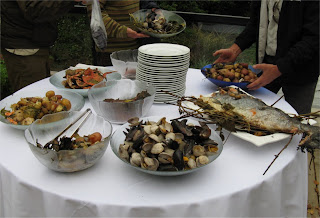
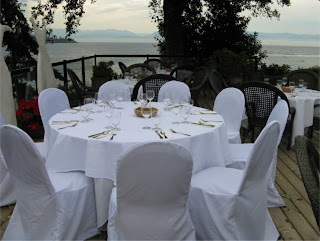
to enjoy in a gorgeous al fresco dining area
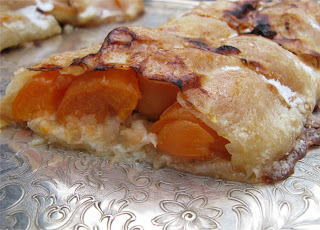
and finish with some of Sooke Harbour House’s excellent desserts.


Latest Posts
- Writers at Word!
- Sublime and Twisted Readings coming up!
- Sublime
- Good weather for reading
- The world, the world
- Sublime launch!
Aldeburgh Poetry Festival Barny Haughton BBC BC poets Berkswell blackberries Black Stilt Bologna book launch Borough Market Carlo Petrini Catalonia Cyrus Todiwala dairy Daunt's Books Dijon Edinburgh Fanny Bay Feast of Fields Food and Morality food history food journalism Jenna Butler lardo Malahat Review Michael Pollan Okanagan olive oil tasting olive trees Omnivore's Dilemma Our Food Our Future Oxford Parmigiano-Reggiano Planet Earth Poetry poetry poetry readings Poetry videos prosciutto salumi Sean O'Brien Suffolk ticks Wendy Morton Wired Writing Yvonne Blomer
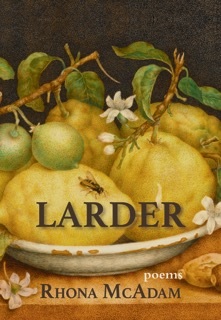
In her latest collection, Rhona McAdam navigates the dark places of human movement through the earth and the exquisite intricacies lingering in backyard gardens and farmlands populated by insects and pollinators, all the while returning to the body, to the tune of staccato beats and the newly discovered symmetries within the human heart.
“…A beautiful, filling collection, Larder is a set of poems to read at the change of the seasons, to appreciate alongside a good meal, and to remind yourself of the beauty in everything, even the things you may not appreciate before opening McAdam’s collection….”
Rhona McAdam is a writer, poet, editor, and Registered Holistic Nutritionist with a Master’s in Food Culture from Italy and a deep-rooted passion for ecology and urban agriculture. Her work spans corporate and technical writing to poetry and creative nonfiction, often exploring the vital links between what we eat and how we live. Based in Victoria, BC, and available via Zoom, Rhona is always open to new writing commissions, readings, or workshops on nutrition and the culinary arts.