-
Salone tastings: Milan and Paris
One of the great joys of Salone del Gusto is the opportunity to have some real face time with some of the foods that in their vast numbers tend to overwhelm one in the exhibition halls. For an hour or so you can rest your feet, meet some producers, and learn about their wares.
Urban agriculture has been on my mind in recent years, so I was happy to see a series this year called Feeding the City, which offered panels from Berlin, Milan and Paris. I couldn’t make the Berlin one, but I had two very different experiences in the others.
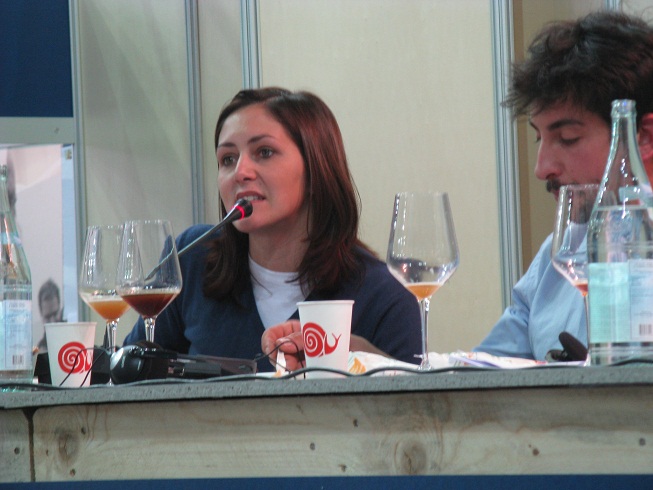
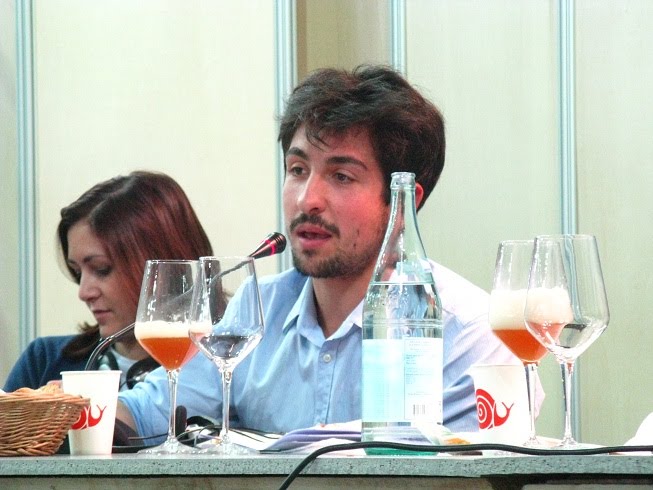
Milan put on an excellent show. A panel representing Nutrire Milano (Nourishing Milan) explained the idea behind their project, which was to see if it was possible to feed the city with food from the local area, a maximum of 40 km from the city centre. They brought a variety of products that used such products as raw milk, fruits, vegetables, honey and cured meats.
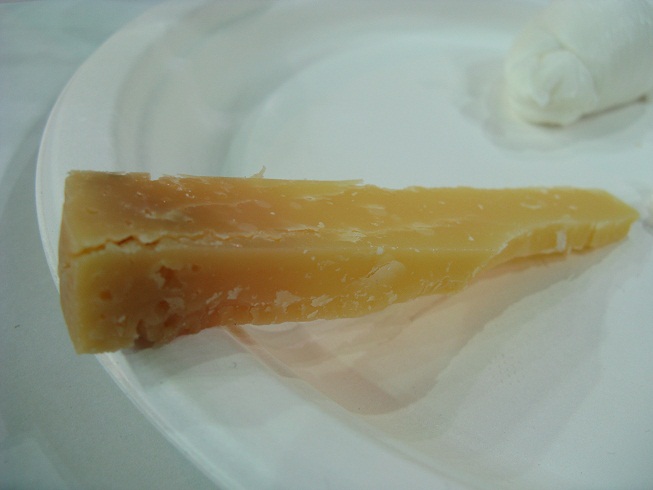
Two young cheesemakers offered us some excellent ricotta and mozzarella, and some sublime aged (2 years) cheese made from Jersey milk.


Another youthful producer
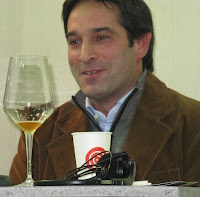
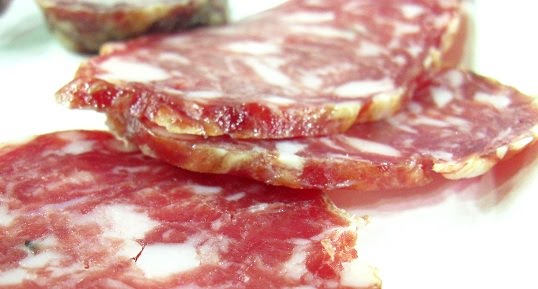
who is learning sausage-making from his octogenarian grandparents introduced his salame (Filzetta – named for the casing),
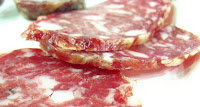
Cotechino (normally served warm, but logistics dictated the circumstances)
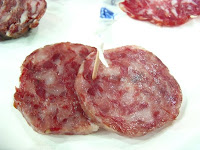
and liver mortadella, which had been ground with mortar and pestle in a method used before mechanization.

He uses natural curing in his half-dozen varieties, which are made between September and April (not in the summer when it would be too warm).
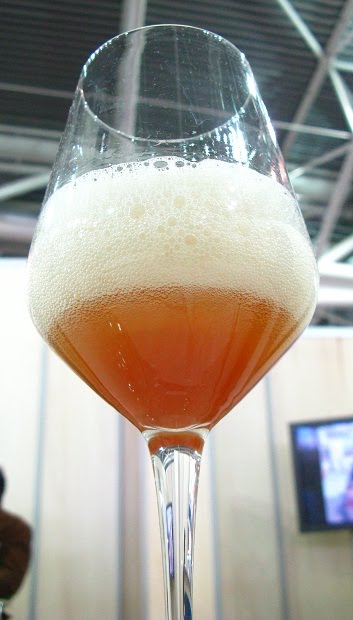
The monks were cloistered, so couldn’t come to introduce the beers themselves. They are Benedictines, who learned the brewing methods from Trappists, and ferment the beers in the bottle (like champagne). We had an amber and a dark one


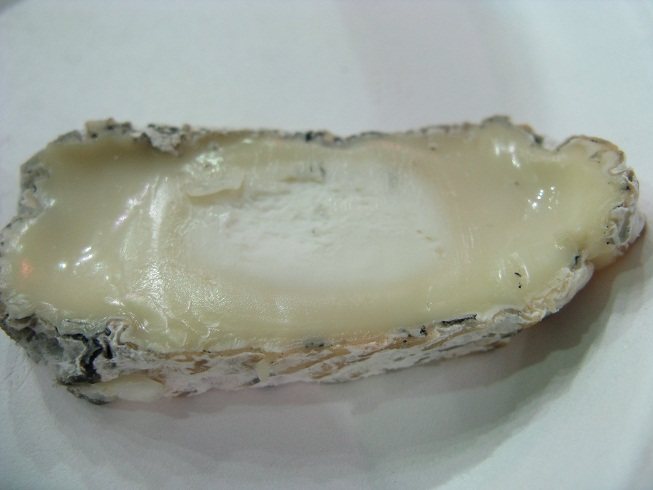
The maker of the goat cheese selection wasn’t there, but her handiwork was excellent.
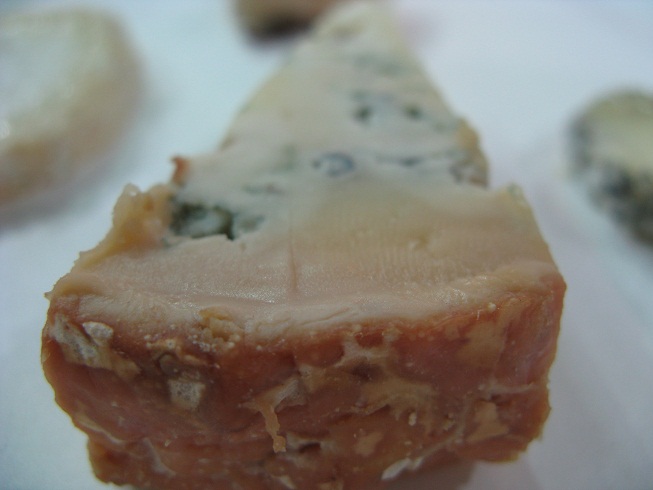
We had two variations of Tronchetto, one coated in ash and the other a blue.
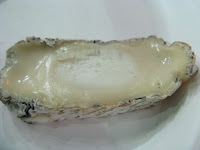

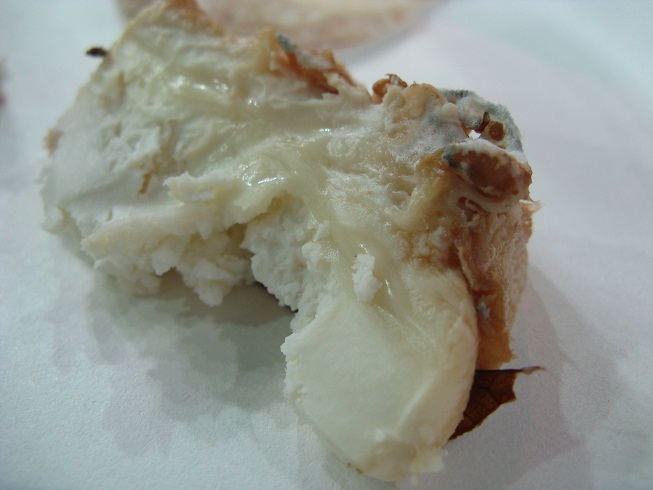
And one that had been aged in chestnut leaves.
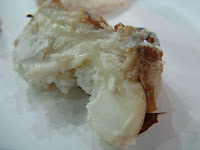
Mauro the apiarist urged us to save some of the goat cheese for tasting with the honeys he’d brought, observing that the bitterest (chestnut) was excellent with aged and blue cheeses (he was quite right).
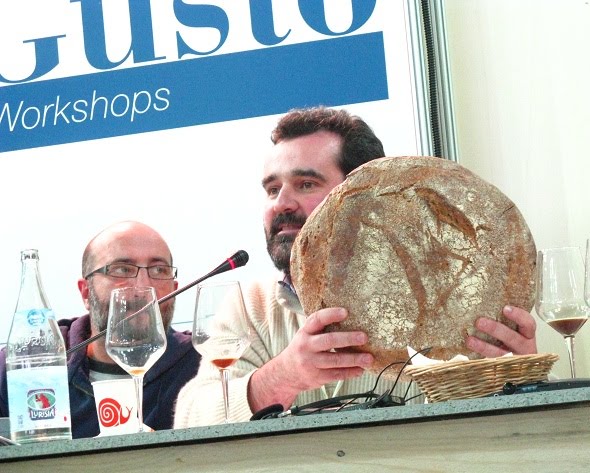
The honeys were (clockwise from the lower left): acacia, millefiore, tilia cordata (wild linden), castagno (chestnut), melata (honeydew). It was served with bread made from flour grown around Milan
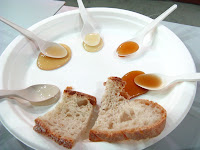
and baked by Davide Longoni who pointed out the connection between the words pane (bread), padre (father) and fame (hunger). His bread is big and broad; the kind of food for which you need a table, company and good wine, he said. He said it was flawed but he was learning how to work with the flour – the know-how of working with local “extreme” flours (with little gluten) to make traditional breads has been lost – but he hopes one day to produce loaves he’s happy with.
The Paris tasting could not have been more different, in every possible way. A sell-out crowd gathered, each relieved of 40 euros for the privilege of being there to – as it turns out – drink some beer and cider
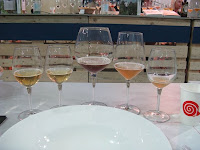
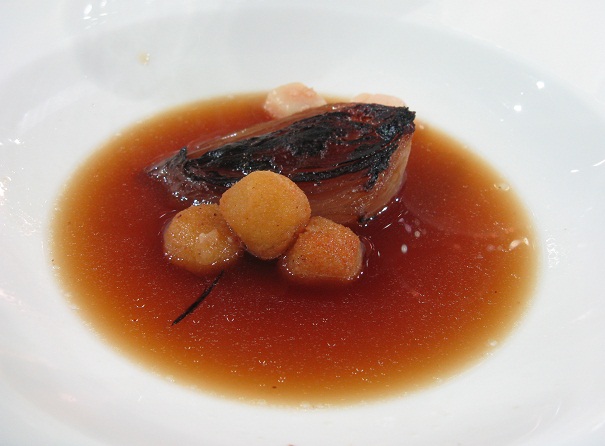
and (to be cruelly blunt) eat a bit of clear broth with half a charred onion floating in it.
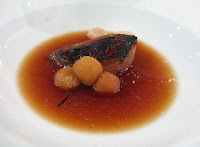
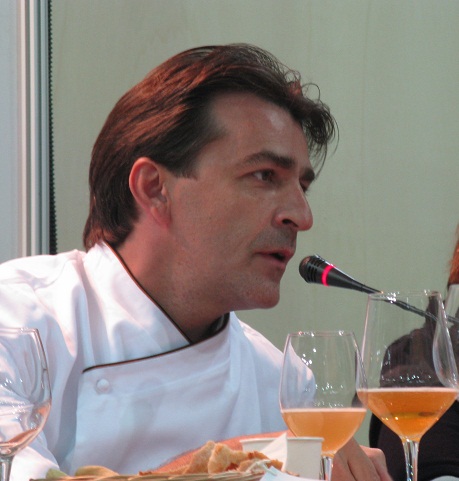
It was good, but the experience left a definite bad taste in the mouth. Even the translation was crazy, after a commendably seamless week of simultaneous translation. Speakers said their bit in French; notes were taken and translated into Italian, which was then translated into English. Though we could pass the time looking at handsome slides from the handsome book that Michelin-starred chef Yannick Alléno
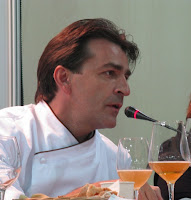
was flogging. Much was made by the panel host of the strikes in France and the difficulties of getting the panelists to their flights which had apparently been booked with odd timing that managed to cut the proceedings short. It is a shame the panelists hadn’t managed to pack a few more ingredients in their bags; I ended up feeling the same sense of rip-off that I have felt eating in Parisian restaurants. No, not all of them. But this was really no place to short-change your customers.
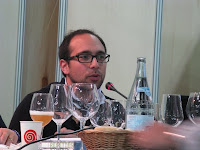
No “feed the city” sentiment at work here either. The young beerseller, SimonThillou (La Cave à Bulles) had knowledge and affection for the beers and ciders, Ok, admitting cliched expectation here but I was looking forward to a fleet of French wine, so the locally produced (from imported ingredients) beers and ciders – a bit sweet for my taste – from apples grown in the Isle de France, were disappointing.

And Samuel Nahon’s Terroirs d’Avenir caters mostly to high-level chefs like Alléno. So how commendible is it to source local (Isle de France) artisanal product for a niche and exclusive market? Not sure; not (as I grumble) that we saw much of it. He declined to expound on difficulties he’d encountered, and simply explained that he’s providing a guaranteed market for low yield or “ugly” but delicious fruits and vegetables, and giving Parisians a chance to taste foods known by their grandparents. He does sell to the public somewhat spontaneously in “marchés éphemères” (pop-up markets) as well.
-
Shame on Candian Conservatives (again)
Info and action – www.cban.ca/474
PRESS RELEASE For Immediate Release
Conservatives Shut Down Debate on Biotech Harm to Farmers
Parliamentary hearings cancelled to protect biotechnology corporations
October 28, 2010, Ottawa – Today, House of Commons Agriculture Committee hearings on Private Members Bill C-474 – dealing with the issue of genetic engineering – were cancelled and invited witnesses were turned away because, last night, Conservative Members of Parliament voted down a motion to extend debate on the Bill. The motion to extend the debate by 30 days was defeated by just 4 votes.
Bill C-474 would support farmers by requiring that “an analysis of potential harm to export markets be conducted before the sale of any new genetically engineered seed is permitted.”
“The Conservatives ended the debate in order to protect the biotech industry from any more scrutiny,” said Lucy Sharratt, Coordinator of the Canadian Biotechnology Action Network. “This Bill spurred the first real debate in Parliament over the negative impacts of genetically engineered crops and that’s why Conservatives shut it down.”
“The vote to extend the hearings should have been an uncontroversial procedural matter but the Conservatives made a calculated political move to save biotech corporations like Monsanto from the spotlight,” said Sharratt. “The debate was exposing the reality that some genetically engineered crops can cause serious economic harm to farmers and the Canadian economy, and our government currently has no legislative way to stop economically harmful GE crops.” Farmers are at risk when GE crops are commercialized in Canada without also being first approved in our major export markets.
This morning’s Agriculture Committee hearings were cancelled and National Farmers Union President Terry Boehm, who was invited by the Committee to testify, was turned away. Boehm traveled from Saskatchewan and planned to speak in favour of the Bill. Many more witnesses, including other farm leaders, will now not have a chance to present to the Committee. The Committee has already heard strong testimony in support of Bill C-474 from organizations representing conventional alfalfa growers. The growers are predicting that Monsanto’s GE alfalfa will harm their markets. “The debate was making it increasingly harder to justify a position against the Bill,” said Sharratt.
The final vote on the Bill could be called within weeks. The Bill was introduced by Alex Atamanenko, the NDP Agriculture Critic and MP for British Columbia Southern Interior.
-30-
For more information: Lucy Sharratt, Coordinator, Canadian Biotechnology Action Network, 613 241 2267 ext 6; cell: 613 263 9511 coordinator@cban.ca
-
Terra Madre: GMOs, nutraceuticals, organic/biodynamic farming
I paid a fleeting visit to a session on GMOs, functional foods and nutraceuticals, both areas of concern for Slow Food, whose No-GMO campaign was visible during the week.
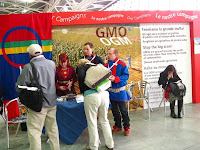
A few snippets:
- more is spent on marketing than researching GMO products;
- GMO is a technology of failure, because only 4 plants have been successfully modified since 1987, and these use the same processing methods as the nineties, so no advancement in the ten years 1997 to 2000;
- plants evolve in ways that GMO do not; there is the same cross contamination between regulatory bodies and biotech firms in Europe as there is in the US, for example the marketing manager for Syngenta came from the European agency responsible for risk analysis and testing of GMOs.
- the “3 sisters” (why the feminization?) Monsanto, DuPont and Syngenta with the other five (including Pioneer, Hasbro, Sogeti) control most of the seed companies in the world, and have made alliances with pharmaceutical companies who develop fungicides;
- and that Monsanto earns more from royalties than it does from plants and seeds.
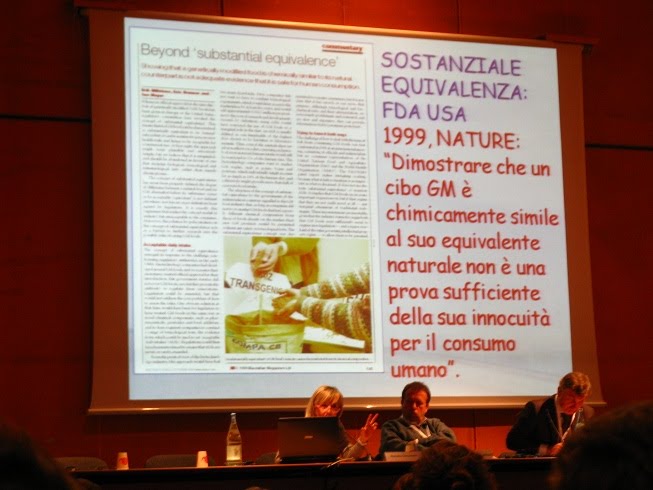
Manuela Giovannetti from the University of Pisa spent some time explaining the “substantial equivalence” myth

which has been contested since the nineties, and yet is still in use to allow GMOs into our countries. There are many other sources of information which call into question the science upon which the policies pursued by governments are based. And with that I had to flee to a tasting, about which more another time.
Paid an even briefer visit to the Earth Workshop on organic and biodynamic farming, which was underway when I arrived.

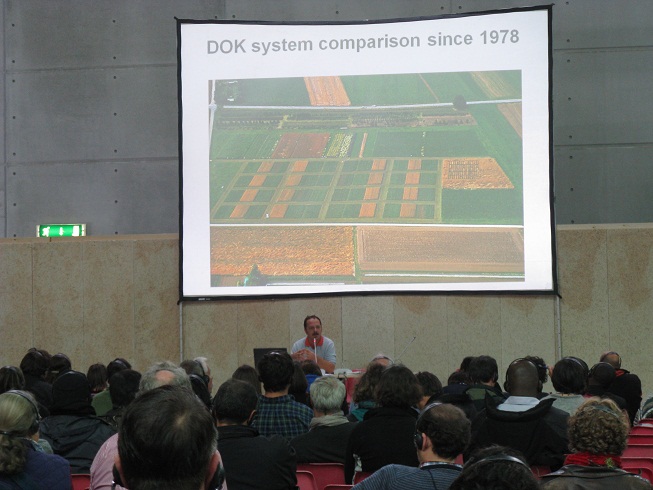
I caught some discussion of a 21-year study (1977-1998) in Switzerland which compared organic, biodynamic and conventional farming methods using 7 year crop rotations. The study was funded by government rather than multinationals, a dangerously rare situation nowadays. According to the speaker, the soil fertility findings were of particular interest because biodynamics came out far ahead of any other method, showing an increase in soil fertility, which he attributed to biodynamic methods of composting. The trials showed organic methods caused a drop in soil fertility of 10% over the 21 years; conventional methods, using chemicals as well as manure, dropped soil fertility 8%, and conventional using only artificial inputs dropped 15% while biodynamics increased soil fertility 1% (after an initial drop of 4%).












Latest Posts
- Sublime
- Good weather for reading
- The world, the world
- Sublime launch!
- Planet Earth Poetry – Readings by Volunteers, Victoria 2026
- Poetry at the Goldfinch
Aldeburgh Poetry Festival Barny Haughton BBC BC poets Berkswell blackberries Black Stilt Bologna book launch Borough Market Caerphilly Carlo Petrini Catalonia culatello Cyrus Todiwala dairy Dijon Edinburgh Fanny Bay Feast of Fields ferries Food and Morality food journalism Michael Pollan olive oil tasting Omnivore's Dilemma Our Food Our Future Oxford Parmigiano-Reggiano persimmons Planet Earth Poetry poetry poetry readings Poetry videos prosciutto salumi Sean O'Brien sensory analysis Suffolk ticks tortelli di zucca Troubadour Wendell Berry Wendy Morton Yvonne Blomer
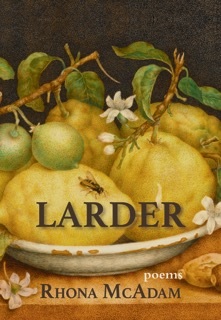
In her latest collection, Rhona McAdam navigates the dark places of human movement through the earth and the exquisite intricacies lingering in backyard gardens and farmlands populated by insects and pollinators, all the while returning to the body, to the tune of staccato beats and the newly discovered symmetries within the human heart.
“…A beautiful, filling collection, Larder is a set of poems to read at the change of the seasons, to appreciate alongside a good meal, and to remind yourself of the beauty in everything, even the things you may not appreciate before opening McAdam’s collection….”
Rhona McAdam is a writer, poet, editor, and Registered Holistic Nutritionist with a Master’s in Food Culture from Italy and a deep-rooted passion for ecology and urban agriculture. Her work spans corporate and technical writing to poetry and creative nonfiction, often exploring the vital links between what we eat and how we live. Based in Victoria, BC, and available via Zoom, Rhona is always open to new writing commissions, readings, or workshops on nutrition and the culinary arts.