-
Another Fabulous Food Fest
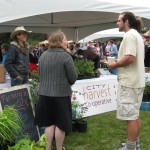
 Sunday dawned gloomy and grey and I feared we were in for yet another chilly drizzly day, but things had warmed and brightened considerably by noon when the ICC Food Fest opened its gates to a sold out mob of gastronomes. We were each equipped with glasses, boards and napkins and set loose in the grassy grounds of Fort Rodd Hill for an afternoon’s fine browsing.
Wine+beer tent queue There was a lot on offer, but not so much that a hungry diner couldn’t manage to sample it all at least once. Hungry and thirsty diners were pretty much out of luck, though, since the fine minds of the BC Liquor Control Board had deemed it necessary to sequester the alcohol into an undersized tent entirely separate from the food it was meant to accompany. This is the same sharp thinking that prevents the apparently uncontrollable drinkers of British Columbia from enjoying a glass of wine with their meal on the ferries, a task that Europeans have been managing for decades without mass drunkenness. And just last month I witnessed numerous brave Americans taking beer or wine with their otherwise unspeakable meals on one of the Washington State Ferries, and we all drove off that ship without any trouble.
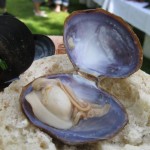
Aside from that, it was a relaxed and convivial affair. Taste with thine eyes. The varnish clam was a surprise – I’ve seen the shells on the beach but hadn’t been served one before. They’re an invasive species, one of the newer ones (though the other popular variety, Manila Clams, are also invasive) and quite tasty, though I still fondly remember the butter clams of my youth.
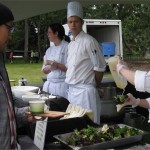
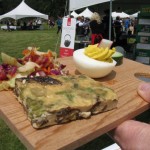
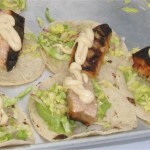
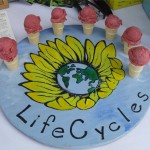
The veggie platter included an asparagus and morel frittata, which was delicious; so were the salmon tacos which tasted that much better after a lengthy queue while the fish was gentled on the bbq. And the LifeCycles plum gelato with its whisper of balsamic vinegar was excellent: it was made from urban fruit from the Fruit Tree Project.
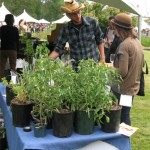
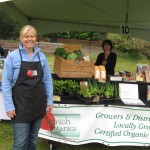
Farmers were there too: for the chefs revere the growers of their food. Farmer Mike Nyberg manned the Haliburton Farm stand; Heather Stretch and Rachel Fisher were on hand next door at Saanich Organics, where their very handsome and helpful book All the Dirt was on sale alongside the beautiful produce. And Farmer Derek Powell from Haliburton was spotted yukking it up with some City Harvesters.
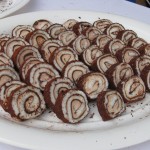
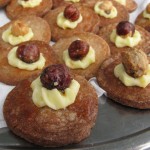
Best till last. There were some gorgeous sweets, including a a chocolate roll, a hazelnut biscuit, and some creamy crispy raspberry macarons from the wunderkind of VIU’s Culinary Arts program.

-
Silence, prawns and barley
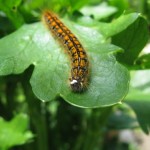
Tent caterpillar with 3 predatory tachinid fly larvae attached. I have been off-line for a while. In this space should have been some amusing tidbits from the Writers Union AGM which I unfortunately missed in its entirety due to what I am calling Italian influenza, since I received it from someone who brought it back with her from Rome.
I have passed the time of my recovery (and then some) picking tent caterpillars off my roses, blueberries and rhubarb. Not nearly enough of them have the tachinid fly larvae attached, but those that do seem to have two or three, which is hopeful, as the tachinids are helpful against caterpillars of many kinds, so I’m letting those afflicted eat their fill before they get the last headache of their lives.. and will be planting lots of tachinid-friendly plants like dill, parsley and Queen Anne’s Lace.
Meanwhile, BBC has been broadcasting Strands on its Book of the Week (sigh.. I remember when CBC used to have such offerings) by poet Jean Sprackland. In the second installment, she discusses the effects of anti-depressants on prawns. The excess fluoxetine excreted by Prozac users ends up in the ocean. It affects prawns by causing them to throw caution to the winds and swim towards the light… whereupon they become easy pickings for predators. This chemical also affects reproduction in mussels and has been found in fish near Montreal. Who knows, after that, how the fluoxetine travels through the food chain.
Add this to what we already know – the effects on fish of excreted birth control pill hormones, the drugs that we’re obliged to ingest through drinking water and produce grown in fields fertilized with sewage sludge – and to all we don’t yet know about the effects on other organisms.
In this anthropocentric world, we have invented a reality in which curing human ailments trumps any effect on other living beings. There are no legal checks on pharmaceutical companies to prove their products will not harm other species, or even humans who find them in their drinking water or vegetables down the line. Surely it’s long past time big pharma should be required to prove its products will not harm the rest of our ecosystem?
I have become a barley bore while plodding away these past few weeks on an article that will appear in a future issue of Small Farm Canada. I had a lot of great information I couldn’t include so here are some of my overflow facts that prove barley is the best thing ever:
- Our oldest grain, barley has been cultivated for around 10,000 years: it was found in Egyptian tombs and has a long and varied history, as a grain, a flour and a beer starter among others.
- It’s the grain highest in beta glucan, a soluble fibre which slows digestion of glucose, making it helpful for diabetics, and is getting attention for potential in fighting obesity and heart disease.
- In Nepal and Tibet tsampa (sampa) is a staple: toasted barley flour that is mixed with yak butter to make a nutritious (B vitamins, minerals and of course that all important beta glucan) bread or cake called pa. (A disheartening news item in the Nepali Times reports that tsampa is losing ground to instant noodles which are nutritionally bankrupt. The result of course is an increasingly malnourished population.)
- In parts of India, the beverage sattu is made of roasted barley, wheat/rice/chickpea flour, jaggery (raw sugar) and water. It’s quenching, nutritious and a long established fast food for travellers.
- In the British Isles, barley water is an old traditional drink whose benefits are said to include: clearing the complexion, preventing wrinkles, soothing the digestion, cleansing the kidneys, curing cystitis, treating atherosclerosis and preventing gallstones.
- In Italy, roasted barley is brewed as a coffee substitute: caffe orzo (not to be confused with the pasta)
- Roasted barley tea is called mugicha (麦茶?) in Japanese, dàmàichá (大麦茶) or màichá (麦茶 or 麥茶) in Mandarin Chinese, and boricha (보리차) in Korean.
- Barley has been studied for use in bioremediation:
- Bioremediation of coal bed methane product water
- Bioremediation of CCA-treated wood (using malted barley as a nutrient source for the metal-tolerant bacterium Bacillus licheniformis)
- Barley is a metallothionein (as are wheat, peas and soy): in animals they have been shown to bind copper, cadmium, zinc and silver and to detoxify normally lethal concentrations of cadmium and copper in yeast
- Barley is salt-tolerant and has been used to extract sodium chloride to reclaim sea water-flooded fields (it’s being studied as a way to remediate the tsunami-damaged farmland in Japan)
- Barley is thought to be an aluminum hyperaccumulator.
- Barley straw is a traditional treatment to prevent blue-green algae in ponds.
-
Skagit River Poetry Festival
 It’s been a brilliant couple of days in La Conner WA, and the weather likewise. Cool blue skies over a flock of talent at this biennial event. Tonight’s readings by Nikki Giovanni, Bob Hicok and Marie Howe were dazzling.
After admonishing one and all to be sure to record and archive readings such as these, Giovanni explained to us mostly white folks what the agonies of hair care were for black women of her age, raised on flat ironed hair and a chronic fear of the moisture or heat that could bring the nappiness back. She had to explain to us what a “kitchen” was, so we could hear her poem The Wrong Kitchen.
Hicok ranged from proprietary leanings on his birth-decade, the Sixties, to the tender agonies of a mother with Alzheimer’s, a topic he’s worked before. His Speaking American was a delightful opener. We’d heard his name already in an afternoon discussion on humour in poetry, invoked by Tony Hoagland when he’d been asked whose poetry and sense of humour resonated (our own Lorna Crozier – brilliant in all the sessions I caught – cited Alden Nowlan and Susan Musgrave).
Howe finished the evening off with a painfully funny reading, including poems about her mother and her daughter, a new sequence about Mary Magdalene’s seven devils, and a poem she said she’d like to retitle After the Divorce.
The best session of this friendly little festival had to be the marathon reading this afternoon at which every invited poet (and there were 31 of them) read a single poem. The earth-shakers for me included Elizabeth Austen’s Untitled; Ellen Bass’s Gate C22, Jericho Brown’s Heart Condition, Karen Finneyfrock’s What Lot’s Wife Would Have Said (If She Wasn’t a Pillar of Salt) (possibly my favourite poem of the weekend); and Tony Hoagland’s The Social Life of Water.
Those of you who’ve heard me rant about festivals that cram poets into cattle-car readings rather than letting them roam the stage in twos and threes like prose writers may find my delight in this reading surprising. But here it was a sampler, an opportunity for a fully-packed autditorium to hear all the poets – not just those who the tight scheduling of a two-day festival would allow. And to hear poets of such calibre reading one fine poem after another was a pure pleasure.
So, one more day in La Conner, with its smart shops and casual oceanfront air.
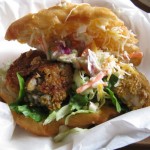 And its amazing oyster tacos from the Swinomish seafood kiosk, Legends Salmon Bar, which were so delicious in their frybread wrappers I had to have them for lunch two days in a row.
Latest Posts
- Sublime
- Good weather for reading
- The world, the world
- Sublime launch!
- Planet Earth Poetry – Readings by Volunteers, Victoria 2026
- Poetry at the Goldfinch
Aldeburgh Poetry Festival Barny Haughton BBC BC poets Berkswell blackberries Black Stilt Bologna book launch Borough Market Caerphilly Carlo Petrini Catalonia culatello Cyrus Todiwala dairy Dijon Edinburgh Fanny Bay Feast of Fields ferries Food and Morality food journalism Michael Pollan olive oil tasting Omnivore's Dilemma Our Food Our Future Oxford Parmigiano-Reggiano persimmons Planet Earth Poetry poetry poetry readings Poetry videos prosciutto salumi Sean O'Brien sensory analysis Suffolk ticks tortelli di zucca Troubadour Wendell Berry Wendy Morton Yvonne Blomer
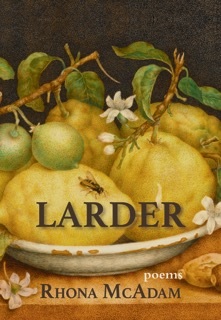
In her latest collection, Rhona McAdam navigates the dark places of human movement through the earth and the exquisite intricacies lingering in backyard gardens and farmlands populated by insects and pollinators, all the while returning to the body, to the tune of staccato beats and the newly discovered symmetries within the human heart.
“…A beautiful, filling collection, Larder is a set of poems to read at the change of the seasons, to appreciate alongside a good meal, and to remind yourself of the beauty in everything, even the things you may not appreciate before opening McAdam’s collection….”
Rhona McAdam is a writer, poet, editor, and Registered Holistic Nutritionist with a Master’s in Food Culture from Italy and a deep-rooted passion for ecology and urban agriculture. Her work spans corporate and technical writing to poetry and creative nonfiction, often exploring the vital links between what we eat and how we live. Based in Victoria, BC, and available via Zoom, Rhona is always open to new writing commissions, readings, or workshops on nutrition and the culinary arts.