-
Good spreads
I used to use Epicurious a lot, until they started littering their site with pop-up ads, including the kind that crawl up your screen till you click them away. But I recently revisited them and either my pop-up blocker works better these days or they’ve done away with the ads.
I see Epicurious’ editor has a blog now (you have to sign up for their mailing list to comment though) in which she discussed one of my favourite things from England, Marmite, and observed that taste preferences are somewhat polarised on the matter. There are those of us who think it is an indispensible item for the larder, and those who would only use it to poison the slugs, all of which is tastefully documented on Marmite’s own site.
Personally I think a lot of those who try it once and gag are simply using too much, in quantities appropriate to something milder, like peanut butter. But it’s very concentrated so must be spread very thinly to enjoy it properly; I think using lots of butter is also important. And it is a wonderful thing to have on hand to flavour soups and gravies: totally vegetarian and wheat-free to boot. Marmite has an interesting marketing campaign; what other brand actually sells sloganed (“J’déteste Marmite”) t-shirts to its detractors? And who buys them?
Once when I visited Amsterdam, a helpful local suggested I buy pindakaas as a good typically Dutch treat to take home. I had to tell her we already had peanut butter, which I suppose other countries might claim as typically theirs as well. Interesting , this proprietary pride in snack foods.
-
Music ‘n poetry
Just received my brochure for the Wired Writing Studio which starts with the Banff Centre residency October 2-14, 2006. A wonderful thing is Wired. Robert Hilles and Marilyn Dumont will be excellent poetry resources. Fred Stenson runs a comradely ship, with the hilariously droll technical support stylings of Chris Fisher. The food’s not bad either, and there are some great deals on concerts for participants: I began my lifetime of fandom to the Jaybirds early in my stay, and also attended a bone-shaking appearance by Steve Earle and the Dukes (I prefer him acoustic, thanks, but good to have had the experience). And the Calgary/Banff Wordfest happens during the studio time as well. Geez, what am I waiting for??
Among the many musical offerings we noticed in Austin, the best ones all seemed scheduled to begin after we left. The rodeo, the SXSW conference, everyone but AWP seems to schedule music. (Actually that’s not fair: there was a boogie night at AWP that we were simply too whacked to attend.) Playing in town after we left: Eliza Gilkyson, Ruthie Foster, The Gourds, Bela Fleck & the Flecktones, Lucinda Williams, Rhonda Vincent. It’s not fair it’s not it’s not. But I have to think, on the other hand, why do I know about these people? Because I have seen them play way up here, at the Vancouver Island Music Festival in Courtenay/Comox, and the Edmonton Folk Music Festival. All that is except Bela and he comes up here from time to time, so I live in hope. And except Lucinda, because you have to have some event to look forward to.
So I spent yesterday meditating on oulipo. It sounds like about as much fun as you can have with poetry, but I need more than that, or do I mean less, to move me in a poem, and I wonder at the wisdom of narrowing the readership of the already microscopic readership of poetry for the sake of intellectual gymnastics. Old fartism I suppose, and there are doubtless many fine, coherent examples out there I wouldn’t guess were oulipean. Christian Bok certainly made headlines with Eunoia a couple of years ago, each section consisting of poems made of words that use only one vowel. Damned clever it may be, but it’s not for me, except in small doses. There’s no getting around the fact you have to compromise the sense of a line when you’re performing that scale of legerdemain. Anyway, I found a charming interview by John Ashbery with Harry Mathews, the only American oulipoean, which was worth the journey.
So the point of all this was that we had to invent our own form and write a poem in it for last night’s class. I decided, since I was in sonnet mode, to mess with that. I took the end-rhymed words from an existing sonnet (arbitrarily chosen; I used Richard Wilbur’s Praise in Summer) and used them as the first word of each line of a new poem. To escalate the challenge, I decided to invert the metre into predominantly trochaic pentameter (which makes sense since the chosen words were stressed syllables from the end of iambic pentameter lines) and to rhyme as best I could the first word of the line with the last, so that the poem still rhymes (murderous rhyme scheme too: ababbcbccdcdaa), but it does so at both ends of the line, which pleased my symmetrical soul. Some of the rhymes had to be feminine rather than masculine, and a lot of them are very loose, but I did what I could. And I thought I should mirror, to some extent, the meaning of the source poem, so mine is a rant about winter. It took me so long to write it ended up being an imperfect first draft and I’m waiting for workshop feedback next week before I carry on working it, but I enjoyed the challenge.
-
Sonnets a-gogo
Double-barrelled week for me, this. I missed last week’s class on sonnets and am plunging in to the one on oulipo. Thought I’d catch up on last week by reading the always readable Don Paterson‘s introduction to his anthology, 101 Sonnets. He did not disappoint:
“Academics, in particular, have talked an awful lot of rubbish on the subject of rhyme; they often make the crucial error of failing to understand that the poem ends up on the page as a result of a messy and unique process, not a single operation.”
“Rhyme always unifies sense, and can make sense out of nonsense; it can trick a logic from the shadows where one would not have otherwise existed.”
“…[the sonnet is] a box for [poets’] dreams, and represents one of the most characteristic shapes human thought can take. Poets write sonnets because it makes poems easier to write. Readers read them because it makes their lives easier to bear.”
And the anthology is a little treasure, not least because of Paterson’s brief notes on each piece tucked away at the back of the book. So helpful to have had someone else do the brow-clutching and rhyme analysis for us.
I also enjoyed reading the American queen of formalism, Marilyn Hacker, who wrote the chapter on sonnets in An Exaltation of Forms. She notes that the North American rant against form often uses the sonnet as its kicking post, and that this scale of objection is absent from British and Irish debate “perhaps because the sonnet, if an ‘interloper’ from the Romance languages, nonetheless has five hundred years of history in their literature…” And nonetheless herself finds early and perhaps unexpected examples in American literature: Ezra Pound, H.D. and Gwendolyn Brooks.
What both poets say is that sonnets have had a bad rap, to be tagged as difficult and constricting. But poets, it seems – if the Oulipians are anything to go by – not only thrive on difficulty but invent it if it appears to be lacking in their lives:
Raymond Queneau, Oulipo’s co-founder: Oulipians are “Rats who build the labyrinth from which they will try to escape.”
As for eats, this week has been a wash since return from foodsville, TX. Not least because there’s been no time to get to the grocery store and I’ve been surviving on things I stashed in the freezer before I left, and a few limp vegetables that survived my absence. I did attempt cajun blackened ribs last night, but although they were acceptably spicy, I’d call them undistinguished. I think I prefer tomato-based rib recipes. The spice mix will be employed in further experimentation once the weather warms enough to bring out the barbecue.
 Anyway, Anton the awesome is returning for indefinite stay tomorrow. Maybe I’ll make him some Flea Fighting Biscuits to welcome him home? These rely heavily on garlic and brewer’s yeast to work their magic. Gives dog breath a whole new dimension…




Latest Posts
- Sublime
- Good weather for reading
- The world, the world
- Sublime launch!
- Planet Earth Poetry – Readings by Volunteers, Victoria 2026
- Poetry at the Goldfinch
Aldeburgh Poetry Festival Barny Haughton BBC BC poets Berkswell blackberries Black Stilt Bologna book launch Borough Market Caerphilly Carlo Petrini Catalonia culatello Cyrus Todiwala dairy Dijon Edinburgh Fanny Bay Feast of Fields ferries Food and Morality food journalism Michael Pollan olive oil tasting Omnivore's Dilemma Our Food Our Future Oxford Parmigiano-Reggiano persimmons Planet Earth Poetry poetry poetry readings Poetry videos prosciutto salumi Sean O'Brien sensory analysis Suffolk ticks tortelli di zucca Troubadour Wendell Berry Wendy Morton Yvonne Blomer
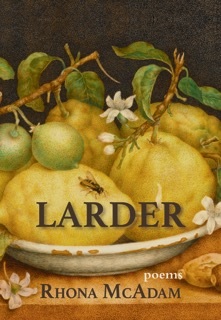
In her latest collection, Rhona McAdam navigates the dark places of human movement through the earth and the exquisite intricacies lingering in backyard gardens and farmlands populated by insects and pollinators, all the while returning to the body, to the tune of staccato beats and the newly discovered symmetries within the human heart.
“…A beautiful, filling collection, Larder is a set of poems to read at the change of the seasons, to appreciate alongside a good meal, and to remind yourself of the beauty in everything, even the things you may not appreciate before opening McAdam’s collection….”
Rhona McAdam is a writer, poet, editor, and Registered Holistic Nutritionist with a Master’s in Food Culture from Italy and a deep-rooted passion for ecology and urban agriculture. Her work spans corporate and technical writing to poetry and creative nonfiction, often exploring the vital links between what we eat and how we live. Based in Victoria, BC, and available via Zoom, Rhona is always open to new writing commissions, readings, or workshops on nutrition and the culinary arts.