-
Glosas & a few words about rejection
I’ve been working on a glosa arising from a quatrain by our late lamented high priestess of Canadian poetry, Gwendolyn MacEwen. An interesting thing, the glosa. Aside from Marilyn Hacker, who seems to have tried every form invented, you don’t really see them much by any but Canadian poets. That PK Page has a lot to answer for! In her inspiring collection, Hologram, she defines it as a stanza form, based on a quatrain by another poet, consisting of four 10-line stanzas where the 6th and 9th lines rhyme with the 10th. (Pah, child’s play, sez I after wrestling through 9 stanzas of terza rima..)
But my research tells me that it is also considered pretty much a nonce (love that word) form, also known as a glose (that seems to be how the Americans spell it) and that you can use any number or kind of lines as your starting point: they need not even be poetry. Neither is there any law that says the stanzas must be ten lines or follow any particular rhyme scheme.
The art of it is, I think, firstly to find a way to make the source lines your own, so that they have – fully – two lives; and secondly to walk a fine balance between bringing your poem to its own life and paying appropriate tribute to the source poet’s words. Choosing those source lines is difficult enough, and it’s good to know we can look beyond quatrains for them.
Rejection. Ouch: it never stops hurting, but I guess in this world so overcrowded with words we can’t write without it. One of the AWP sessions in Austin that I wasn’t able to make centred on The Resilient Writer, a collection of interviews with writers who survived to talk about rejection. Meanwhile, I found a blog about rejection by an editor who helpfully and comprehensively explains the nature and context of rejection letters… in a way that doesn’t hurt… TOO much.
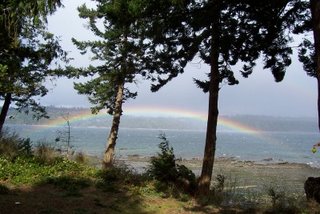
So up here in Fanny Bay we might not have escaped another day of rain, but we did get a bucket of oysters for supper last night, and this morning a real live rainbow!
-
Chicken and rhetoric
What I was really craving last night – and had defrosted a small flock of chicken thighs in anticipation – was Chicken Jeera, but too late discovered that the nub of ginger in my fridge was mummified beyond reconstitution. Claudia Roden to the rescue! Her Mediterranean Cookery has been endlessly helpful to me in the past, and last night she gave me Pollo al Rosmarino, which instructs that a couple of sprigs of rosemary and a couple of halved cloves of garlic be heated in a mixture of butter and oil, to which you add and brown your chicken pieces (I had 6 thighs), and then throw in a glass of white wine, some salt and pepper, and turn it down to simmer for half an hour. Very nice it was, molto facile; eaten with potatoes, onion and zucchini cubed and cooked in lemon, butter and garlic, with a bit of fresh asparagus, it was just the thing to end the day.
Anyone who read Jill Tedford Jones’ article about Elizabethan sonnets and country and westen lyrics may have been as intrigued as I by the sheer number of rhetorical devices named in the piece. We use them in our poetry all the time, without necessarily knowing what they’re called. Tedford Jones speculates that “the student in Queen Elizabeth’s day could probably easily identify and create more than a hundred such devices,” while I could define perhaps half a dozen. So I’m going to work through these ones, consciously injecting one or two (devices, not terms) into new poems, and who knows, if you’re really unlucky, perhaps make my conversation more polysyllabic from now on. I found a couple of helpful sites – American Rhetoric and The Forest of Rhetoric – to help me get started. Here’s my Greek chorus:
anaphora
anastrophe
anadiplosis
antanaclasis
antimetabole
antithesis
apostrophe
appositive
chiasmus
ellipsis
epanalepsis
epistrophe
hyperbaton
hyperbole
metonymy
onomatopoeia
parenthesis
paronomasia
polyptoton
polysyndeton
syllepsis
symploce
synecdoche -
Words and water
Just looking ahead to a weekend’s literary merrymaking in Campbell River. The Words on the Water writers festival, being held in the Maritime Heritage Centre, starts on Friday. Even with a disabled website (some tragically ill-timed mishap involving corporate changes in their service provider ownership, coupled with who knows what associated administrative problems) they’ve managed to sell out their weekend passes and their Friday and Saturday night events.
We’re hoping to get to the Saturday daytime sessions at least, which will feature Evelyn Lau, Jan Zwicky, Claudia Casper, Robert Bringhurst, David Carpenter, Annabel Lyon, Gregory Scofield and Patrick Lane.
Because we can’t get into evening readings, I reckon we’ll be forced out onto the cold wet streets in search of alimentary culture instead. One pilgrimage I am never too sorry to make when I’m in Courtenay is to Tita’s, which I bet is the best Mexican food on Vancouver Island, or I’ll eat my sombrero.


Latest Posts
- Sublime
- Good weather for reading
- The world, the world
- Sublime launch!
- Planet Earth Poetry – Readings by Volunteers, Victoria 2026
- Poetry at the Goldfinch
Aldeburgh Poetry Festival Barny Haughton BBC BC poets Berkswell blackberries Black Stilt Bologna book launch Borough Market Caerphilly Carlo Petrini Catalonia culatello Cyrus Todiwala dairy Dijon Edinburgh Fanny Bay Feast of Fields ferries Food and Morality food journalism Michael Pollan olive oil tasting Omnivore's Dilemma Our Food Our Future Oxford Parmigiano-Reggiano persimmons Planet Earth Poetry poetry poetry readings Poetry videos prosciutto salumi Sean O'Brien sensory analysis Suffolk ticks tortelli di zucca Troubadour Wendell Berry Wendy Morton Yvonne Blomer
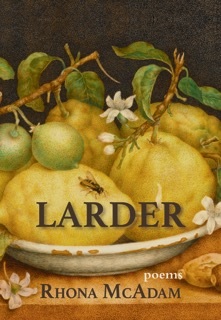
In her latest collection, Rhona McAdam navigates the dark places of human movement through the earth and the exquisite intricacies lingering in backyard gardens and farmlands populated by insects and pollinators, all the while returning to the body, to the tune of staccato beats and the newly discovered symmetries within the human heart.
“…A beautiful, filling collection, Larder is a set of poems to read at the change of the seasons, to appreciate alongside a good meal, and to remind yourself of the beauty in everything, even the things you may not appreciate before opening McAdam’s collection….”
Rhona McAdam is a writer, poet, editor, and Registered Holistic Nutritionist with a Master’s in Food Culture from Italy and a deep-rooted passion for ecology and urban agriculture. Her work spans corporate and technical writing to poetry and creative nonfiction, often exploring the vital links between what we eat and how we live. Based in Victoria, BC, and available via Zoom, Rhona is always open to new writing commissions, readings, or workshops on nutrition and the culinary arts.