-
Mslexia, Kathleen Jamie and the University of Gastronomic Sciences
Just got my copy of the Apr/May/Jun issue of Mslexia. The annual poetry competition closes April 28, so you might squeeze in if you hurry. The theme for the next issue is Travellers’ Tales, and the one after that I’m sure will speak to a lot of us here on the Wet Coast this year: Rain. The Making a Poem column this issue features the Scottish poet Kathleen Jamie:
“I don’t believe in writer’s block. I think you write the things that are given to you to write and then you wait for the next thing that is given to you to write. In between are what we must call fallow periods. That’s the only word for it. I hate the idea of flogging yourself in production, producing stuff for the sake of it.”
Meanwhile, I’ve been thinking about going back to school and getting another master’s degree. The University of Gastronomic Sciences offers one in Food Culture: Communicating Quality Products. Based in Italy, the program includes rigorous field seminars to learn about the production of the best foods and wines of Italy, France, Spain and Northern Europe. Sounds like a worthy academic goal, no? The price tag, room, lunches and travel abroad included, is a trifling 21,000 Euros, or just a sliver of prosciutto under $30,000 Canadian. Well, we have till July to stew on it.
-
Suet, treacle and some other things
Canadians who have acquired British cookbooks may sometimes need to know equivalent ingredients or measurements. Here’s a site that offers quite a bit of information, although not an answer to the question that still stumps me: what in a Canadian grocery store can equate to shredded suet for making mincemeats, dumplings, pastries and puddings? The suet offered by grocers in Victoria when I asked included bird suet (studded with birdseed!) and chunks of fat pared from beef cuts.
The official word on suet as sold in England is that it is made by grating the hard white fat which surrounds the kidneys, although there is also a vegetarian version, which according to the label is made of hydrogenated vegetable oil, wheat flour, sunflower oil, pectin and sugar. Lard and shortening are the wrong consistency: too soft and greasy. I haven’t experimented to see if they actually work in the finished product, though. I did find mention that hard coconut fat might be the answer. Further experimentation clearly needed in this area. Stay tuned.
Or apparently I can order vegetable suet through A Bit of Home, which happily is based in Toronto so no issues with customs, GST and duty. Everything from self-raising flour to jelly cubes to PG Tips pyramid teabags. Disappointing not to see Cornish Wafers, or Mackerel in brine which are – besides the cheese, the yogurt, the stunning produce selection, the extravagant selections of cream, of marmalade and of sugar – among the things I miss most about living in London.
I must make a return visit to the lonely little UK shelf in Market on Yates, which stocks a similar selection to A Bit of Home. I scored a 500g jar of Marmite there last year for around $18 – which is still cheaper and easier than flying over and slogging back with it in the overwrought luggage.
In The Boy from the Chemist is Here to See You, Paul Farley painted a memorable portrait of black treacle, loosely equivalent to molasses in North America (I’m happy to see that Treacle also appears in New British Poetry):
Funny to think you can still buy it now,
a throwback, like shoe polish or the sardine key.
When you lever the lid it opens with a sigh
and you’re face-to-face with history.
By that I mean the unstable pitch black
you’re careful not to spill, like mercurythat doesn’t give any reflection back,
that gets between the cracks of everything
and holds together the sandstone and bricks
of our museums and art galleries… -
Chicken salad and the mysteries of poetic craft
In a weak moment I bought one of those pre-barbecued chickens, basted in salt and lathered with a toxic red substance. Still, it left me with enough cold chicken for a good old chicken salad, a food that – like tuna casserole – was mysteriously absent from my upbringing and which I have embraced in later life. Here’s a perfectly straightforward recipe, based on one from the Fanny Farmer Cookbook:
2 cups cooked chicken, skinned and chopped
1 chopped green onion
1 rib celery, chopped
1/2 cup mayonnaise
2 tbsp plain yogurt
1 tbsp wine vinegar
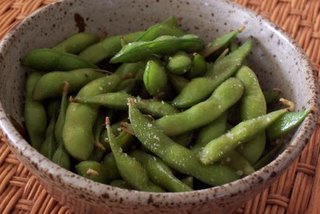
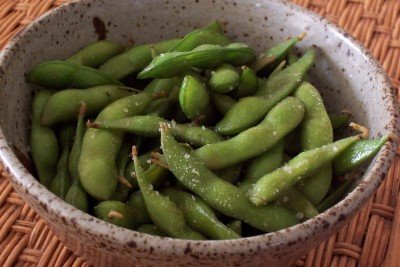
Salt and ground pepper to tasteCombine mayonnaise, yogurt and vinegar and blend well; add seasonings. Toss chicken, onion and celery with dressing until well mixed. Serve as a salad, on a bed of greens, or as a sandwich filling, on toasted English muffins. Why mess with simplicity? Have it with a lovely bowl of Edamame, drizzled with sesame oil and dusted with salt.
It hardly needs saying that Mark Strand is not a chicken, or a salad, nor even simple, but interesting to know he is Canadian-born (PEI). I first came across his name as co-editor (with Eavan Boland) of the form poetry anthology, The Making of a Poem. He’s also published a handy little book of essays on poetry called The Weather of Words. I’m finding it heavy going, but there are always moments in any such collection, and so I soldier on. I thought this, from the start of Notes on the Craft of Poetry, was an interesting take on it:
“Each poem demands that I treat it differently from the rest, come to terms with it, seek out its own best beginning and ending. And yet I would be kidding myself if I believed that nothing continuous existed in the transactions between myself and my poems. I suppose this is what we mean by craft: those transactions that become so continuous we not only associate ourselves with them but allow them to represent the means by which we make art… To a large extent these transactions I have chosen to call craft are the sole property of the individual poet and cannot be transferred to or adopted by others. One reason for this is that they are largely unknown at the time of writing and are discovered afterwards, if at all.”
He quotes Orwell’s rules of good writing, and questions whether these or any rules can really be applied to poetry: “For the poems that are of greatest value are those that inevitably, unselfconsciously break rules…”
His argument against craft is that it cannot work as a defining or diagnostic concept, because poetry “cannot be understood so much as absorbed.” He seems to be an advocate for mystery, arguing that we not attempt to impose a structure on the process of creating poems, because to do that is to imply a common purpose for poetry, which it eludes, because a poem’s purpose “…is not disclosure or storytelling or the telling of a daydream; nor is a poem a symptom. A poem is itself and is the act by which it is born. It is self-referential and is not necessarily preceded by any known order, except that of other poems.”



Latest Posts
- Sublime
- Good weather for reading
- The world, the world
- Sublime launch!
- Planet Earth Poetry – Readings by Volunteers, Victoria 2026
- Poetry at the Goldfinch
Aldeburgh Poetry Festival Barny Haughton BBC BC poets Berkswell blackberries Black Stilt Bologna book launch Borough Market Caerphilly Carlo Petrini Catalonia culatello Cyrus Todiwala dairy Dijon Edinburgh Fanny Bay Feast of Fields ferries Food and Morality food journalism Michael Pollan olive oil tasting Omnivore's Dilemma Our Food Our Future Oxford Parmigiano-Reggiano persimmons Planet Earth Poetry poetry poetry readings Poetry videos prosciutto salumi Sean O'Brien sensory analysis Suffolk ticks tortelli di zucca Troubadour Wendell Berry Wendy Morton Yvonne Blomer
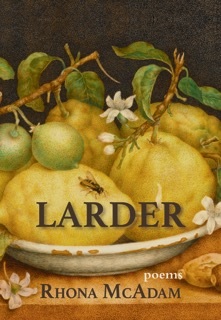
In her latest collection, Rhona McAdam navigates the dark places of human movement through the earth and the exquisite intricacies lingering in backyard gardens and farmlands populated by insects and pollinators, all the while returning to the body, to the tune of staccato beats and the newly discovered symmetries within the human heart.
“…A beautiful, filling collection, Larder is a set of poems to read at the change of the seasons, to appreciate alongside a good meal, and to remind yourself of the beauty in everything, even the things you may not appreciate before opening McAdam’s collection….”
Rhona McAdam is a writer, poet, editor, and Registered Holistic Nutritionist with a Master’s in Food Culture from Italy and a deep-rooted passion for ecology and urban agriculture. Her work spans corporate and technical writing to poetry and creative nonfiction, often exploring the vital links between what we eat and how we live. Based in Victoria, BC, and available via Zoom, Rhona is always open to new writing commissions, readings, or workshops on nutrition and the culinary arts.