-
The cheese, the salt and the rennet
Can I just say for starters what a rare pleasure it is to be surrounded by 24 people who do not find it the slightest bit odd to take photographs of one’s meals?
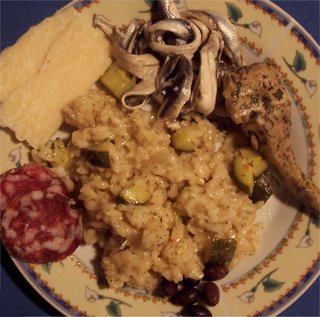
Yesterday’s supper was a better class of leftovers: risotto al limone (con zucchini) (handcrafted by me), plus booty from the supermercato: marinated anchovies, marinated fresh artichoke, thin slices of Salamini Italiani alla Cacciatora and Grana Padano, and a sprinkling of tiny Sicilian olives. Followed by a thin wedge of panforte. Just because I can.
Tonight for supper I had some fresh pasta from the grocery store: ravioli con cervo – surely my first encounter with venison ravioli. I could taste a mild game quality to it, but it was subtle and a bit unremarkable. Either my tastebuds are blown from this neverending cold, or the taste was too delicate to make much impact on this overwhelmed palate.Anyway, we also sampled some fresh mozzarella tonight – utterly sublime, and a more meaningful mouthful as we’d learned about the making of it in cheese technology class today. I had been reading, before I left Canada, about artisan cheese makers who still produce it by hand, but our instructor was dubious on that point: and given the kneading and stretching must be done on a cheese mass whose internal temperature is 60 degrees c, in a water held at about 80 degrees c, I imagine a few artisans of yore may have been a little relieved to turn the task over to machines. Still I’d like to know what the work did to or for their skin tone…
I remember having some dinner conversations before I left Victoria about why cheese was salted, and I’m happy to report back on that with some preliminary information. We learned a bit today about salination: how cheeses are salted in brine or with dry salting, depending on the type of cheese. The salting is done after the milk has coagulated, formed into curds, been put into moulds to shape them, and then pressed; and the salt reaches the inside of the cheese through osmosis. It serves not only to flavour the cheese but to act as a retardant to the growth of bacteria, yeast and mold, and to move – again through osmosis – more of the liquids out of the cheese, in the interests of its texture and water content. We’d heard about similar effects of salt on cured meat in our classes last week as well. But it’s an imperfect preservative system as there are more bacteria to be wary of than those who perish in salt, which is why, we were told, the rind of gorgonzola is not meant to be eaten.
We had as well some instruction on the matter of heat-treating milk, including pasteurisation and UHT. Suffice to say that what you gain in food safety by killing bacteria, you may lose in flavour and the ability of your milk to coagulate predictably.
Oh, and some interesting stuff about rennet, which I’ve known about and loved for its use in making Junket since my somewhat old fashioned and clearly politically incorrect childhood (any other Junket eaters out there?). But even so, I am aware there is a political issue about the use of rennet in vegetarian cheeses, and it is simply that purely vegetarian cheeses are made with an alternative to rennet – some kind of coagulating agent made from fungi, molds, bacteria, yeasts or plant sources, or more likely and reliably, genetically engineered micro-organisms. Because rennet is made from the abomasum (fourth stomach) of newborn calves (or lambikins or even kids in the case of goat cheese I suppose); and it takes, we were told, 5 stomachs to produce 1 gram of rennet. And that’s enough about all that for one day.
-
Bletting the last persimmon
Today I slap down a mighty poetic gauntlet to you all. Who cares to write a poem using the word blet, or bletting?
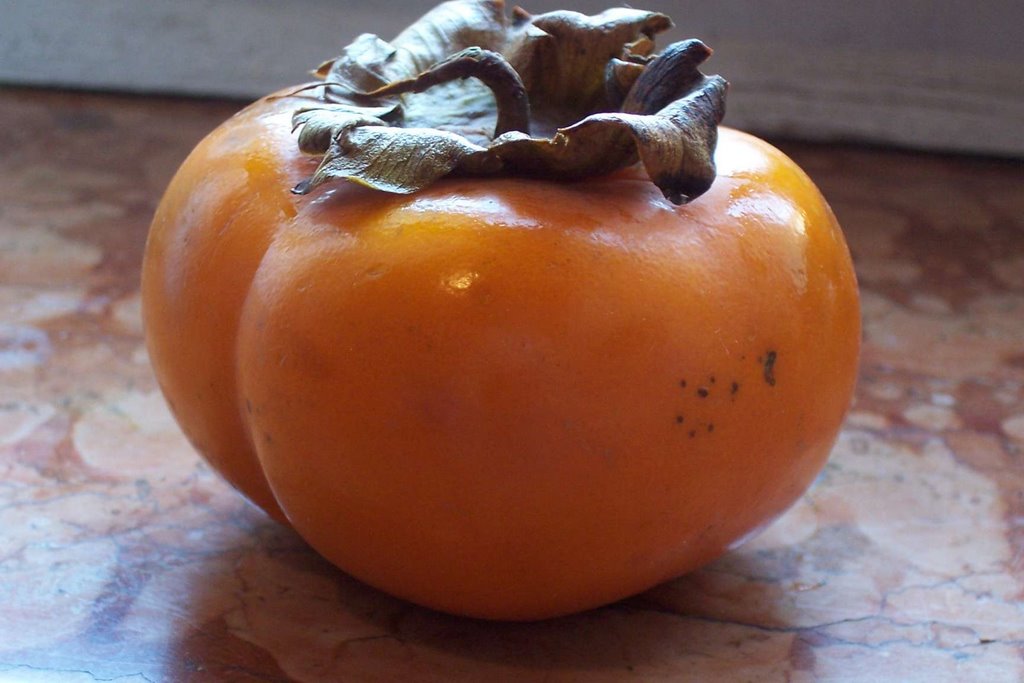
While I was in England last month, Sue, her mum and I were discussing persimmons and sharon fruit at some considerable length, as you so often do while lingering over a beautiful tricoloured fruit salad of pomegranate seeds, blueberries and sharon fruit. Well perhaps linger isn’t quite the word for it. The moment my spoon hit the empty bowl for the last time I was off to find out what makes a persimmon different from sharon fruit. Here’s what I’ve found out so far.

Persimmon (y’all knew that means “a dry fruit” in the Algonquin language, right?) is the family of fruit to which the sharon fruit belongs. It is divided into two types, the astringent and non-astringent, with a further sub-category of types which can have their astringency altered (in either direction) by pollination.
Astringent persimmons can still be eaten once their astringency (think soul-puckering dryness) has been removed, by (aha) bletting — a word coined in 1839 from the French world blessi, which denotes a particular type of bruised appearance found in fruits such as the medlar and the persimmon. The process is known as ammezzimento in Italiano.
Chemically speaking, bletting brings about an increase in sugars and a decrease in acids and tannins (tannins cause the unripe fruit to be puckery). In some cases bletting is simply a ripening process (the fruit is exposed to light frost for a few days after it is ripe), but in others there is a chemical process (water, alcohol or carbon dioxide treatments) used commercially to remove the astringency. Opposite to what we expect of some fruits, the persimmon can be stored at room temperature or softens more quickly if refrigerated.
Sharon fruit is a non-astringent persimmon, which means it doesn’t have to be as completely soft and ripe as other varieties in order to be enjoyed in, for example, a fruit salad. There is a trademarked version which is grown in Israel, but Spain and South Africa are also big producers, and it’s also grown in China, Japan, Korea, Italy, Greece, Turkey, USA, New Zealand, Australia, Chile, Brazil, Georgia and Iran (other forms of persimmon are grown widely in many other countries). It is rich in Vitamin A (Beta Carotene – for healthy skin, mucus membranes and night vision) as well as glucose, sodium, potassium, magnesium, iron, calcium and Vitamin C, and clocks in at only 71 calories per 100 grams.
The persimmon tree comes from the Ebony family (Ebenaceae), and it is sometimes grown as a wood rather than a fruit: its unusual heartwood has been used for veneer and specialty items, while its strength and shock resistant qualities have made it a popular choice for textile shuttles, billiard cues and heads for driver golf clubs. In some species (Diospyros ebenum) the wood is jet black, while in others (Diospyros virginiana) it is light-coloured and fine-grained, and in still others (Diospyros celebica) it is striped. The leaves of Diospyrus melanoxylon, also known as coromandel ebony or tendu, are used in India to make bidi cigarettes.
Known to the ancient Greeks, its scientific name, Diospyros, means “food of the Gods” (lit. “the wheat of Zeus”). The fruit variety known as the date plum (Diospyros lotus) is one of several fruits reputed to have been the ‘lotus’ of the so-called lotus-eaters of Homer’s Odyssey.
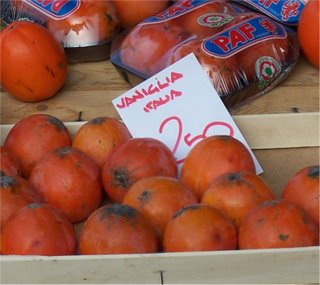
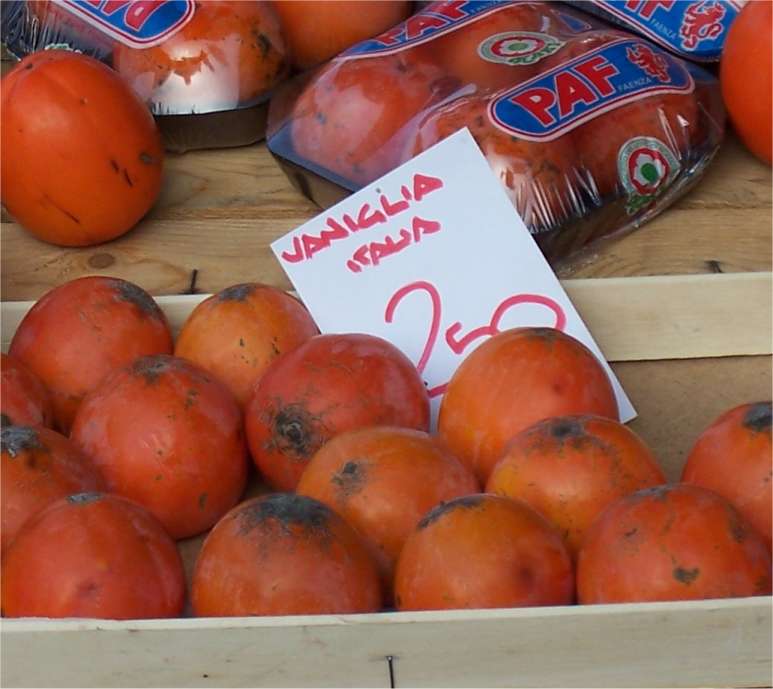
The familiar orange-coloured species which began in China and later introduced to North America and Europe is the kaki (cachi, cachi vaniglia or cachi mela in Italian) fruit (Diospyros kaki). Other varieties of the fruit you might encounter: black sapote (D. digyna, native to Mexico – starts green and ripens to black), mabolo or velvet-apple (D. discolor, a bright red variety from the Philippines), date-plum (D. lotus), fuzzy persimmon (D. pubescens), Texas persimmon (D. texana – once used by Native Americans as a dye to tan hides) and American/Common persimmon (D. virginiana) or “pawdad”.A list of varieties that might be handy to learn:
* Astringent (need to be custard-soft to be edible): Eureka, Hachiya, Honan Red, Saijo, Tamopan, Tanenashi, Triumph (sold as Sharon Fruit when the astringency has been removed);
* Nonastringent (can be eaten when firm): Fuyu, Gosho/Giant Fuyu/O’Gosho/Hanagosho, Imoto, Izu, Jiro, Maekawajiro, Okugosho, Suruga;
* Nonastringent, but astringent if seedless: Chocolate, Gailey, Hyakume, Maru, Nishimura WaseWell, there you have it. Interested parties may wish to start planning now to attend the annual persimmon festival held each September for the past sixty years in Mitchell, Indiana.
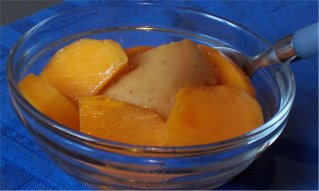
Meanwhile, we lucky parmigiani can bring home daily celebrations from Gelateria Grom, whose offerings include gelato di caco, very nice with some fresh slices of fruit! -
Thorns in the cheese and elsewhere
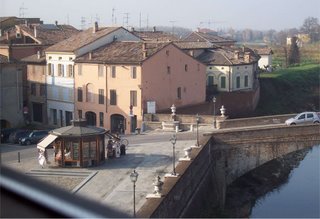
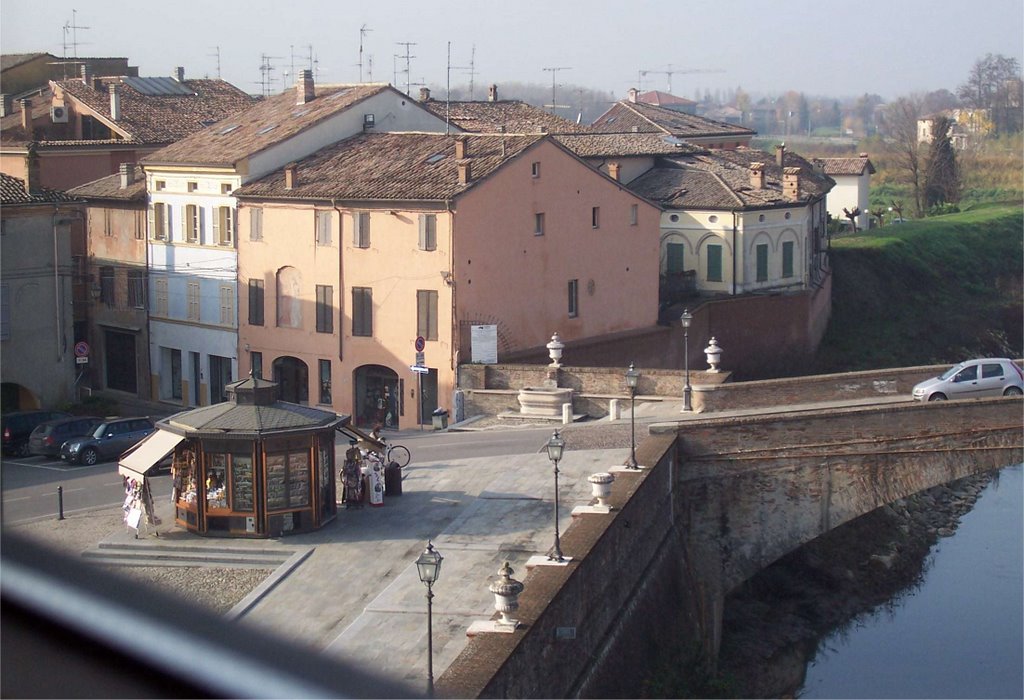
Piazza Garibaldi, ColornoInteresting fact learned the other day: the tool used to break the curd during the making of a parmigiano-reggiano cheese is called a spino, meaning thorn-bush, after the hawthorne bushes traditionally used in the process. We are looking forward to our first field trip to see the process for ourselves in the next week or so.
The week is flying by as we compare notes on our various degrees of illness and ease into life in this new country, new course of study. Tomorrow the public services have conspired to allow those of our class living in Parma to experience our first public transit sciopero (strike), and so our morning will be spent competing for taxi service to get us to classes on time. This will be swiftly followed by a train strike on the weekend. Bemused travellers in this country will have noticed alternate train and other schedules posted ‘in caso di sciopero’. Such is their regularity that you can consult a calendar of them to plan your movements accordingly.





Latest Posts
- Sublime
- Good weather for reading
- The world, the world
- Sublime launch!
- Planet Earth Poetry – Readings by Volunteers, Victoria 2026
- Poetry at the Goldfinch
Aldeburgh Poetry Festival Barny Haughton BBC BC poets Berkswell blackberries Black Stilt Bologna book launch Borough Market Caerphilly Carlo Petrini Catalonia culatello Cyrus Todiwala dairy Dijon Edinburgh Fanny Bay Feast of Fields ferries Food and Morality food journalism Michael Pollan olive oil tasting Omnivore's Dilemma Our Food Our Future Oxford Parmigiano-Reggiano persimmons Planet Earth Poetry poetry poetry readings Poetry videos prosciutto salumi Sean O'Brien sensory analysis Suffolk ticks tortelli di zucca Troubadour Wendell Berry Wendy Morton Yvonne Blomer
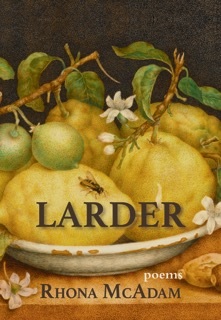
In her latest collection, Rhona McAdam navigates the dark places of human movement through the earth and the exquisite intricacies lingering in backyard gardens and farmlands populated by insects and pollinators, all the while returning to the body, to the tune of staccato beats and the newly discovered symmetries within the human heart.
“…A beautiful, filling collection, Larder is a set of poems to read at the change of the seasons, to appreciate alongside a good meal, and to remind yourself of the beauty in everything, even the things you may not appreciate before opening McAdam’s collection….”
Rhona McAdam is a writer, poet, editor, and Registered Holistic Nutritionist with a Master’s in Food Culture from Italy and a deep-rooted passion for ecology and urban agriculture. Her work spans corporate and technical writing to poetry and creative nonfiction, often exploring the vital links between what we eat and how we live. Based in Victoria, BC, and available via Zoom, Rhona is always open to new writing commissions, readings, or workshops on nutrition and the culinary arts.