-
In which I revisit a couple of cooking sites
I was feeling so much better this evening, and checking a few food/recipe sites, testing my tolerance for pictures of food (still fairly low – glad that so far you don’t get aromas through the laptop) and I noticed a couple of major differences between two I’ve visited in the past, both by British food celebs.
Further to yesterday’s posting on recipe copyright I was interested to see, while stopping in at Nigella Lawson’s site that I think it has been revamped since my last visit. It’s very much a glossy marketing forum for books, dvds, kitchenware and of course Nigella herself. No Nigella recipes on offer; instead a clever wrinkle whereby she invites readers to post their own recipes. She does provide an index to her own – simply the recipe title and the name of the book it’s from. Drat, and me separated from my one Nigella cookbook by 7 or 8000 miles I think it is. (There are some of her recipes available at UKTV Food, including a good one for lemon risotto.)
Thankfully Delia Smith still offers a hefty selection of recipes, though some (would be interesting to know what percentage) of them are now locked into “premium content” which you have to pay for. (I wonder if more and more recipes will slip into the “premium” void?) While the site is also a serious marketing tool – you can buy kitchenware, books, online recipe collections and even wine – she has a number of added-value pages, like her online cookery school. If you’ve ever lamely wondered how to make shortcrust pastry, joint a raw chicken, or prepare and serve a mango, she gives you step by step instructions with photos. And if that leaves you thirsting for more she offers links to her own cooking school in Norwich (no she doesn’t teach the classes) and the Leith School in London.
On the other hand there is a page where she plugs products for McCain’s that she has developed to bulk up her football team (Norwich City). An interesting wrinkle – given the U.S. copyright controversy – is that she gives a few of the recipes for these away in case you want the hands-on challenge of making a high-carb, low-fat dish like Lean Shepherd’s Pie from scratch (–if “scratch” to you includes using McCain’s frozen mashed potatoes) (why on earth would anyone use frozen mashed potatoes for anything??). And she does tell the alert reader, flat-out, that a simple baked potato (not counting any fillings) is a better source of carbohydrates than anything McCain’s is offering.
-
Sick of being sick, food in Britain, and copyrighting recipes
I have been languishing in my sickbed for two solid days, mostly too ill for meditation, although I have reached the following conclusion: surely the ailment that delivers the hardest blow to the solar plexis of the student of food culture is stomach flu. My diet since Monday has consisted of a large bottle of water, two glasses of juice, and this evening about a half cup of cooked white rice. Not least of my discomforts was the irritation of knowing I was missing lectures by visiting food culture expert Laura Mason, who I’d particularly wanted to hear. I did manage to listen to the radio for a little while today, and reflect on some recent articles I’d read.
I listened again to a report on Italian vs British food on the latest Food Programme, which is available online until Sunday when it is replaced by a report on olive oil: very timely for us as we begin a few weeks of study on that very topic. This episode was built around a visit to Fiera del Bue Grasso in Piemonte. Some interesting discussion about attitudes to food, issues around steroid use in cattle, and a recipe for brasato. One remark caught my ear (by eminent food writer Anna del Conte, a longtime Italian expat living in Dorset), which was that there was good food to be had in Britain, and the opportunity to buy from producers, but getting hold of it was tied to class (and income).
On a partially connected note I spotted a piece by Israeli food writer Daniel Rogov on finding good food in Britain. I was amused by his observation that “French restaurants have become the rage in the city and many of these serve meals that, in addition to being creative and exquisite are often so expensive that a weekend in Paris is a cheaper way to enjoy French food than by dining in London.”
I had come upon Rogov while reading his excellent commentary on recipe writing which I’d been led to by following a report on some weird things happening with food patents and copyrights Oddly enough, a friend (thanks Ruth!) had earlier in the week sent me a link to an article about food experiments by the very chef Cantu mentioned in the copyright article. Not convinced this is the kind of food I want to spend my money on just now: too many unprocessed foods I haven’t tried yet, still in their original packaging. (Why does everything I read lately make me want to wail “what have we done to our food??”)
-
Innocent fun with hot beverages
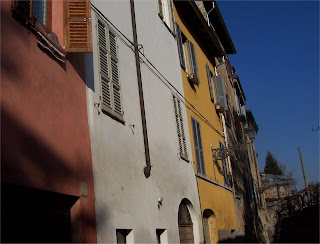
Needing some fresh air, I took a walk around Oltretorrente, just across the river; BBC Weather said it was foggy and cold. Who can you trust?I was trying to study some Italian this afternoon when I got distracted by La Stampa’s photo pages taken from LatteArt. So if you are good at decorating your cappuccino, you can send your photos in to the website, or you can refer to it for demos on making la foglia (leaf), il cuore (heart) or la mela (apple) designs on your cup at home. All you need is a steady hand. And good luck.
That got me thinking about other hot beverages.
- Maybe once you’ve finished messing about with cappuccino you can move on to a spot of tasseography.
- Did you know you can now earn a Tea Appreciation Certificate? (…Only in Canada you say?)
- When I first moved to London and worked as a temp, there were still Tea Ladies to be found in many of the offices I worked in; indeed there was one in our company’s Johannesburg office as well. It was one of those jobs that should never have been phased out, since machines are lacking in character, sympathy and common sense. I loved meeting these ladies who were always kind to newcomers and who knew everyone in the office, and their drink preferences. It’s good to see there are still places in the world that employ them: I found positions advertised in Kuwait and Kuala Lumpur.
- Did you know there’s a web page devoted to the Ovaltineys? On it you can hear that old standard “We are the Ovaltineys” (once heard, never forgotten).
- Horlicks has a fun site with interactive information about sleep (hint: the answer to sleep problems is often a nice cup of Horlicks).
- Sketos, metrios, glykos or vary glykos: how do you like your Greek coffee? Learn how to make it with a series of helpful photos.
- Long ago I tried mate, after reading something that glamourised for me the gourd and bombilla used to drink it. Now it seems to be everywhere, often known as Yerba Mate, although this sounds slightly redundant as my reading suggests yerba (Argentinian spelling of hierba, or grass) is the raw ingredient, and mate is the hot beverage. I didn’t know it had quite so many names though: Erva mate; Congonha; Paraguay cayi; Paraguay tea; Jesuit’s tea; St Bartholomew’s tea; Hervea; K’kiro; Caminu; Kali chaye; Erveira; Hervea; Erva-verdadeira; Matéteestrauch.


Latest Posts
- Sublime
- Good weather for reading
- The world, the world
- Sublime launch!
- Planet Earth Poetry – Readings by Volunteers, Victoria 2026
- Poetry at the Goldfinch
Aldeburgh Poetry Festival Barny Haughton BBC BC poets Berkswell blackberries Black Stilt Bologna book launch Borough Market Caerphilly Carlo Petrini Catalonia culatello Cyrus Todiwala dairy Dijon Edinburgh Fanny Bay Feast of Fields ferries Food and Morality food journalism Michael Pollan olive oil tasting Omnivore's Dilemma Our Food Our Future Oxford Parmigiano-Reggiano persimmons Planet Earth Poetry poetry poetry readings Poetry videos prosciutto salumi Sean O'Brien sensory analysis Suffolk ticks tortelli di zucca Troubadour Wendell Berry Wendy Morton Yvonne Blomer
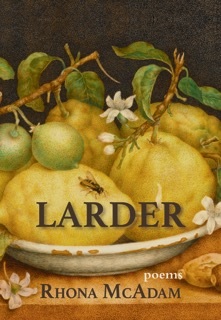
In her latest collection, Rhona McAdam navigates the dark places of human movement through the earth and the exquisite intricacies lingering in backyard gardens and farmlands populated by insects and pollinators, all the while returning to the body, to the tune of staccato beats and the newly discovered symmetries within the human heart.
“…A beautiful, filling collection, Larder is a set of poems to read at the change of the seasons, to appreciate alongside a good meal, and to remind yourself of the beauty in everything, even the things you may not appreciate before opening McAdam’s collection….”
Rhona McAdam is a writer, poet, editor, and Registered Holistic Nutritionist with a Master’s in Food Culture from Italy and a deep-rooted passion for ecology and urban agriculture. Her work spans corporate and technical writing to poetry and creative nonfiction, often exploring the vital links between what we eat and how we live. Based in Victoria, BC, and available via Zoom, Rhona is always open to new writing commissions, readings, or workshops on nutrition and the culinary arts.