-
Biodynamite
Saturday I overcame the weekend handicaps imposed by what are generously described as “improvements” on the Underground, and managed to arrive at Victoria coach station in time to welcome my classmate Jenn to London. Off we sped on the trusty number 11 bus, alighting beneath the shadow of St. Paul’s and walked unswayingly across the Millennium Bridge, and along the waterfront until we reached Borough Market,


in good time for the launch of Biodynamic Food Fortnight. We managed to source some fantastic snacks before events began: a toasted Montgomery cheddar cheese sandwich

(watching the cheddar raclette being assembled
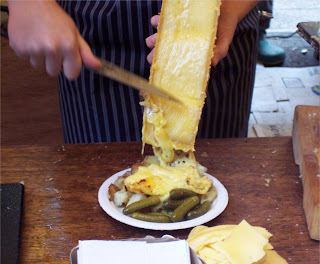
made me so faint I was forced to take a native oyster or two from a seventh generation oyster seller.
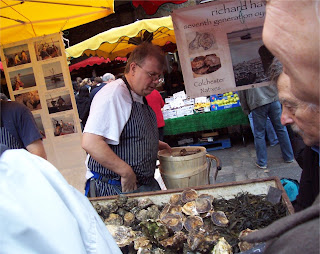
Revived, we ascended many stairs into the massively crowded Borough Market boardroom. The celebration was all around biodynamic farming methods, which we’d heard about on our trip to Crete. Basically it is to do with sustainable agricultural practices – including respecting the natural seasons of what you grow; organic – chemical free – farming; humane animal husbandry; and some extras that have to do with moon cycles and spirituality which believers say puts the farming back into the earth’s natural cycles. It arises from the work of Rudolf Steiner.
With listeners spilling out the door we had a couple of lively welcomes from guest chefs Michel Roux (Jr.) and Cyrus Todiwala. Roux extolled at some length the beauty of the biodynamic produce and meat he uses, concluding that it was for him a science of respect for the living things we consume. And then Todiwala gave an endearingly sprawling talk which tied together biodynamic farming, Zoroastrianism, poisoned vultures and the omnivores of India. (The poisoned vultures theme was interesting: he was speaking about the use of the anti-inflammatory drug Diclofenac, which is administered to farm animals and which poisons the kidneys of vultures, whose ecological role includes consuming carrion so that wild dogs – who can spread rabies – don’t. He didn’t mention the fact that farmers also deliberately poison vultures, believing them to spread disease among their livestock; and they can be accidentally poisoned by hunters using poisoned bait for other purposes)
We were by this time perishing from heat and overcrowding and too long standing, so we plunged back into the market, which – holy overcrowding! – by now looked like this:
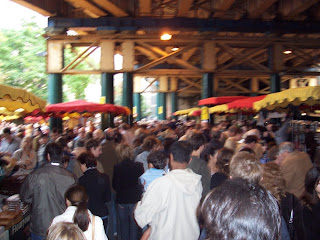
And pushed our way along, glimpsing wistfully a Comté cheese stand…
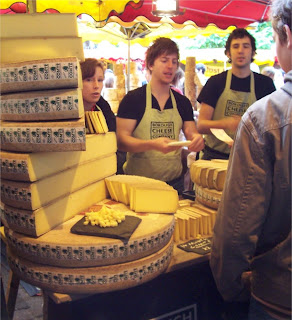
until we reached the oysters,
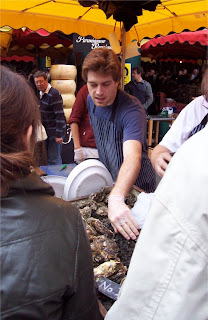
where we knocked a couple more back.
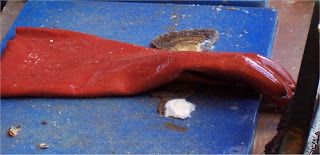
Then on to a whirlwind tour of Covent Garden, including of course Neals Yard Dairy, and a bite to eat at Food For Thought. And then through Chinatown and off into the wilds of Kensington to have a browse through Whole Foods, which – after the high street outside, and Borough Market, and just about everywhere else in London – really wasn’t that crowded. Lots and lots of everything there, but we left relatively unscathed.
-
Culture, culture, culture and a little bee bim bap
It’s been a pretty poetic week all in all. Monday evening I went to the South Bank to see Sean O’Brien and Ian Duhig read. I’d been admiring O’Brien’s latest, The Drowned Book, for the past couple of weeks, so was happy to hear him in person, and it turned out to be an auspicious week for him, winning his third Forward Prize a couple of days later. Ian Duhig won me over a couple of years ago with his wonderful ode to string vests, from The Lammas Hireling, and he gave an entertaining and eccentric reading from his new collection, The Speed of Dark.
Tuesday we went out to Troika, which I hadn’t visited for years, and ate too much (thanks for the cheesecake, Howard).
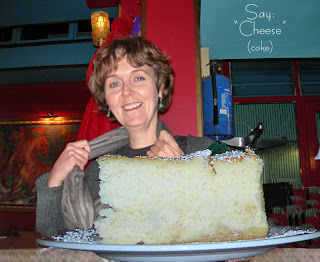
Wednesday I had a day off while I shifted myself to the next charitable bed, in lovely leafy Turnham Green.
And Friday was a start-to-finish day of culture, with some bee bim bap in the middle. I got to the British Museum, despite a painfully slow District Line, in time to collect my ticket and timed entry to the Terracotta Army exhibition. It was a great show; someone had told me the soldier count was only 17 figures (of a possible 7000) but the selling point – getting nose to nose with those present – was convincing, and it was a good thing to see as it’s been widely promoted and will be much talked about.
It was called The First Emperor, and was intended more as a briefing on the life (rather short – died at 49) and times of China’s first emperor, Qin Shihuangdi, and what had led him to have the army – plus civil servants, acrobats and musicians (perhaps they haven’t found the chefs yet) – and his still-buried tomb created on such a scale. Protection, company and entertainment in the afterlife, apparently. Not a nice man, I suppose, but one of awesome ambition. Probably not much liked by the conscripts (over over 700,000) who lived and died making his afterlife a happy one. I wonder where they ended up: let’s hope they are in a kind of eternal beach resort with the likes of those who built the pyramids.
The space chosen for this show was the grand old British Library Reading Room, which had had to be reinforced and rearranged for the occasion. I’d watched a television documentary about the show which gave some useful context for it, so I felt I got as much as I needed and made my way through in about an hour to meet Nancy for some coffee followed by aforementioned bee bim bap, which was good but, really, could not surpass the Bul Go Gi House‘s version, back in Edmonton.
At one of the Poetry School‘s 10th anniversary celebration events on Friday afternoon, there was a good showing for Eavan Boland (introduced by Michael Schmidt) who spoke delightfully and occasionally controversially about the place of the simile in modern poetry. Her first metaphor was a surprising one: she talked about how much she had enjoyed building computers, and how in about 1992 Unix lost its dominance to the appeal of GUI. Unix, she said, had been described to her as a language that spoke to the core of the machine, while GUI spoke to both machine and user. How right, she remarked, to lose a language that was facing inwards.
And went on to argue that the simile was the tool of epic poets, and was no longer relevant; poems and images should be an integrated whole where logic is suppressed and the reader engages to discover meaning instead of being handed it. Though there were some lovely similes in one of the poems she discussed (Sylvia Plath’s “Words“). Her own beautiful example was “The Black Lace Fan My Mother Gave Me“. She provided but didn’t speak to an old favourite of mine: “A Disused Shed in County Wexford” by Derek Mahon. (Which, as I had been talking with Nancy about ekphrasis earlier in the day, I decided could be identified as such, due to the presence of flashbulbs. So there.)
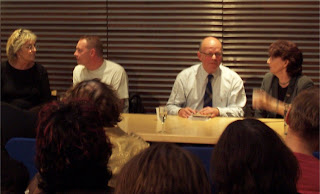
After a break, many of us and some more as well, reconvened to hear Boland in tandem with Robert Potts and Germaine Greer, with Schmidt again hosting events. The topic was Poetry Makes Nothing Happen and the response was, well, pretty much but that doesn’t make it a bad thing. Boland had some sharply phrased things to say about the death of pastoral poetry – gone forever, she observed, in a world where there can be no moral engagement with a nature we have destroyed. And when talk turned to the role of the poet in grappling with the harsh realities of our world, she invoked Seamus Heaney‘s Nobel speech, and the anecdote that speaks of being “caught between dread and witness”. Greer made some good points about the value of poetry that might make nothing happen in a world where too damn much is going on too fast to allow us to make sense of it (shades of Serge Latouche!).
-
Been such a long, long time…
…since I had a minute to blog, it really has. Which reminds me of one of my favourite songs:
But back to reality, whoever has time for that.
Tracking backwards, I was so so so so very lucky to join in a collective event to belatedly celebrate Nancy’s birthday on Saturday afternoon: she had the great wisdom to suggest that those of us who wished could come to the Barbican and watch a play in her esteemed company, and the play she chose was, honestly, one of the best I’ve seen. The company was the inescapably and reliably brilliant Theatre Complicite, and their new production, A Disappearing Number, featuring the wonderful Saskia Reeves, was intricate and funny and incredibly moving. It is odd, isn’t it, that when you see something moving, you can’t actually move for a while, and so in a way we enjoyed sitting stunned in our seats long after the last hurrah.
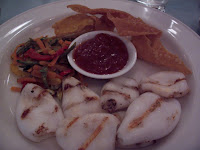
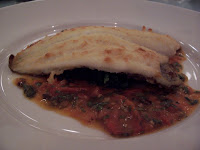
We eventually did get up and wandered outside for fortifying cups of tea in the rain, watching the London rats race by with their rucksacks and flapping maps, and then went for a very nice meal at Fish Central (pour moi, grilled squid, brill and sticky toffee pudding).

Friday I went back to my old (work) stomping grounds and was whisked away by one of the head hunters in a taxi and a train and a car all the way to darkest Henley where I met the lovely Belinda, who runs Stirring Stuff. We had an informal demonstration by two members of her Big Boys’ Cookery Club, who prepared a substantial and delicious meal of veal kidneys with peas, broad beans, roasted shallots and fried bread (it sounds nicer in French but I don’t recall all the words) and talked Slow Food until bedtime, the distant sounds of one of the resident teens and her thousand friends somewhere above our heads, and returned to London in the morning.
Thursday I reached farther back into the past and met up for a drink and catch-up in a pub near Victoria Station with Graham, another former Spencerian; Wednesday I had a most delicious supper with Tina, a return visit to The Fish Hook in Turnham Green for some spicy fish soup and a bowl of mussels in cream.
Tuesday was a poetry reading – a big one – at Oxfam Marylebone, a quarterly event organised and hosted by expat Canadian poet Todd Swift. It was an impressive lineup (though missing one – most unfortunately, David Morley couldn’t make it) and the readings moved at a cracking pace, so was not as wearing as the length of the list might have suggested. We heard Fleur Adcock, Chris Beckett, Julia Bird, Giles Goodland, Chris McCabe & Mario Petrucci, a good and invigorating mix for a rainy night.

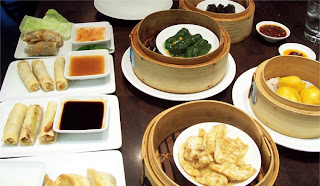
Before the reading, Tammy and I enjoyed a terrific late in the day dim sum from what we think is (another) chain restaurant, Ping Pong. Everything was good. Very good.
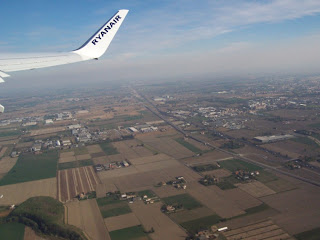
And before that, I flew back from Parma. Only last Monday.


Latest Posts
- Sublime
- Good weather for reading
- The world, the world
- Sublime launch!
- Planet Earth Poetry – Readings by Volunteers, Victoria 2026
- Poetry at the Goldfinch
Aldeburgh Poetry Festival Barny Haughton BBC BC poets Berkswell blackberries Black Stilt Bologna book launch Borough Market Bra Caerphilly Carlo Petrini Catalonia Cyrus Todiwala dairy Daunt's Books Dijon Fanny Bay ferries Food and Morality food history food journalism lardo Michael Pollan Monsanto Okanagan olive oil tasting Omnivore's Dilemma Our Food Our Future Oxford Parmigiano-Reggiano Planet Earth Poetry poetry poetry readings Poetry videos prosciutto salumi sausage making Sean O'Brien Suffolk ticks Wendell Berry Wendy Morton Yvonne Blomer
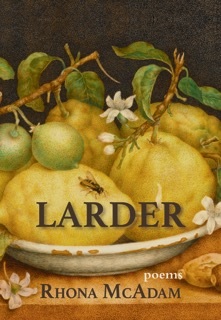
In her latest collection, Rhona McAdam navigates the dark places of human movement through the earth and the exquisite intricacies lingering in backyard gardens and farmlands populated by insects and pollinators, all the while returning to the body, to the tune of staccato beats and the newly discovered symmetries within the human heart.
“…A beautiful, filling collection, Larder is a set of poems to read at the change of the seasons, to appreciate alongside a good meal, and to remind yourself of the beauty in everything, even the things you may not appreciate before opening McAdam’s collection….”
Rhona McAdam is a writer, poet, editor, and Registered Holistic Nutritionist with a Master’s in Food Culture from Italy and a deep-rooted passion for ecology and urban agriculture. Her work spans corporate and technical writing to poetry and creative nonfiction, often exploring the vital links between what we eat and how we live. Based in Victoria, BC, and available via Zoom, Rhona is always open to new writing commissions, readings, or workshops on nutrition and the culinary arts.