-
Global food & expensive wine
I just stopped myself from cheering when I read a newspaper report about global food and farming in an English paper on the plane ride home. The very next day A Friend (thank you, friend) sent me a link to The Guardian‘s coverage of the piece. Since the report’s release on April 15, it’s also been in the New York Times, Le Monde, der Spiegel and many others. But as of Thursday, there does not appear to be any coverage at all of this story in the Canadian press, other than a brief preview on the CBC news site. Perhaps it will break soon.
The report is a 2500 page plan for a global agriculture capable of seeing the world through the next 50 years. The study was the result of five years’ work by the International Assessment of Agricultural Science and Technology for Development (IAASTD for merciful short) with input from some 400 experts; the organisation is funded by participating countries and by a serious group of international agencies (FAO, GEF, UNDP, UNEP, UNESCO, the World Bank and WHO).
The report concluded that neither genetically-modified crops nor industrial food production are workable ways to feed the world; that the only way forward is to employ methods such as organic and small-scale agriculture. It must surely by now seem obvious to most of us, and is thankfully proposed in this report, that to survive in the world as it now is, we must grow our food sustainably: in ways that are less dependent on fossil fuels; make use of locally available resources, natural fertilizers and traditional seeds; and aim to preserve the soil and water supply. The report is critical of the whole biofuel madness: as we are already seeing, using food crops for biofuels is only going to worsen food shortages and price rises.
It should surprise no one that in light of these findings, Australia, the United States and Canada are the countries questioning some of the language in the report’s concerns about biotechnology, especially genetically modified foods. But these are the very countries which must make immediate changes if the world is to feed itself. So…. what happens next?
Summaries of the report are here, on the IAASTD’s website , and there is “a faithful summary of the leading scientific report” on GreenFacts. Unesco has some information and there are presentations and documents of all shapes and sizes about the report on the IAASTD’s Press Materials page.
Meanwhile, an interesting study of wine-drinking concludes that expensive wines do not bring more pleasure to drinkers unless they know what the price tag says. Although it concedes that educated palates do not find a negative correlation between wine and costliness, this overall trend – that expensive wine is actually less enjoyable if you don’t know what it costs – was revealed after more than 6,000 blind tastings were analysed by the American Association of Wine Economists.
-
GM labelling in Canada – you can do something!
Canada stands with other GM producing nations (like the US) in refusing to require labelling of GM foods (currently it’s voluntary) but also trying to force non-GM enthusiasts into allowing GM products into their markets.
It’s a hugely complicated matter, as North America has already travelled so far down the GM road; it can be hard to say what is and is not GM any more. As previously discussed here, more than 90% of Canada’s canola crop is deliberately or accidentally now genetically modified. There is no way to prevent contamination of most non-GM crops once their GM neighbours are out there in our fields.
But, happily, GM crop contaminated pollen may not be the only thing on the Canadian wind this spring. Canadians should sharpen their writing utensils and dash off letters to their MPs right this minute, since Bill C-517 is on the table now, this very week. This bill, introduced by Bloc Québecois MP Gilles-A. Perron, calls for mandatory labelling of GM products; the last attempt to pass this legislation in 2001 was defeated in parliament.
Without labelling of GM products, Canadians cannot know for sure what they are eating, and it is worth remembering that GM foods have not been proven safe for long term human consumption; they are also banned from use in Canadian organic food production (but how would an organic producer know, without labelling?). Worth a try, it seems to me.
For more info and how to get your oar in, see the info on the Greenpeace website.
-
Hasta luego London
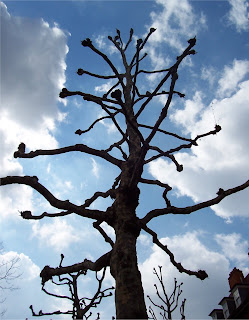
A flash farewell to London left me time only for a sprint to the Tate, where the trees are quite shockingly beautiful,
and Peter Doig’s show was in its best points big and beautiful, particularly, for me, the landscapes and snows that drew on his years in Canada.

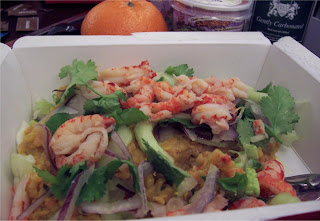
A nice box of crayfish salad on a pretty tasty lump of lentils from the Tate’s cafeteria gave me the strength to press on.
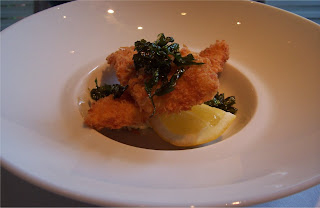
And a last lovely lunch on Tuesday at La Trompette gave us goujons of lemon sole with a gorgeous tartare sauce
and seared loin of tuna with green bean and caper vinaigrette, tapenade, sauce vierge and quail’s eggs in darling little panko jackets
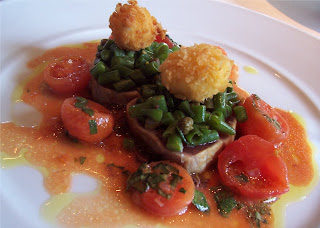
followed by red mullet with shrimp and herb risotto, grilled fennel and bok choy

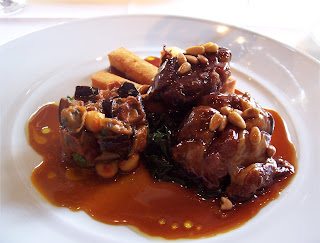
and glazed shoulder of lamb with chickpeas, aubergine and cumin, pine nuts and panisses
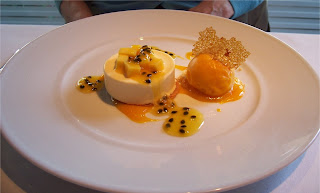
finishing with iced yuzu parfait with mango sorbet and passion fruit,
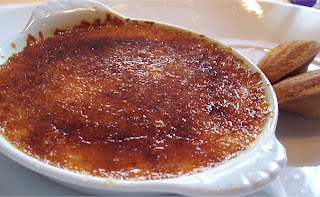
and (super-yum!!) crème brûlée with rhubarb and ginger compote and warm pistachio madeleines.
Then it was time to take to the skies, waving goodbye to the O2
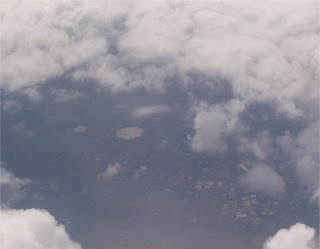
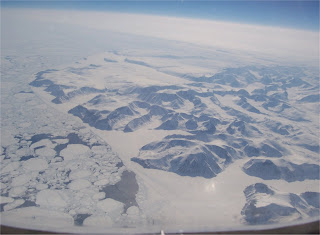
and hello to Baffin Island. Not quite as cold in Victoria, but not all that warm either, so I haven’t missed spring here.


Latest Posts
- Sublime
- Good weather for reading
- The world, the world
- Sublime launch!
- Planet Earth Poetry – Readings by Volunteers, Victoria 2026
- Poetry at the Goldfinch
Aldeburgh Poetry Festival Barny Haughton BBC BC poets Berkswell blackberries Black Stilt Bologna book launch Borough Market Carlo Petrini Catalonia Cyrus Todiwala dairy Daunt's Books Dijon Edinburgh Fanny Bay Feast of Fields Food and Morality food history food journalism Jenna Butler lardo Malahat Review Michael Pollan Okanagan olive oil tasting olive trees Omnivore's Dilemma Our Food Our Future Oxford Parmigiano-Reggiano Planet Earth Poetry poetry poetry readings Poetry videos prosciutto salumi Sean O'Brien Suffolk ticks Wendy Morton Wired Writing Yvonne Blomer
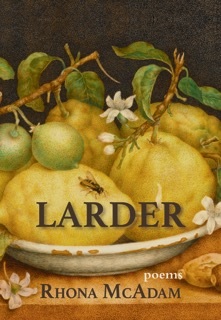
In her latest collection, Rhona McAdam navigates the dark places of human movement through the earth and the exquisite intricacies lingering in backyard gardens and farmlands populated by insects and pollinators, all the while returning to the body, to the tune of staccato beats and the newly discovered symmetries within the human heart.
“…A beautiful, filling collection, Larder is a set of poems to read at the change of the seasons, to appreciate alongside a good meal, and to remind yourself of the beauty in everything, even the things you may not appreciate before opening McAdam’s collection….”
Rhona McAdam is a writer, poet, editor, and Registered Holistic Nutritionist with a Master’s in Food Culture from Italy and a deep-rooted passion for ecology and urban agriculture. Her work spans corporate and technical writing to poetry and creative nonfiction, often exploring the vital links between what we eat and how we live. Based in Victoria, BC, and available via Zoom, Rhona is always open to new writing commissions, readings, or workshops on nutrition and the culinary arts.