-
Of sausages, sauerkraut and sorrel
I had opened a jar of sauerkraut the other day and was pondering what to do with it. I still have some beets from my bumper Christmas organic box, and I started thinking about some borscht I once had that included both beets and sauerkraut.
But in looking for this recipe I stumbled upon several others for sauerkraut borscht which call for smoked sausages (like those St Gregor ones I have stashed in my freezer).
Which reminded me that borscht, to many of us, means a kind of beet soup, but that is a woefully limited view of a term that, like paella, can mean an almost infinite range of dishes under a common culinary umbrella.
Which led me to look further at the page I’d happened upon, which was a collection of Mennonite recipes. Last summer I made sorrel soup (here called Zummahborscht) out of some weeds I’d pulled at Haliburton Farm. The soup was delicious and lemony; the labour involved was a bit tedious, as I had to rinse and sort the leaves rather more than I would a grocery store bag of greens, but I think it was worth it and I’ll be volunteering for weeding duties again this year.
-
Grass and grass-eaters
Nancy gave me the most wonderful book: Table Talk, by the overwhelmingly acerbic AA Gill. The chapter on rice starts seriously enough, though:
The grass family (Gramineae) is extraordinary. From its largest member, maize, to one of its smallest, teff, grass provides the staple diet of humans. If you believe that you are what you eat… you can divide the world neatly — indeed, almost exactly — in half between two Gramineae–philes: wheat-eaters and rice-eaters.
…
The wheat world and the rice world are better definitions of our most fundamental division than the myopically geo-political ‘first’ and ‘third’, the mealy-mouthed ‘developed’ and ‘developing’, or the plainly geographical north/south.He makes some interesting points about the two halves:
In terms of wholesomeness, rice and wheat are remarkably similar. Wheat has slightly more protein, rice more carbohydrate. For labourers, rice alone is just enough for sustenance… you can feed more people with an acre of rice than an acre of wheat.
…
…rice will sustain a dense population, but it is also more intensive to grow than wheat. Look at how many people are needed to plant a paddy field compared with a wheat field. It needs elaborate water management; it’s high maintenance. Rice may keep a large population just above starvation, but it also needs that population to grow it. Paddy fields become a closed circle of work producing the energy to work.Wheat, on the other hand, feeds a smaller population, but allows them more space and time to do other things, such as develop a social system and technology that ends up colonising rice-eaters. After breakfast, space and time are everything.
By coincidence, a day or two after reading this, I heard the first part of a week-long dramatisation of a rather grim radio play called The Death of Grass, part of a Science Fiction series. It’s only available online for a week. Worth a listen.
With apologies to the mutton campaign, I’d like to share a more characteristic moment from AA Gill:
The ingénue vegetables were midgets and dwarves, boiled so that they held their natural shape only by a collective act of nostalgia. But they were ambrosia compared with the mutton. The colour of a gravedigger’s fingernail, it was a mortified curl of muscle form some unknown extremity of ancient ovine. It resisted knife and fork, being mostly translucent, sweaty gristle and greasy fat. It was inedibly disgusting, without question the nastiest ingredient I’ve been served this year.
-
Of Sausages and St David’s Day
I do not, so far as I know, have a drop of Welsh blood in me, but I wish those of you who do a happy St David’s Day. I read that Welsh recipes have something in common with poetry (not surprisingly I suppose!) in that they were saved from dying out during the Industrial Revolution, when farmers turned from the land to the factories and mines, by oral tradition, one generation passing them to the next, until they were written down. As food does get caught up in class struggles too, I guess these more humble dishes would also have risked loss by having given way to more ‘elevated’ fare cooked in French-influenced English kitchens of the time.
If you want to celebrate today with a particularly good dish, I recommend Glamorgan Sausages, which you can probably make well enough with Feta or Lancashire if you are in a Caerphilly-deprived area.
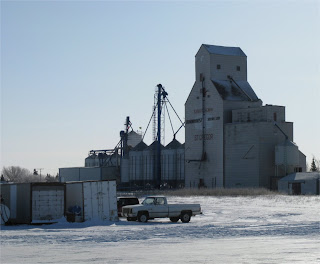
Speaking of sausages, before I left Saskatchewan, I was directed by two independent and reliable gastrophiles (Dee and Glen) to the town of St Gregor
and the red and white striped home of Prime Meats.
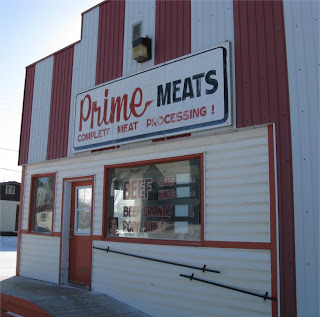
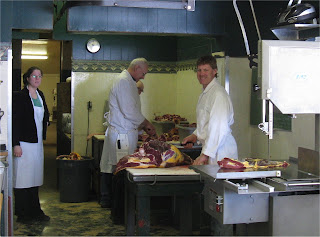
Glen has been a loyal customer for at least 30 of the 31 years the company has been offering local employment and high quality smoked locally-reared meats to smoked German sausage fans far and wide, and so I accepted his judgement. The odour of woodsmoke, which Dee commented on, was most appetising, and you can peek behind the counter to see men in action on sawdust floors. Long may they continue!.
And for those who wish to celebrate Welsh heritage in poetry, why not try your hand at three classic Welsh poetry forms? (Though I am a bit dubious about the Welshness of Terza Rima… was Dante a Welshman?)


Latest Posts
- Sublime
- Good weather for reading
- The world, the world
- Sublime launch!
- Planet Earth Poetry – Readings by Volunteers, Victoria 2026
- Poetry at the Goldfinch
Aldeburgh Poetry Festival Barny Haughton BBC BC poets Berkswell blackberries Black Stilt Bologna book launch Borough Market Carlo Petrini Catalonia Cyrus Todiwala dairy Daunt's Books Dijon Edinburgh Fanny Bay Feast of Fields Food and Morality food history food journalism Jenna Butler lardo Malahat Review Michael Pollan Okanagan olive oil tasting olive trees Omnivore's Dilemma Our Food Our Future Oxford Parmigiano-Reggiano Planet Earth Poetry poetry poetry readings Poetry videos prosciutto salumi Sean O'Brien Suffolk ticks Wendy Morton Wired Writing Yvonne Blomer
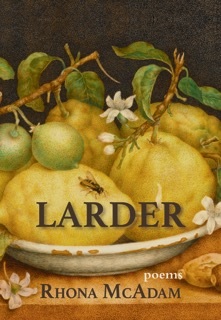
In her latest collection, Rhona McAdam navigates the dark places of human movement through the earth and the exquisite intricacies lingering in backyard gardens and farmlands populated by insects and pollinators, all the while returning to the body, to the tune of staccato beats and the newly discovered symmetries within the human heart.
“…A beautiful, filling collection, Larder is a set of poems to read at the change of the seasons, to appreciate alongside a good meal, and to remind yourself of the beauty in everything, even the things you may not appreciate before opening McAdam’s collection….”
Rhona McAdam is a writer, poet, editor, and Registered Holistic Nutritionist with a Master’s in Food Culture from Italy and a deep-rooted passion for ecology and urban agriculture. Her work spans corporate and technical writing to poetry and creative nonfiction, often exploring the vital links between what we eat and how we live. Based in Victoria, BC, and available via Zoom, Rhona is always open to new writing commissions, readings, or workshops on nutrition and the culinary arts.