-
Happy farmers and googly-mad writers
The blessed 60 day extension to the Madrona Farm fundraising campaign has yielded some truly gratifying results. Written up in Guy Dauncey‘s EcoNews, it caught the attention of a right thinking reader, Mel McDonald, who came up with the $200,000 that was needed for a matching donation by Ed Johnston, which reduced the amount needed to an entirely manageable sounding $287,000 – by March 31st. Still a lot of money to come up with, but “a lot” is certainly less than “a staggering amount”. And it’s a pittance compared with the amount that’s been raised – $1,413,000 so far.
A group of BC writers are carrying on their declamation of the Google Book Settlement as the final opt-out date looms hugely (January 28) before us. This is the date to opt out or opt back in if you went out but changed your mind. If you’re just plain mad, there’s a letter of protest (Canadian Writers Against Google Settlement petition) being sent to the US courts: to add your name, send it quickly to dvbolt@aol.com . Writers who are spending this last day on the fence are advised to devote some small part of it reading this FAQ on the settlement by the (US) National Writers Union.
-
David O’Meara reading, A Chemical Reaction, and Slow Food Pasta
Food and poetry reared their twin heads last week, with a sprinkling of pesticide in the middle.
On Tuesday, Ottawa poet David O’Meara came into town to read from Noble Gas, Penny Black as well as older and newer work, at Open Space Gallery. The reading was probably the highest he’d done; we were up near the ceiling becoming part of an installation (Bamberton: Contested Landscapes). Here, he sizes up the pulpit with Tim Lilburn.
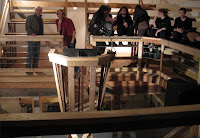
Introduced by Garth Martens…
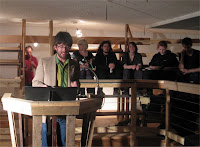
O’Meara took the.. er.. floor, and after the reading was interviewed by poet Steven Price.
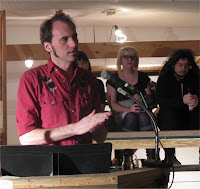
Thursday I attended a screening of A Chemical Reaction, sponsored by the Canadian Cancer Society, which is lobbying for a cosmetic pesticide ban in BC (you can send the government an email: they are seeking input on this matter till February 15). The man behind the film, Paul Tukey, is a former landscaper who through his own and his son’s experiences learned the personal and health costs of cosmetic chemicals.
He wanted to tell the exemplary story of the town of Hudson, Quebec, which imposed the first cosmetic pesticide ban in North America – due to the fearless work of local dermatologist Dr. June Irwin, who continues – at her own expense – testing skin and blood samples from all her patients, to monitor the presence of toxic chemicals in their bodies.
The film was an instructive lesson in the hard work of pushing municipal legislation through, particularly when it puts a multinational’s revenue stream at risk. Because of the town’s wish to stay chemical free, chemical companies sued it all the way up to the Supreme Court (it won!).
But those guys don’t give up without a long, expensive fight. Now Canada is being sued by Dow Chemical for violating the terms of NAFTA, which it feels, give it carte blanche to make its money unimpeded by pesky legislation or trivialities like long term health costs caused by recommended application of its products (hmm, why does that sound so familiar..?)
Dr Irwin’s advice to those who wish to follow her example and don’t know where to begin? “Letters to the editor are free” she says, and makes full use of that avenue. Her other strategy was to attend – live and in person as we all have the right and privilege to do – municipal council meetings, and speak up about her concerns, supported by her findings. Even so, with her more or less constant presence and insistence that they read her findings, it took her six years to convince them to act. The film asserts that had it not been for a receptive mayor, the bylaw would never have gone through. Despite the medical evidence.
The film also explains the systematic way the pesticide companies have exerted influence on state legislators in the US to make sure no municipality can follow Hudson’s lead. But as Tukey observed: we all have the right to vote with our wallets. Just stop buying the stuff.
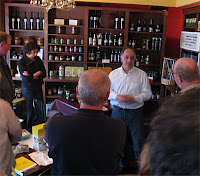
To round out my week, on Sunday, Slow Food Vancouver Island held a pasta workshop and tasting at Ristorante La Piola in Victoria. About 40 of us milled about the place listening to various people talk pasta and sauce. Here’s Mauro Schelini, of The Tuscan Kitchen, advising us only to buy pasta machines that are made in Italy (the Chinese ones, he says, are too frail and have a tendency to spit metal filings into your pasta when they are new).
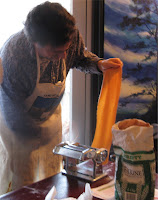
Don Genova shows us how to roll…
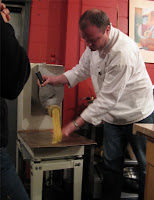
La Piola’s executive chef Cory Pelan catches and cuts the pasta as it comes out of the extruder.
The best part of any demo… seeing the tasting plates fill.
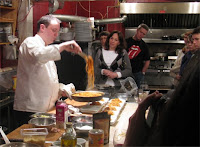
Eric Whitehead, mushroom forager, of Untamed Feast, shares a few morels and his special way with pasta sauce.


…Resulting in more tasting plates…
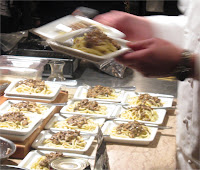
And very happy endings:

-
Milky justice
Last week’s Ontario court case decision on the Michael Schmidt/raw milk issue – which has been dragging on since Schmidt had his farm raided in 2006 – has lactivores bubbling over with questions. Schmidt had been charged with illegally selling unpasteurized milk to people who chose to drink it, and exercised their choice by the only means legally open to them, by subscribing to a ‘cow share‘ enterprise. This means buying a share of a cow and contributing to its upkeep, in return for which receiving a quantity of raw milk. There is a similar system – Home on the Range Dairy – in BC which has been subjected to a sustained attack by our own public health buttinskis in recent weeks.
One part of the public health attack has been to publish a misleading press release that mentions the presence of fecal matter in the dairy’s milk. What the release fails to mention is that fecal matter is present in just about everything we eat, drink and touch, including soft drinks, spinach, government-inspected beef, and public health-approved pasteurized milk and milk products. It can certainly cause serious health problems, but the important distinction where testing is concerned is the fecal count, not the mere presence of fecal matter, and the press release is curiously shy of mentioning this. Nor do the public health officials claim to have tested for or found E. coli, which is, according to the Food Safety Network, the best way of testing for fecal contamination. In fact the whole manner of testing in this instance is considered highly biased.
Raw milk is a murky subject, much debated. It is hard to separate the views of the pro-pasteurization side from their vested interests in industrial scale production – which can by their very nature cause so many health problems that some kind of public protection is certainly called for. Most of the pro-raw milk defense comes from the Weston A. Price Foundation, which is not universally revered, but does have many sane and healthy supporters. There are genuine causes for concern about raw milk, as there are for production of any animal food likely to be consumed by people with delicate immune systems.
My personal experience with raw milk was in Italy, where the law allowed me to purchase raw milk from a machine in a shopping mall – the provision being I had to fill the bottle myself. There was a large sign posted on the machine warning pregnant women that raw milk could be dangerous, but I saw at least one near-term consumer ignore this. The milk was fabulous, rich and flavourful and made impressive custards and puddings. When we visited Epoisse producers in France, we were given a tasting and demonstration at which it was explained that the runniness of a ripe Epoisse is due to EU and North American market requirements that they use pasteurized milk. When the cheese is properly and traditionally made with raw milk, the paste shouldn’t collapse, but be soft and firm. Pasteurization also kills off many of the microflora that give any artisanal cheese depth, texture and flavour.
So. Canadian raw milk consumers are rejoicing in what seems like a great victory in the Schmidt case, but is in fact only a local affirmation by the Ontario Court of Justice that he operated within the law in Ontario. It’s unlikely the ruling will give strength to either side of the pasteurization argument, as the presiding judge made clear in his closing remarks:
I wish to make it perfectly clear that my decision to acquit the defendant on all charges-
* In no way stands for the proposition that henceforth it is legal to market unpasteurized milk and milk products in the Province of Ontario;
* In no way purports to undermine or invalidate the milk marketing legislation in this Province, which has been held to be valid legislation byt he Ontario Divisional Court in Allan v. Ontario (Attorney General) (supra);
* In no way supports either side of the debate on whether the consumption of unpasteurized milk or milk products is healthy or constitutes a health hazardCBC has a poll you can take to share your opinion on whether or not people should be allowed to drink raw milk. Take it here.


Latest Posts
- Sublime
- Good weather for reading
- The world, the world
- Sublime launch!
- Planet Earth Poetry – Readings by Volunteers, Victoria 2026
- Poetry at the Goldfinch
Aldeburgh Poetry Festival Barny Haughton BBC BC poets Berkswell blackberries Black Stilt Bologna book launch Borough Market Caerphilly Carlo Petrini Catalonia culatello Cyrus Todiwala dairy Dijon Edinburgh Fanny Bay Feast of Fields ferries Food and Morality food journalism Michael Pollan olive oil tasting Omnivore's Dilemma Our Food Our Future Oxford Parmigiano-Reggiano persimmons Planet Earth Poetry poetry poetry readings Poetry videos prosciutto salumi Sean O'Brien sensory analysis Suffolk ticks tortelli di zucca Troubadour Wendell Berry Wendy Morton Yvonne Blomer
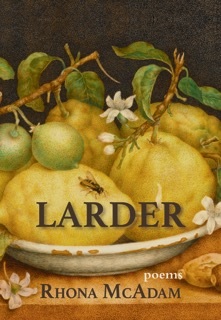
In her latest collection, Rhona McAdam navigates the dark places of human movement through the earth and the exquisite intricacies lingering in backyard gardens and farmlands populated by insects and pollinators, all the while returning to the body, to the tune of staccato beats and the newly discovered symmetries within the human heart.
“…A beautiful, filling collection, Larder is a set of poems to read at the change of the seasons, to appreciate alongside a good meal, and to remind yourself of the beauty in everything, even the things you may not appreciate before opening McAdam’s collection….”
Rhona McAdam is a writer, poet, editor, and Registered Holistic Nutritionist with a Master’s in Food Culture from Italy and a deep-rooted passion for ecology and urban agriculture. Her work spans corporate and technical writing to poetry and creative nonfiction, often exploring the vital links between what we eat and how we live. Based in Victoria, BC, and available via Zoom, Rhona is always open to new writing commissions, readings, or workshops on nutrition and the culinary arts.