-
Edible words
I have not talked about poetry for a while. Food has seemingly taken over; but food poetry and writing are holding their own too. Here’s a little update of my food writing news:
Food poems are being published in a couple of specialist food & literature publications: I’m currently in CuiZine, out of Montreal, and will soon be slathered on the pages of Alimentum, which is from New York.
JackPine Press in Saskatoon, which does wild and innovative limited edition chapbooks, is publishing Sunday Dinners next month, which features 8 of my food poems presented like the treasures found in the pages of old cookbooks, thanks to the artistic genius of my clever collaborator, Colleen Philippi. We’ll be launching it here in Victoria at Open Space Gallery on June 19.
Not sure when, but sometime in the next 12 months I’ll also be launching a 20-page chapbook of food poems, The Earth’s Kitchen, from Lantzville’s delightful Leaf Press. More on that as it unfolds.
And my most recent and most exciting news is that I’ll have a piece included in Lonely Planet‘s anthology of food & travel writing, A Moveable Feast: Life-Changing Food Encounters Around the World, which will be published in the fall.
-
Let me eat cake
It’s a breezy day in Victoria and damp enough to keep me away from the lawnmower again this morning. Soon, all will be jungle.
I spent last weekend baking cakes instead of mowing my lawn. Here’s what I learned:
Angel food cake is just 4 things: egg whites, sugar, flour and acid (cream of tartar), plus flavourings (salt, vanilla). The acid stabilizes the egg whites once they are beaten. We also added lemon zest and a little lemon juice (which adds both flavour and more stability). We were told never to use non-stick pans, and to mist (with water) rather than oil the pans so that the fragile batter had something to cling to as it rose. It also needs walls to hang onto, hence the use of tube pans. And when we cooled it (for a minimum of 3 hours) we did so upside-down to allow gravity to help the cake stay tall. The steam trapped inside the pan during cooling helps to loosen the cake when it’s time to take it out.
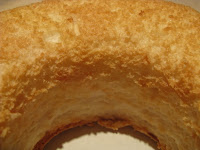
After that it kept brilliantly and was lovely and light 3 days later when I served it with some awful organic California strawberries and cream (the things I do for food knowledge).
(Actually: I will not be buying California strawberries again as I’ve just watched Forever Plastic and seen how non-recyclable is plastic clamshell packaging)
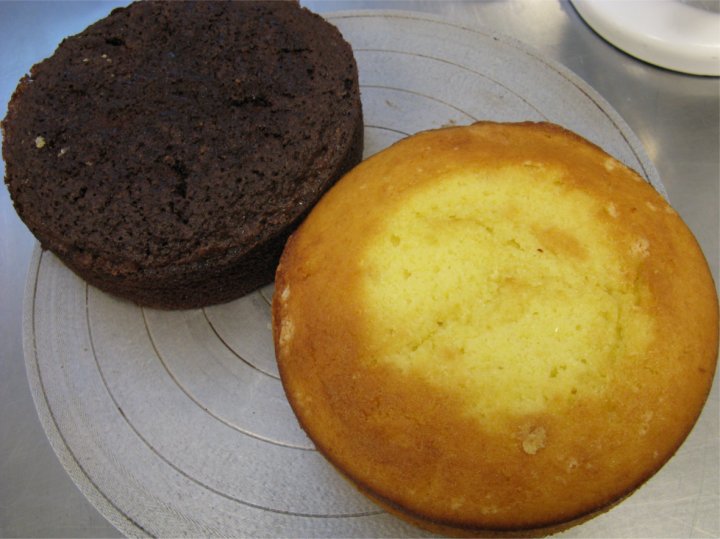
Then we made two more cakes (chocolate and butter)
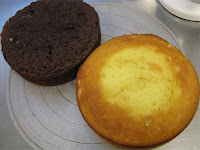
and learned a bit about butter cakes: the importance of making your butter/sugar mix fluffy before you start throwing eggs into it; the abrasive effect of sugar on butter which helps to cream it; and the importance of smoothing the batter before you put it in the oven. We learned three tests to determine whether a cake was done: feel (does it spring back when touched); stability (if it looks wobbly it’s not done); edges (are they pulling away from the pan’s sides?). And we inverted the cake pans (propped up so the tops weren’t touching anything) to keep the filling light while cooling.
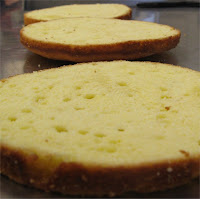
We then chilled our cakes and on day 2 we cut them (not to be attempted when they’re fresh from the oven). First we put the cake on a rotating cake stand and marked two evenly spaced lines with our knives; then we lightly circled round cutting about an inch in, to make sure the first cut was even; then we circled round again and severed the first round. Then we repeated and separated the three layers. We kept the bottom layer as the bottom and, depending on how bulgy the top was, might flip it over to make for a flat top in the finished product.
We had made some simple syrup and some orange curd for use in our frosting exercises.
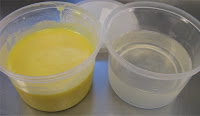
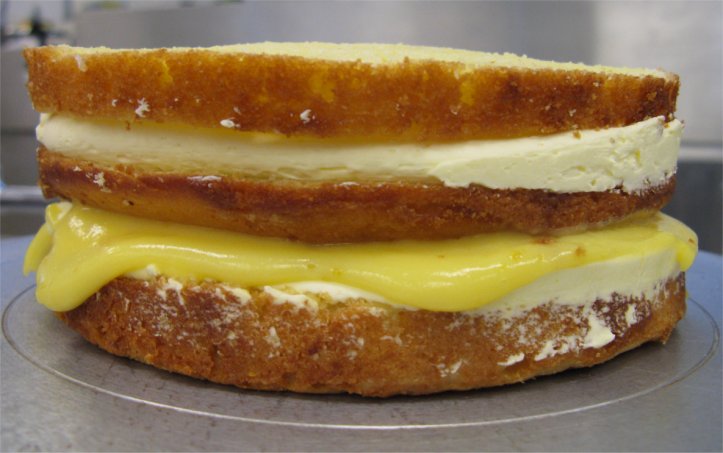
We brushed all three layers of the cakes with simple syrup, to keep them moist. Then we spread the curd on two of the layers. If it was too soft (we’d made it with gelatine but some batches were softer than others) we piped some butter cream icing to make a dam

to keep it from drooling over the edges like this

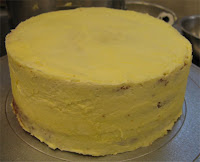
and then refrigerated it so everything could firm up. Then we took it out and applied a thin layer, the “crumb coat,” and put it back to chill some more before the final decorating. Cakes can be frozen at this stage.
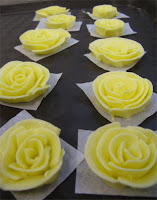
We passed the time learning to pipe flowers
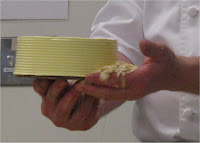
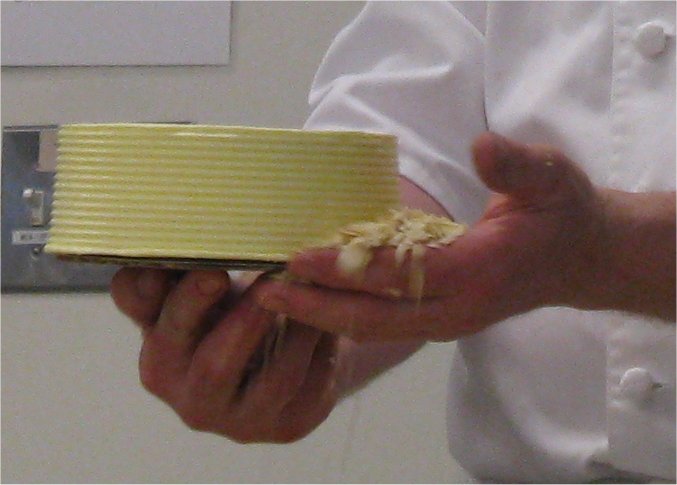
and comb icing round the sides.

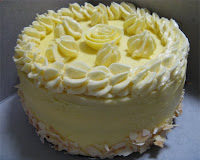
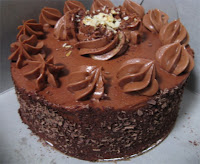
I did not master the combing but was quite pleased with my flowers. So was my bench-mate, apparently, as he made off with most of mine before I got to the decorating stage. Still, it looked ok even with no combing and only one flower. The almonds round the bottom helped (but they’re also there to hide the inevitable imperfections that iced cakes will have at the base).
Chocolate one looked ok too, and the ganache filling was divine.
-
Spring greens, crackling and tuna
Now that I’m harvesting just about a meal’s worth of greens every day, at least those I can wrest from the appetites of the resident slugs, I am starting to think about what to do with them. It’s mostly rocket/arugula/rucola, a bit of kale, and a bit of spinach. (This picture includes purple sprouting broccoli which is done now.)

Spinach is a funny one. It used to be the champion green, loaded with iron… until we discovered (back in 1937) that someone had misplaced a decimal point and it’s not the Popeye dream after all. Now I learn that its oxalic acid content makes it hard to digest what iron it does contain; and tea and coffee can also make it harder to absorb. Apparently drinking a Vitamin C-rich drink with your meal will help your body along.
I am always entertained by other people’s scientific experiments with food, so I enjoyed this quest for the perfect pork crackling.
And as seafood generally becomes more problematic, I am particularly leery around tuna. The popular wisdom is eternally contradictory. For example, I hear that bluefin is out, but troll-caught albacore is ok due to sustainable fishing methods (so says the ‘impartial’ advice from a website called PR web, and a number of albacore fishery websites). Then I read this article which explains that sushi grade albacore is the worst for mercury levels. I think I will have to go on mostly avoiding it.








Latest Posts
- Sublime
- Good weather for reading
- The world, the world
- Sublime launch!
- Planet Earth Poetry – Readings by Volunteers, Victoria 2026
- Poetry at the Goldfinch
Aldeburgh Poetry Festival Barny Haughton BBC BC poets Berkswell blackberries Black Stilt Bologna book launch Borough Market Caerphilly Carlo Petrini Catalonia culatello Cyrus Todiwala dairy Dijon Edinburgh Fanny Bay Feast of Fields ferries Food and Morality food journalism Michael Pollan olive oil tasting Omnivore's Dilemma Our Food Our Future Oxford Parmigiano-Reggiano persimmons Planet Earth Poetry poetry poetry readings Poetry videos prosciutto salumi Sean O'Brien sensory analysis Suffolk ticks tortelli di zucca Troubadour Wendell Berry Wendy Morton Yvonne Blomer
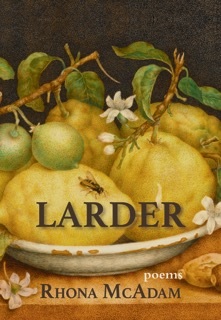
In her latest collection, Rhona McAdam navigates the dark places of human movement through the earth and the exquisite intricacies lingering in backyard gardens and farmlands populated by insects and pollinators, all the while returning to the body, to the tune of staccato beats and the newly discovered symmetries within the human heart.
“…A beautiful, filling collection, Larder is a set of poems to read at the change of the seasons, to appreciate alongside a good meal, and to remind yourself of the beauty in everything, even the things you may not appreciate before opening McAdam’s collection….”
Rhona McAdam is a writer, poet, editor, and Registered Holistic Nutritionist with a Master’s in Food Culture from Italy and a deep-rooted passion for ecology and urban agriculture. Her work spans corporate and technical writing to poetry and creative nonfiction, often exploring the vital links between what we eat and how we live. Based in Victoria, BC, and available via Zoom, Rhona is always open to new writing commissions, readings, or workshops on nutrition and the culinary arts.