-
AWP: The madness begins
Read Full Post: AWP: The madness beginsDay one of the conference over and already I feel limp as an old pile of carbon paper. Eight hours, five sessions… so much passed over, unseen, unheard, unread. A few Canadian writer friends emerging from the 4000 faces: Eunice Scarfe, Caterina Edwards and Aislinn Hunter.
My first session was Formal Play in Modern poetry, a group of young poets giving papers. Bryan Penberthy (or, oh lordy was it Brian Spears?) talked about attempting to harness persona for a book-length sequence of Robert Johnson poems. Listing Anne Carson’s Autobiography of Red and Michael Ondaatje’s Collected Works of Billy the Kid among his models, he explained how he eventually stopped trying because he felt he was imposing his voice or his idea of Johnson on his subject. “My voice is my voice,” he said, “and I have a hard enough time telling my own story without channelling someone else.”
I flew the considerable length of two considerably long buildings to find Bird-Witted: Birds in Modern Poetry, where there were many allusions to Elizabeth Bishop and readings of her poems “The Sandpiper” and “Little Exercise”. Michael Sowder explained some of the reasons genus corvus (crows, ravens) had populated his poetry for many years; for example because corvus is sacred to Apollo, god of poetry. The panel’s own eccentric poetry god Gerald Stern warbled his way to the podium on some old bird tunes, “Bye, Bye Blackbird” and “White Cliffs of Dover” among them. He read a couple of poems on his bird of choice, the cardinal.
Back I galloped to my original starting point, where I learned about the Academy of American Poets‘ survey of poetry reading in USA. The report has yet to be released, but we learned some surprising facts, for example that current readers of poetry are more involved in all leisure time activities except watching television than are readers of things other than poetry. They are also more socially engaged than non-poetry readers, so the myth of the poetry lover as lonely weirdo is incorrect (phew!). The man from the NEA told us about its survey on involvement in the arts (not just poetry) which found that less than half – 46% – of all US adults have read anything at all – poetry, fiction, drama – in the past year. There are some valiant attempts in the US to boost interest in poetry through programming such as Poetry Out Loud, a national program of poetry memorisation and recitation for students, and National Poetry Month (coming up quickly: April!).
Moving swiftly and decisively down the hall, I heard the editors of a clutch of the “monoliths” of American literary journals – the Missouri Review, the Virginia Quarterly Review, the Georgia Review, the Kenyon Review and the Southern Review – talk about some of their issues. Like why they were all white bearded men (four of five had goatees!) when their readers and contributors aren’t. But also about the importance of university funding to what is invariably a loss making enterprise, albeit a crucial part of the cultural life of American literature, and “one of the few art forms where the practitioners can be the patrons,” said one editor, urging us all to subscribe.
I managed the first half hour of The Poetry House at 20 reading before collapsing onto a bus and resting up for the evening speaker, Walter Mosley, who described his only previous experience of an AWP conference, back in 1989. He said he’d felt like a fraud as he was unpublished and not teaching writing, but he warmed to the sense of a community of writers that he found at that meeting. And, as in a good fairy tale, he returned home from the conference sporting that post-conference glow, got a helping hand from a fellow writer, and found an agent, a publisher and enduring fame. He had some fine words to say about the value of writing for writing’s sake, the great good fortune of writers who can turn their many obstacles into subjects for their writing – a true poetic justice, he said – and who can and must witness to the injustices of our time and place because we have the words and the voice to do it.
And food? We walked in the steps of Janis Joplin (and Frank Zappa, Waylon Jennings, Willie Nelson and a zillion others) to Threadgills for some home cookin’. Chicken and dumplings (with free second helpings) were on special, but we opted for fried catfish, which was right tasty.
-
Austin ABC
Read Full Post: Austin ABCA is for Art: we ambled on up to AMOA where the Christo and Jeanne-Claude exhibition was running with an informative little documentary. We came out of there just itching to wrap something – anything – up in saffron fabric and a bit of old string…
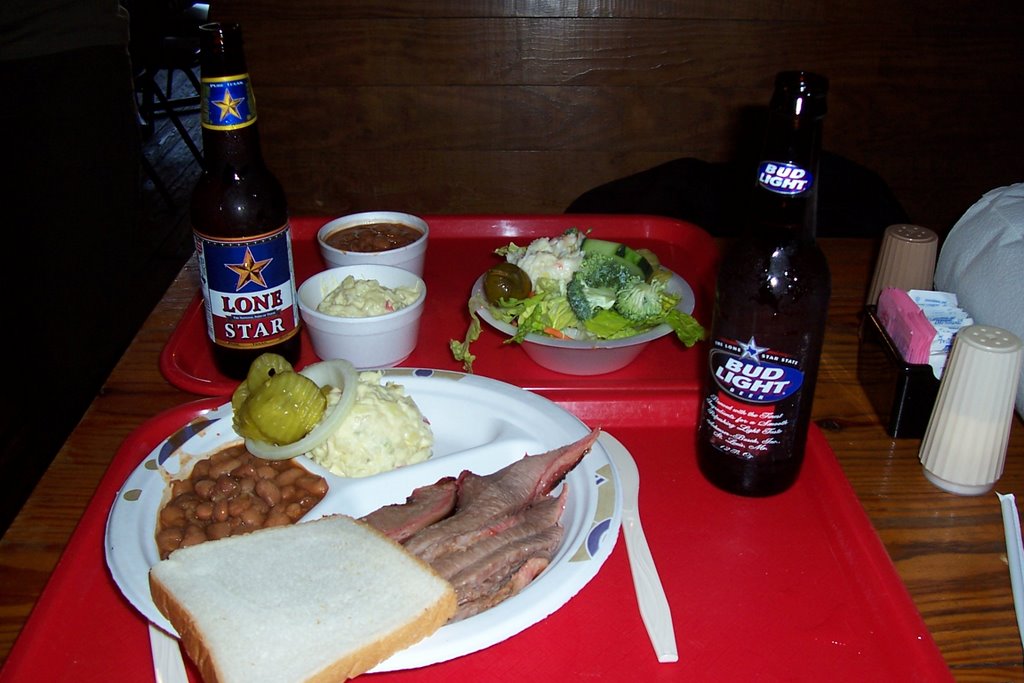
 B is for Barbecue!At last! I have been initiated. On the recommendation of a local gal working the AWP registration desk, we walked behind the convention centre to the Ironworks, which provided authentic and delicious Texas barbecue with all the fixin’s. Perched over a creek (where we spotted a jumbo turtle – snapper? – and three smaller ones frolicking, or perhaps terrorizing one another) with plenty of autographed testimonials on the walls, it had lots of selection for carnivores and even a good little salad bar and tasty beans for the vegetarians.
  A couple of locals gave me some guidance for choosing my meat. “In the south-east,” she drawled, “they *think* that barbecue is pork. But in Texas, it’s beef.” And so it was.
C is for the fabulous, the legendary and the conveniently local Continental Club, where we attended happy hour and the musical stylings of blueser Gary Clark Jr. Lanky is one word for him. Limber of plectrum are a few more. To these old ears he proved that good things come in threes: “Shame, Shame, Shame” and “Mercy, Mercy, Mercy” were among his repertoire. Best of all, he was playing for tips at an hour we could manage (7pm). There are two late night shows, 10pm and midnight. If we have the stamina for a return visit post-conference one night, he’s playing again on Friday, and the Seatsniffers from Belgium (?) are on tomorrow.
-
Tacos to typewriters
Read Full Post: Tacos to typewritersYesterday’s rambles took us from commerce to culture. We caught the ‘Dillo, a handy free bus service in reproduction trolley cars, and alighted opposite the Texas State History Museum, where we dodged flocks of school children to get to the excellent gift shop, stocking up on postcards and a few portable Texas flavoured knick-knacks.
By the time we got to Guadalupe on the other side of campus, it was high noon and we had to rustle up some grub. One of the travel forums had mentioned the Chipotle Grill, which was crowded with grateful students eating their incredibly good tacos and burritos for around $5. Thus fortified, we carried out a gruelling investigation of every clothing store in the area – and there are many, all of them apparently catering to twenty-something anorexics – after which we found our way to the Harry Ransom Center to see the Technologies of Writing exhibition.
Its many wonders included a note written to Arthur Miller in lipstick by one of his wives (not, apparently, Marilyn); and a sequence of 8 radiograms written by Ernest Hemingway, reporting from Madrid in 1935. One of them described “gastric remorse from excellent pre-battle celebration.” A letter from Tennessee Williams described how his Jaguar had crashed into a tree in Italy, after he’d taken two or three medicinal swigs from his thermos to counteract his nervousness, and he was struck on the head by his portable typewriter, which was damaged worse than he was. There was a page of manuscript from The Green Dwarf, by Charlotte Bronte, in such microscopic print the curators explained it must have been written with a sparrow feather quill. We saw Anne Sexton’s typing manual, and her Quiet De Luxe Portable Typewriter. Also one of Edgar Allen Poe’s writing desks, and a splendid “writing chair” created for one Compton Mackenzie.
We also visited a gallery on South Congress, Yard Dog Folk Art, where we saw some pieces by Tom Russell. Not *that* Tom Russell, we wondered? But yes, the writer of Navajo Rug (and my personal favourite, Road to Bayamon) is also a painter. Not my cup of tea, glass of beer, sip of water, but good on him just the same.
Disappointingly, Chipotle Grill was to be the culinary highlight of our day. We had a spectacularly average supper at Guero’s Taco Bar. The place – a cavernous silver room – was heaving with diners even at 9pm on a Tuesday night, so in my most charitable mood I can speculate that perhaps there are more reliable choices on the menu than the red snapper and vegetarian dishes we ordered. And nicer wait staff. Say no more.
Our momentum slowed by an incipient cold for one and a resurging migraine for the other, we decided to pass on the poetry open mic at Ruta Maya and ended the evening watching The Philadelphia Story and hoping for more stamina in the morning. We’re expecting a high around 30c today after which it should cool to the mid-twenties again…



Latest Posts
- (no title)
- Sublime and Twisted Readings coming up!
- Sublime
- Good weather for reading
- The world, the world
- Sublime launch!
Aldeburgh Poetry Festival Barny Haughton BBC BC poets Berkswell blackberries Black Stilt Bologna book launch Borough Market Carlo Petrini Catalonia Cyrus Todiwala dairy Daunt's Books Dijon Edinburgh Fanny Bay Feast of Fields Food and Morality food history food journalism Jenna Butler lardo Malahat Review Michael Pollan Okanagan olive oil tasting olive trees Omnivore's Dilemma Our Food Our Future Oxford Parmigiano-Reggiano Planet Earth Poetry poetry poetry readings Poetry videos prosciutto salumi Sean O'Brien Suffolk ticks Wendy Morton Wired Writing Yvonne Blomer
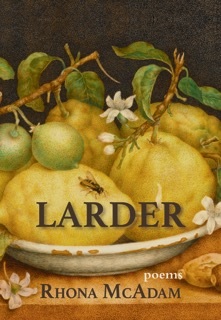
In her latest collection, Rhona McAdam navigates the dark places of human movement through the earth and the exquisite intricacies lingering in backyard gardens and farmlands populated by insects and pollinators, all the while returning to the body, to the tune of staccato beats and the newly discovered symmetries within the human heart.
“…A beautiful, filling collection, Larder is a set of poems to read at the change of the seasons, to appreciate alongside a good meal, and to remind yourself of the beauty in everything, even the things you may not appreciate before opening McAdam’s collection….”
Rhona McAdam is a writer, poet, editor, and Registered Holistic Nutritionist with a Master’s in Food Culture from Italy and a deep-rooted passion for ecology and urban agriculture. Her work spans corporate and technical writing to poetry and creative nonfiction, often exploring the vital links between what we eat and how we live. Based in Victoria, BC, and available via Zoom, Rhona is always open to new writing commissions, readings, or workshops on nutrition and the culinary arts.