-
Chicken and rhetoric
Read Full Post: Chicken and rhetoricWhat I was really craving last night – and had defrosted a small flock of chicken thighs in anticipation – was Chicken Jeera, but too late discovered that the nub of ginger in my fridge was mummified beyond reconstitution. Claudia Roden to the rescue! Her Mediterranean Cookery has been endlessly helpful to me in the past, and last night she gave me Pollo al Rosmarino, which instructs that a couple of sprigs of rosemary and a couple of halved cloves of garlic be heated in a mixture of butter and oil, to which you add and brown your chicken pieces (I had 6 thighs), and then throw in a glass of white wine, some salt and pepper, and turn it down to simmer for half an hour. Very nice it was, molto facile; eaten with potatoes, onion and zucchini cubed and cooked in lemon, butter and garlic, with a bit of fresh asparagus, it was just the thing to end the day.
Anyone who read Jill Tedford Jones’ article about Elizabethan sonnets and country and westen lyrics may have been as intrigued as I by the sheer number of rhetorical devices named in the piece. We use them in our poetry all the time, without necessarily knowing what they’re called. Tedford Jones speculates that “the student in Queen Elizabeth’s day could probably easily identify and create more than a hundred such devices,” while I could define perhaps half a dozen. So I’m going to work through these ones, consciously injecting one or two (devices, not terms) into new poems, and who knows, if you’re really unlucky, perhaps make my conversation more polysyllabic from now on. I found a couple of helpful sites – American Rhetoric and The Forest of Rhetoric – to help me get started. Here’s my Greek chorus:
anaphora
anastrophe
anadiplosis
antanaclasis
antimetabole
antithesis
apostrophe
appositive
chiasmus
ellipsis
epanalepsis
epistrophe
hyperbaton
hyperbole
metonymy
onomatopoeia
parenthesis
paronomasia
polyptoton
polysyndeton
syllepsis
symploce
synecdoche -
Words and water
Read Full Post: Words and waterJust looking ahead to a weekend’s literary merrymaking in Campbell River. The Words on the Water writers festival, being held in the Maritime Heritage Centre, starts on Friday. Even with a disabled website (some tragically ill-timed mishap involving corporate changes in their service provider ownership, coupled with who knows what associated administrative problems) they’ve managed to sell out their weekend passes and their Friday and Saturday night events.
We’re hoping to get to the Saturday daytime sessions at least, which will feature Evelyn Lau, Jan Zwicky, Claudia Casper, Robert Bringhurst, David Carpenter, Annabel Lyon, Gregory Scofield and Patrick Lane.
Because we can’t get into evening readings, I reckon we’ll be forced out onto the cold wet streets in search of alimentary culture instead. One pilgrimage I am never too sorry to make when I’m in Courtenay is to Tita’s, which I bet is the best Mexican food on Vancouver Island, or I’ll eat my sombrero.
-
Leonard on form
Read Full Post: Leonard on formAt the beginning of February, CBC presenter Shelagh Rogers – the best voice in the west? – interviewed our national icon Leonard Cohen about his induction into the Canadian Songwriters Hall of Fame. She talked to him about poetry as well, and he had some interesting things to say about the benefits he’d had from working within the “obligation of rhyme”. “Lift your heart in gratitude,” he says, because it lets you discover congruencies you’d never otherwise encounter. He likes form too:
“Form imposes a certain opportunity to get deeper than your first thought… I don’t have any ideas and I don’t trust my opinions… but when you submit yourself to a form then… you’re invited to dig deeper into the language and to discard the slogans by which you live, the easy alibis of language and of opinion… If you look in the Spenserian stanza for instance, which is a very, very intricate verse form where you have to come up with many rhymes of the same sound, you’re invited to explore realms you usually don’t get to with your ordinary easy thought… I consider my thought stream extremely uninteresting and it’s only when I can discard it that I can say something that I can get behind.”
While you’re hanging around the CBC site, try searching ‘Leonard Cohen’: I stumbled upon a CBC Archives clip of him reciting poems back in 1958…


Latest Posts
- (no title)
- Sublime and Twisted Readings coming up!
- Sublime
- Good weather for reading
- The world, the world
- Sublime launch!
Aldeburgh Poetry Festival Barny Haughton BBC BC poets Berkswell blackberries Black Stilt Bologna book launch Borough Market Carlo Petrini Catalonia Cyrus Todiwala dairy Daunt's Books Dijon Edinburgh Fanny Bay Feast of Fields Food and Morality food history food journalism Jenna Butler lardo Malahat Review Michael Pollan Okanagan olive oil tasting olive trees Omnivore's Dilemma Our Food Our Future Oxford Parmigiano-Reggiano Planet Earth Poetry poetry poetry readings Poetry videos prosciutto salumi Sean O'Brien Suffolk ticks Wendy Morton Wired Writing Yvonne Blomer
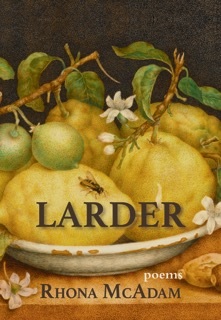
In her latest collection, Rhona McAdam navigates the dark places of human movement through the earth and the exquisite intricacies lingering in backyard gardens and farmlands populated by insects and pollinators, all the while returning to the body, to the tune of staccato beats and the newly discovered symmetries within the human heart.
“…A beautiful, filling collection, Larder is a set of poems to read at the change of the seasons, to appreciate alongside a good meal, and to remind yourself of the beauty in everything, even the things you may not appreciate before opening McAdam’s collection….”
Rhona McAdam is a writer, poet, editor, and Registered Holistic Nutritionist with a Master’s in Food Culture from Italy and a deep-rooted passion for ecology and urban agriculture. Her work spans corporate and technical writing to poetry and creative nonfiction, often exploring the vital links between what we eat and how we live. Based in Victoria, BC, and available via Zoom, Rhona is always open to new writing commissions, readings, or workshops on nutrition and the culinary arts.