-
Cheese-off
Read Full Post: Cheese-off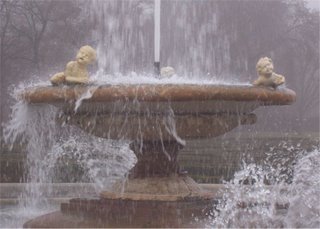
Colorno fountainWe learned something about cheese tasting yesterday in a first class on that subject, when we went nose-to-rind with four fabulous cheeses. It was very exciting and entirely delicious, which was a small miracle given the continuing cold-type ailment which has been working its way around my upper respiratory sytem since the first week of classes.
It helped that we were mostly trying strong cheeses – Fontina, Pecorino Toscano (an unusual one, aged 4 months in a cave!) and a very rare and exquisite four year old Parmigiano-Reggiano – as well as a fresh Mozzarella di Bufala Campana that was soft and yummy and totally unlike most anything that goes by the term “mozzarella” in Canada.
Someone had asked the cheese technology prof why there was no control over the use of the name Mozzarella, since it’s used worldwide to describe substances that only remotely resemble the original product in production methods, appearance and least of all taste, and he said something like, “oh to ask that question is to make wider the wound in the heart of every Italian”.
I’ve been awed and impressed by the pride and passion the people we’re meeting have about their food. His answer to the mozzarella question was that basically by the time Italian producers got around to applying to protect the name, “mozzarella cheese” was in really wide production (from a variety of methods) worldwide and Italy didn’t have an argument of scale sufficient to make a case for reclaiming the name. They did protect the “Mozzarella di Bufala” designation though, since water buffalo are not widely used for this kind of cheese production and are mostly found only in Italy, India and east Asia.
We discussed cheese tasting terminology, needed to capture the effects of various combinations of the 200+ different chemical compounds that make up tastes, smells and aromas in cheese. One important point was that it is fairly critical to have eaten widely and well if you want to taste cheese (or wine, I suppose) because in order to master the terminology you need to know other flavours as they are suggested to your palate – call on your olfactory memory: no easy thing. Apparently there is an international vocabulary to describe all this, that was only developed about six years ago. To supplement our handouts, I came across a good list of terms – the Cheese Connoisseur’s Glossary, at an artisanal cheese website – and an even better one: CheeseNet’s Cheese Glossary.
We did find it difficult to appreciate the full meaning of some of the tasting terms: for those of us not familiar with the exact nature of chestnut or arbutus honey, for example, the term is not so meaningful. Being one who enjoys splitting hairs, I’ve been speculating that given the differences that regional climate, vegetation and soil types make in end products of just about every agricultural enterprise, I’m guessing that there would be a noticeable difference in flavour between Italian and Canadian (and other) chestnut honeys. We’ll have to have a taste-off sometime to find out.
Well. That was it for today. We’ll be tasting six more cheeses next time.
Here are some more photos ’round town:
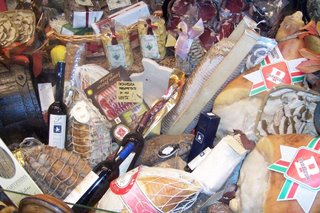
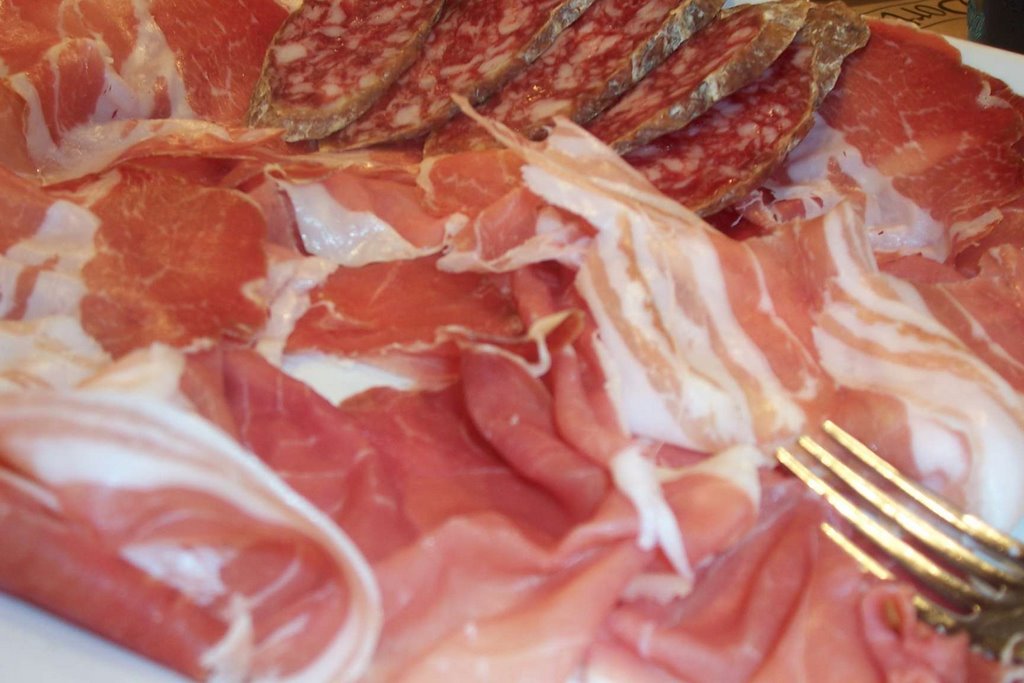
Parma specialties, Via Farini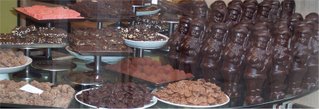
Some scary Santas (Babbi Natale)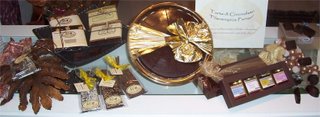
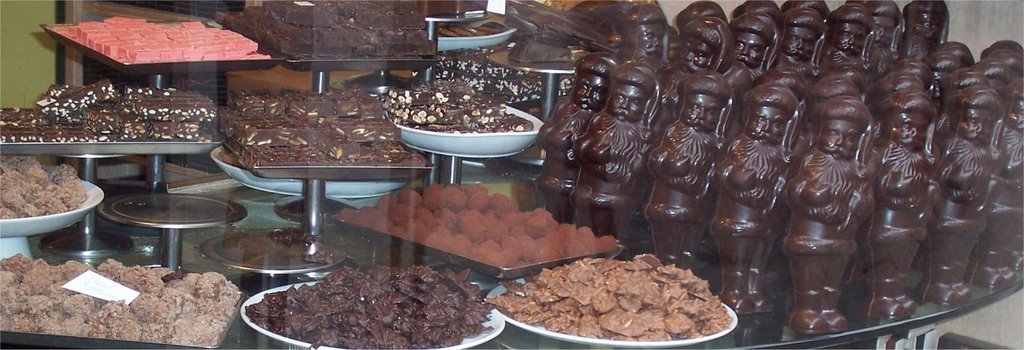
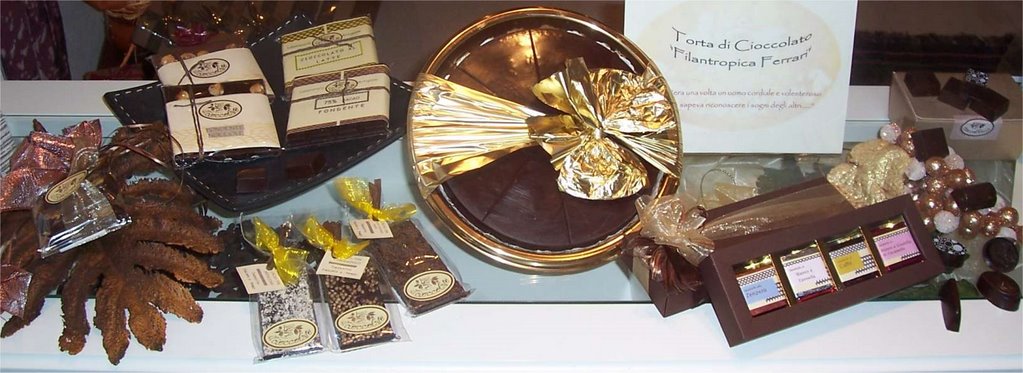
More chocolate…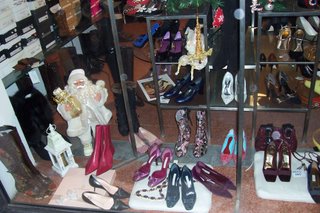
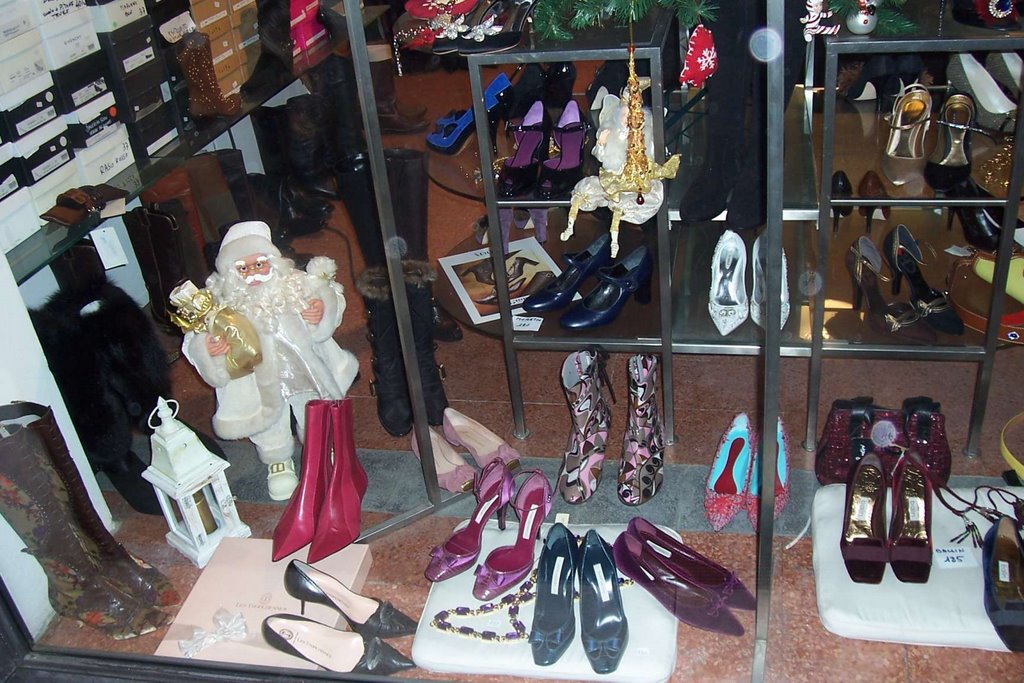
One for the shoe fetishists -
Dining in Viadana
Read Full Post: Dining in ViadanaLast night’s welcome dinner was an amazing and many-splendoured thing. It began with a logistical assembly on the Piazza, where beneath the Christmas tree, 24 of us were sorted and parcelled into car-sized batches, according to ultimate destination, for transport to the restaurant by various staff members. Our convoy (convoglio?) then hurtled through the darkness for half an hour or so, towards Mantova, over the River Po (largest river in Italy), to Viadana. We doubled back beneath the considerable span of its bridge to the Osteria da Bortolino, on the Po’s flood plain. The restauranteur said that they do occasionally have problems for this reason and that where we sat had been under several feet of water during the epic floods – the worst in 100 years – that hit Northern Italy in 2000.
There was a photograph of the building – neglected and run-down – from 1975. Since then it has been restored and embraced by locals and the Slow Food folk alike (it figures in the famed Osterie d’Italia guide – now available in English).
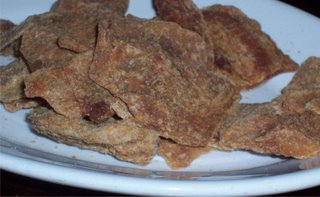
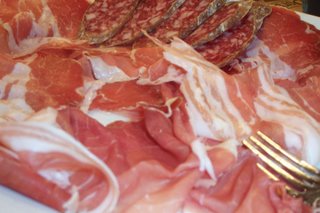
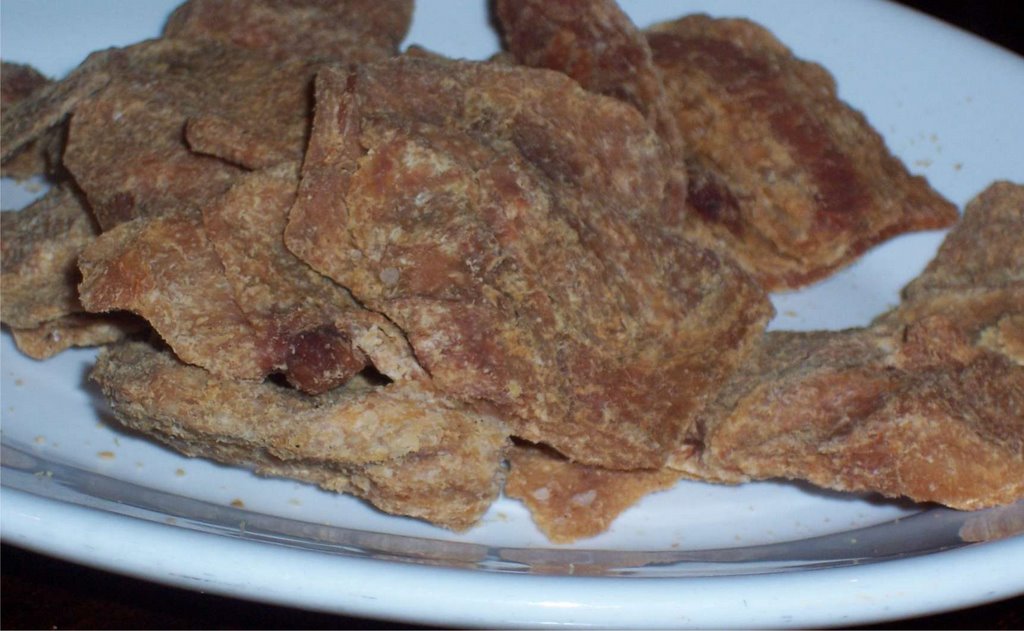
A nice plate of cicoliChosen as a good example of simple and typical osteria fare, it offered us five courses of Mantovan specialties. When we arrived the table was provisioned with baskets of bread and plates of cicoli, the local version of pork scratchings – as they’re called in England – these ones thin slices of fatty pork, fried and salted. Then arrived large platters of salumi – prosciutto of course, and coppa, pancetta and local salami. Delightful of course, and we followed Paolo’s advice that these things were normally eaten with the hands, on some of the bread.
Two courses of pasta ensued. The first, tortelli verdi, looking to me like ravioli – but we’re learning that pasta is named and filled regionally – apparently the pasta fillings change every twenty kilometres in this country. And though it looked like spinach the filling was in fact swiss chard.The next round was tortelli di zucca – a traditional Mantovese pumpkin filling, with mostarda and amaretti – sweet but tangy, not quite as sweet as the pure pumpkin pasta we had last week, sharpened by the mostarda (a sort of fruit jam made with mustard, and served mostly with cheeses). The aroma of the butter in which the tortelli were bathing, sprinkled with parmiggiano, swam out as we passed it around.
Meanwhile the university’s director, Vittorio Manganelli (a serious wine expert whose work on the Italian wine guide requires as many as 80 tastings per day each August!) arrived with a couple of heavy wooden boxes which the director of the Colorno campus, Carlo Catani, pried open, and they then attempted to begin educating our palates with tastings of a couple of the featured wines from the wine guide: first a Langhe Rosso “Bric du Luv” 2003 Ca Viola, from Piemonte. Delightful we thought and certainly preferred over the Lambrusco (a local sparkling red that, well, we had to try for the experience), though our expert somewhat dismissed it for its ‘international’ flavour. And we were then treated to a Barolo, venerated for its long-living tannens and – well – perhaps my vocabulary will be more adequate after next week’s Barolo tasting at a Parma enoteca (wine shop). It was very good, however we want to say that.
We next had a mystery dish – fried polenta slices with a stew that was, afterwards, revealed to be one of the house specialties: la carne di asina, lo stracotto di asinina. Sorry, Eeyore, it were a donkey. A female one. It is a dish traditional to the region, but the meat is hard to source now, and much of it comes from Slovenia or other countries; horse meat is apparently much easier to find locally these days. It’s a dish that takes three days to cook, as it’s rested between incarnations, and then served when it’s meltingly tender and richly flavoured. But to be honest, I don’t think I could have identified it as other than a well-cooked beef-like substance. It came with a platter of warm, meltingly tender spalla cotta – a kind of ham that had been cooked in wine and water.
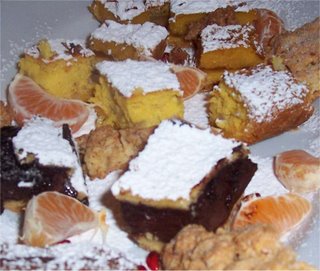
On to the dessert which was a selection of cakes: pear and chocolate; lemon (perhaps a rice cake, from the cheesecake-like consistency?); and a Mantovan specialty, sbrisolona whose name suggests the crumbs (briciole) that will fall from your lips as you eat.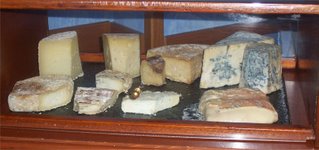
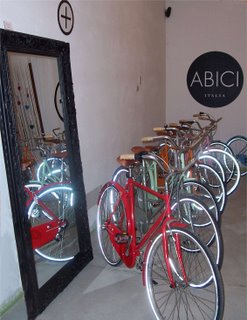
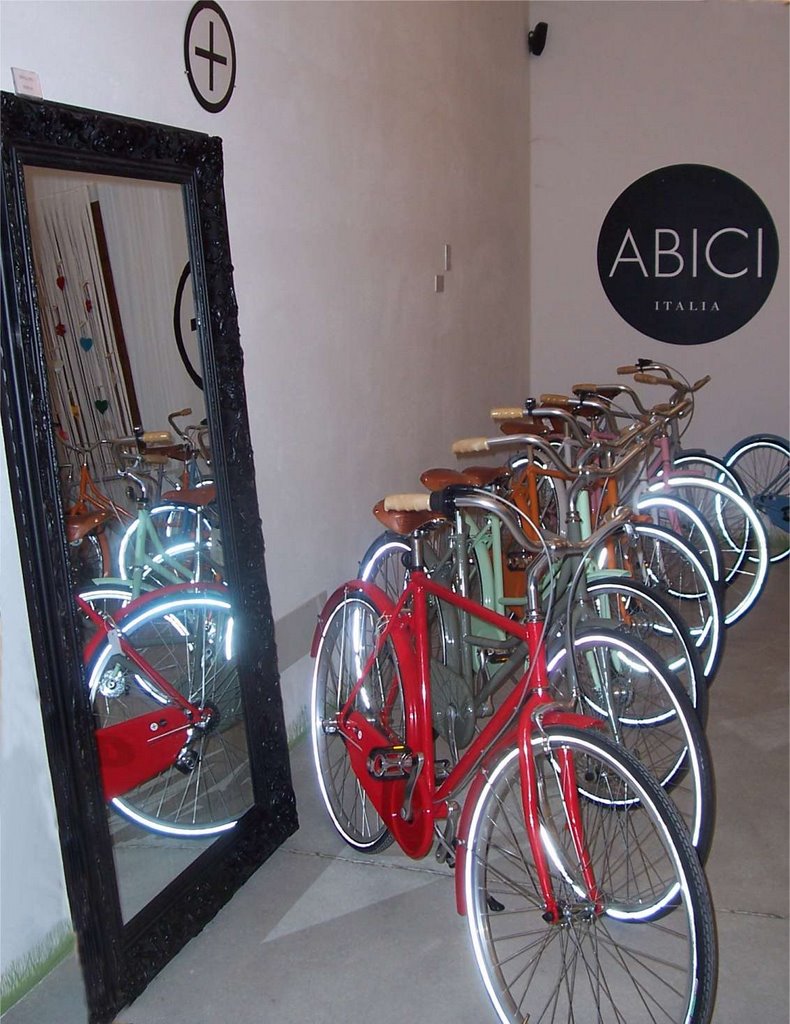
We passed by the beautiful cheese but did not eat…After supper we were bundled back into our vehicles and taken to a mystery location: ABICI (a pun on the Italian a-b-c; bici means bicycle) – a smart and unlikely shop we found on a cobbled street in Viadana. In we trooped for an impromptu party – bottles of prosecco were opened and the beer cooler was opened to us as well, as we marvelled at the designer knick-knacks and of course the bicycles.

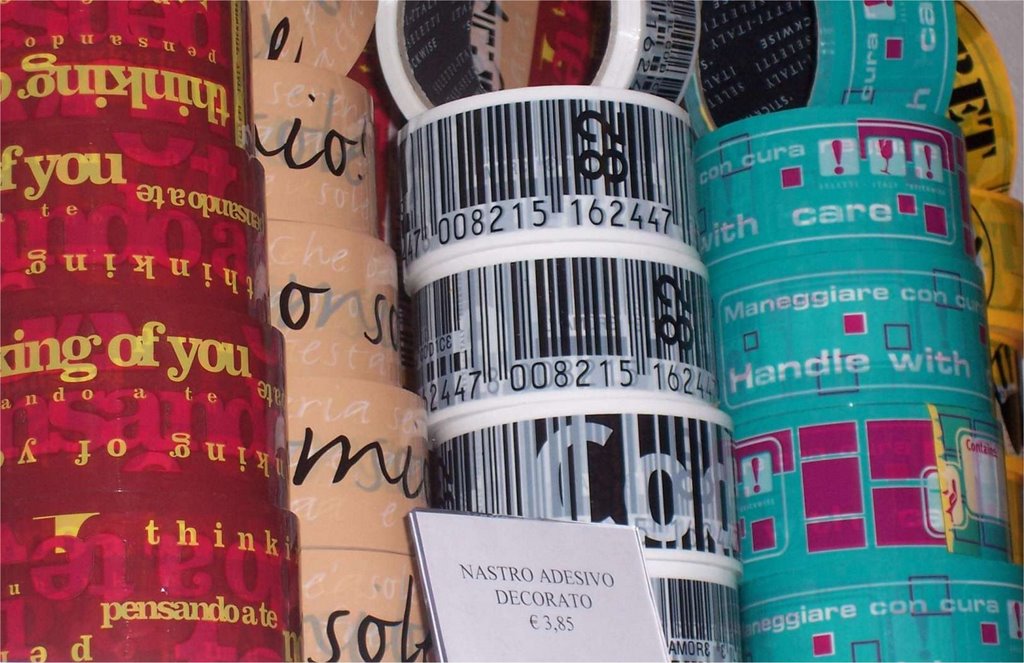
Cool Italian packing tape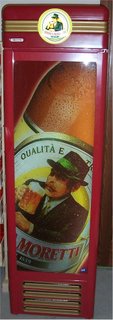
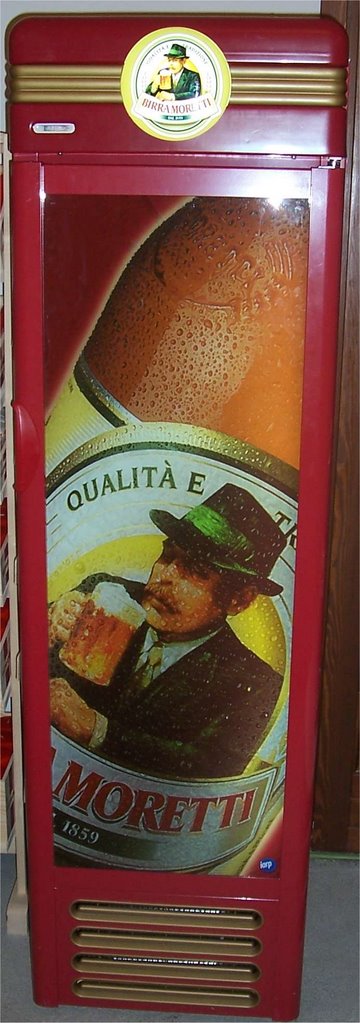
Cool Italian beerThe owners have started a small but flourishing business in producing traditional-styled Italian bicycles, based on models of the 1950s. They have a particular style which differs from the ubiquitous bikes of Amsterdam – which to my untrained eye they resembled. I was told the seating style is different: in Amsterdam they sit upright, and in Italy the riders lean slightly forward. The exact purpose to which these bicycles will be put by the Slow Food movement is a closely guarded secret, or perhaps a yet to be fully planned project, but we will encounter these bicycles again next year.
-
The cheese, the salt and the rennet
Read Full Post: The cheese, the salt and the rennetCan I just say for starters what a rare pleasure it is to be surrounded by 24 people who do not find it the slightest bit odd to take photographs of one’s meals?
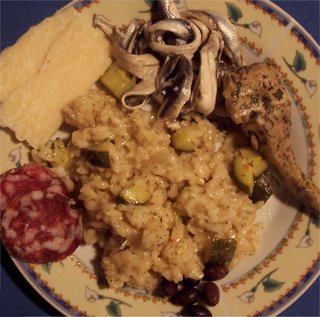
Yesterday’s supper was a better class of leftovers: risotto al limone (con zucchini) (handcrafted by me), plus booty from the supermercato: marinated anchovies, marinated fresh artichoke, thin slices of Salamini Italiani alla Cacciatora and Grana Padano, and a sprinkling of tiny Sicilian olives. Followed by a thin wedge of panforte. Just because I can.
Tonight for supper I had some fresh pasta from the grocery store: ravioli con cervo – surely my first encounter with venison ravioli. I could taste a mild game quality to it, but it was subtle and a bit unremarkable. Either my tastebuds are blown from this neverending cold, or the taste was too delicate to make much impact on this overwhelmed palate.Anyway, we also sampled some fresh mozzarella tonight – utterly sublime, and a more meaningful mouthful as we’d learned about the making of it in cheese technology class today. I had been reading, before I left Canada, about artisan cheese makers who still produce it by hand, but our instructor was dubious on that point: and given the kneading and stretching must be done on a cheese mass whose internal temperature is 60 degrees c, in a water held at about 80 degrees c, I imagine a few artisans of yore may have been a little relieved to turn the task over to machines. Still I’d like to know what the work did to or for their skin tone…
I remember having some dinner conversations before I left Victoria about why cheese was salted, and I’m happy to report back on that with some preliminary information. We learned a bit today about salination: how cheeses are salted in brine or with dry salting, depending on the type of cheese. The salting is done after the milk has coagulated, formed into curds, been put into moulds to shape them, and then pressed; and the salt reaches the inside of the cheese through osmosis. It serves not only to flavour the cheese but to act as a retardant to the growth of bacteria, yeast and mold, and to move – again through osmosis – more of the liquids out of the cheese, in the interests of its texture and water content. We’d heard about similar effects of salt on cured meat in our classes last week as well. But it’s an imperfect preservative system as there are more bacteria to be wary of than those who perish in salt, which is why, we were told, the rind of gorgonzola is not meant to be eaten.
We had as well some instruction on the matter of heat-treating milk, including pasteurisation and UHT. Suffice to say that what you gain in food safety by killing bacteria, you may lose in flavour and the ability of your milk to coagulate predictably.
Oh, and some interesting stuff about rennet, which I’ve known about and loved for its use in making Junket since my somewhat old fashioned and clearly politically incorrect childhood (any other Junket eaters out there?). But even so, I am aware there is a political issue about the use of rennet in vegetarian cheeses, and it is simply that purely vegetarian cheeses are made with an alternative to rennet – some kind of coagulating agent made from fungi, molds, bacteria, yeasts or plant sources, or more likely and reliably, genetically engineered micro-organisms. Because rennet is made from the abomasum (fourth stomach) of newborn calves (or lambikins or even kids in the case of goat cheese I suppose); and it takes, we were told, 5 stomachs to produce 1 gram of rennet. And that’s enough about all that for one day.







Latest Posts
- (no title)
- Sublime and Twisted Readings coming up!
- Sublime
- Good weather for reading
- The world, the world
- Sublime launch!
Aldeburgh Poetry Festival Barny Haughton BBC BC poets Berkswell blackberries Black Stilt Bologna book launch Borough Market Carlo Petrini Catalonia Cyrus Todiwala dairy Daunt's Books Dijon Edinburgh Fanny Bay Feast of Fields Food and Morality food history food journalism Jenna Butler lardo Malahat Review Michael Pollan Okanagan olive oil tasting olive trees Omnivore's Dilemma Our Food Our Future Oxford Parmigiano-Reggiano Planet Earth Poetry poetry poetry readings Poetry videos prosciutto salumi Sean O'Brien Suffolk ticks Wendy Morton Wired Writing Yvonne Blomer
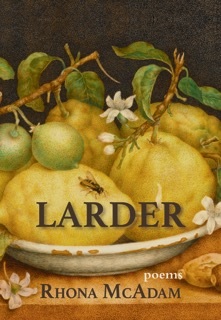
In her latest collection, Rhona McAdam navigates the dark places of human movement through the earth and the exquisite intricacies lingering in backyard gardens and farmlands populated by insects and pollinators, all the while returning to the body, to the tune of staccato beats and the newly discovered symmetries within the human heart.
“…A beautiful, filling collection, Larder is a set of poems to read at the change of the seasons, to appreciate alongside a good meal, and to remind yourself of the beauty in everything, even the things you may not appreciate before opening McAdam’s collection….”
Rhona McAdam is a writer, poet, editor, and Registered Holistic Nutritionist with a Master’s in Food Culture from Italy and a deep-rooted passion for ecology and urban agriculture. Her work spans corporate and technical writing to poetry and creative nonfiction, often exploring the vital links between what we eat and how we live. Based in Victoria, BC, and available via Zoom, Rhona is always open to new writing commissions, readings, or workshops on nutrition and the culinary arts.