-
Tuesday: the pig breeder and then lunch at La Nonna Bianca
Read Full Post: Tuesday: the pig breeder and then lunch at La Nonna BiancaPhew. I have been in more than one barn in my time but never one that smelled like Tuesday’s. This was a day to sober the hardiest meat eater: when we parted ways at the end of it I was reminded of people leaving a funeral.
Our guide through this version of hell was Francesco Sciarrone, the veterinarian and meat inspector who had previously talked to us about animal welfare and slaughterhouses. He and the pig breeder answered questions afterward, and at one point someone asked him how he felt about eating pork, witnessing as he does the entire grim saga from industrial pig production through slaughter every day.
Traditionally, he observed, people ate meat once a week, or maybe every couple of weeks; nowadays we expect meat every day, even several times a day. So, his implicit reply was: if you want meat every day, this is the market economy’s way of fulfilling that request.
He told us he himself doesn’t eat meat every day; he has it maybe once a week, and for that he goes to the butcher in his town, so he knows how the meat was raised and who is slaughtering and processing it. So he pays four, five or maybe six times what we’d pay for the meat of the animals in those hellish sheds, but that’s what it costs to raise it humanely. And he’s fortunate to be in a part of the world where small scale butchers have not yet been entirely driven out of business by supermarkets. (I recently saw some figures for England: The number of butchers in Britain has declined from 22,900 in 1980 to 6,600 in 2005.)
I guess that makes it vote with your feet time. Here’s the Italian version of where that pork chop on your plate comes from:
We kitted up in some protective plastic for the occasion and that kept the muck off us (but was more for the protection of the pigs from infection). The smell when we walked in to the sow shed was overpowering, overwhelming, persistent.
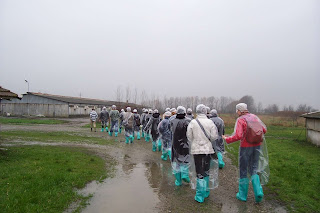
According to the EU, “Sow stalls are the most widely used housing system within the EU because they allow individual rationing, prevent aggression, are easy to manage and occupy little space. However, in some member states, the use of individual stalls for pregnant sows has been made illegal or is currently being phased out.” Signatory states have until 2013 to change their systems, but the stalls (aka gestation crates) can still be used to confine the sows for up to four weeks after gestation, according to the US Humane Society’s report on the subject (they also have a short video clip about sow stalls on their website). I was grateful to learn that the UK has banned these since 1999. I don’t know if there’s legislation governing this in Canada, but the largest pork producer in the US has just announced its intention to do away with them.
Anyway, here – from the point of insemination (usually artificial), for at least the next three weeks – they stand, sit or lie down, because that’s all they can do.

When after 21 days they are seen to be definitely pregnant, they are moved to another barn – which we didn’t see – to finish the gestation period, about three more months. (My reading tells me that at least 60 to 70% of US sows are housed in stalls throughout the entire gestation.) Presumably the ones who didn’t get pregnant the first time get to stand there for another round. If they’re lucky.Then when they are ready to give birth, it’s into the farrowing crates; these too are designed so that the sow cannot turn or move other than to stand, sit and lie down, with what is called a “creep” area for the piglets to move around her. She is barricaded from them so that she does not lie on them (and damage the product). Even when they are safe from crushing, the farmer said there would be around a 10 percent mortality among the piglets, mainly from issues to do with development and feeding.
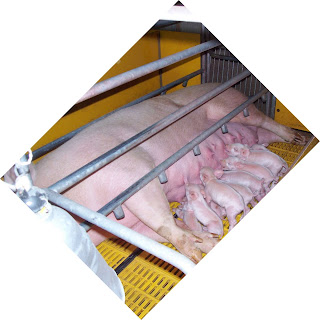
Once the piglets are weaned (by law when they are at least 4 weeks old), the sows are returned to what the EU coyly calls “service accommodation,” namely, in most cases, sow stalls. They can expect to live like this, moving back and forth from one crate to another, for their entire lives, which for good breeders last 6-7 litters (around 3 years). Longer lives than the pigs we eat, which are slaughtered when they reach prosciutto weight – about 9 months and 140kg.When they’re weaned, the piglets move into teen (weaner) housing, kept in family groups. Not because we love them so, but because it keeps them from fighting for hierarchy and damaging the product. The promising ones – from a size point of view – are branded on the hips with PP – Per Prosciutto. We noticed this on some of the hams we saw at the prosciuttificio the day before.

This is all the fresh air these pigs get in their lifetimes.
When you live in conditions like this, you get sick. This was the top of the nearly overflowing bin we passed on the way into the barn. Before slaughter, there’s a resting period for animals who’ve been on medication, to try to get the drugs out of their system – to minimise harm to the people who eat the product.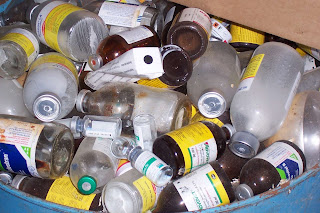
The illumination beyond the door, which looks like daylight, comes from the windowed or skylit outer areas of these barns; it’s not an outdoor run.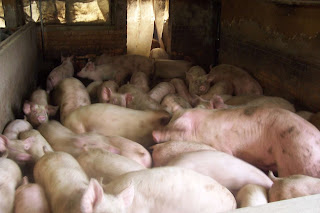
Again, kept in family or familiar groups to keep them from fighting. I guess this is where they stay either until they reach slaughter weight or until they are transferred to another farm to be “finished”. One thing I am guiltily grateful for: that our tour did not take place in the heat of summer, which I’m told is hot and humid – temperatures in the thirties and forties (celcius). I cannot imagine what those sheds must be like then.
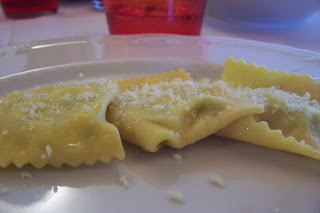
The smell hung around for hours as we debriefed soberly afterwards at La Nonna Bianca, the very trattoria that waylayed Carlo Petrini on his way to talk to us. Even without the salumi, which we declined, the meal was pork-heavy: this is after all pork country. We each said, I’m sure, our private apologies to the pigs on our plates. I mulled over what Petrini had said when asked about animal welfare, something poetic about how you eat the violence you wreak on other living beings.So, the food began its march across our tables. Petrini’s favourite: tortelli verdi (what we’d call ravioli, though by definition, it seems that here, ravioli are meal-filled pasta; these vegetable ones are filled with ricotta and chard, or was it spinach), followed by equally sublime tortelli di zucca (sweet pumpkin filling) (–they disappeared too quickly to photograph), both served with butter and parmigiano–reggiano.
Coppa di maiale arrosto con patate all antico – rich, soft pork with fabulous pan-roasted potatoes, golden and tasty and speckled with crispy bits of rosemary.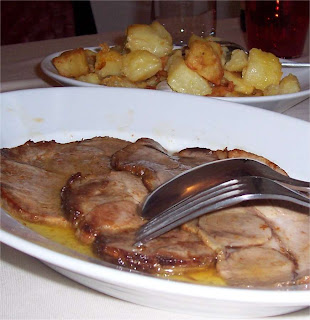
Guanciale brasato con crostoni di polenta (braised pork cheeks) with fried polenta (getting a little full by this point..)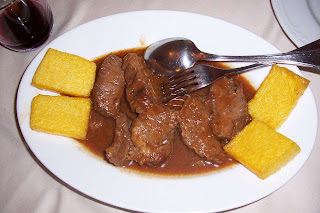
Gorgeous desserts – a kind of standalone creme brulee, a fruit tart and chocolate pudding.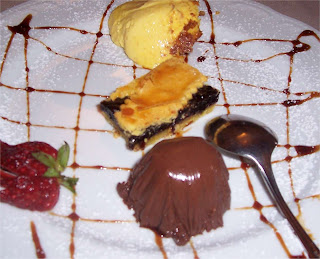
-
Monday: Prosciutto di Parma
Read Full Post: Monday: Prosciutto di ParmaA meltingly sweet bit of salt-cured pork, sliced paper thin, draped on ripe melon: what could be better? A ham that is just ham and salt, no other ingredients; a bit of chemical magic. One of the most wonderful things about Italy, I always thought.
But that was on Monday. A bit predictably, I’m less keen having seen where the pork comes from.
But we start at the beginning, when we visited the Prosciutto di Parma Consortium office. Like most food consortia, this one spends much of its time and money defending the brand from imitators and fraudsters, who aim to confuse the market and reap the benefits without investing in the advertising. The consortium also has an active marketing program, both for the 82% internal and 18% international markets for its products. Not a small market either, with 10 million hams produced as Prosciutto di Parma alone: and there are scores of variations, sold simply as prosciutto crudo, or with other regional designations such as Prosciutto Toscano.
Prosciutto di Parma, a DOP designation, has a narrow and specialised definition. The pig must have been of the Large White, Landrance or Duroc breed, born and raised in one of the 11 regions of central-northern Italy specified in the regulations. It must be raised to a certain weight (a minimum of 140kg); the leg, weighing usually 10-14kg (for a finished weight of not less than seven kg), must be cut in a characteristic shape with a specific percentage of fat; it must be preserved using only salt, and aged for at least 10 months (- depending on weight – but at the production plant we visited, was at least 18 months).
After lunch (yes, it featured prosciutto) we visited a prosciuttificio, prosciutto producer, in Langhirano, a village where 50% of the Prosciutto di Parma is produced. Like all of the producers, it was located within the geographical boundaries of the Parma production area, 5 km south of the via Emilia, bordered to the east by the river Enza and on the west by the river Stirone, and up to an altitude of 900m.
Unfortunately we saw very little of the actual production, but were walked through the plant and shown the hams in various stages of curing. Interestingly we heard that every step in the process is a skilled one, but it is difficult to find people interested in working in this field nowadays, and a lot of the workers are Moslem – so they handle food they cannot eat. Here’s how it all went.
After arrival at the production centre from the slaughterhouse, and about 24 hours in cold storage, the pork legs have been cleaned and salted by machine and by hand, and set on these racks for a week or so, in la cella da prima sale – the room of first salting. Then another salting, and another 12-18 days cold storage, and then they hang for 60 to 70 days in refrigerated, humidity-controlled rooms. Lots and lots of legs.

The hams are now finished with 100 days of salt curing. The salt has penetrated the meat through to the bone and the hams have been washed and brushed and hung in drying rooms, and then hung for another three months in “pre-curing” rooms. It’s time for their final aging, which will last another three to five months in the curing cellar. To soften the meat and prevent the hams from drying out, la sugna – lard mixed with a bit of pepper and perhaps some rice flour – is applied to the exposed surfaces of the meat.
The final test; the ham is now fully cured and properly aged – a minimum of 18 months for the ones we saw; some connoisseurs prefer it aged 24-30 months, but this can be risky as the ham can develop a strong flavour, or become too dry if it’s at the older end of the spectrum. Using a tasto di prosciutti, a horse-bone needle prized for its porous quality, the inspector pierces the ham and then smells the needle to see if the aroma is one of cured ham or.. well, something less aromatic.
If it’s good, it can be sold as Prosciutto di Parma; you can see its ducal crown logo stamped on the rind of the whole ham, or recognise it by the consortium’s branding (a black triangle featuring the ducal crown on the corner of the packaging for pre-packed sliced ham). Shown here and in the testing, you can see the mould that develops naturally during the aging process. Before slicing for consumer use, the hams are brushed and cleaned of course, and the rind is removed. Wholesalers buy the hams and the retailers either de-bone them for slicing or cut them into (de-boned) chunks to sell for consumers to slice at home.
-
Some food reading, viewing, listening
Read Full Post: Some food reading, viewing, listeningAn interesting interview with Whole Foods co-president Walter Robb. The CEO of Whole Foods, John MacKay, posts a blog on the company’s website. Of interest to me and my recent reading is the exchange of public letters between MacKay and Michael Pollan, discussing Pollan’s somewhat skeptical take on the Whole Foods phenomenon in The Omnivore’s Dilemma. and the expansion of organic food production and retailing into something that rather too closely resembles the system that organics grew up to counteract.
David Szanto, who completed our course at UniSG in November, joined us for some merrymaking at the Quebec cheese tasting evening last week, and he pointed me to a recent article in The Guardian, The Organic Church Splits, about the Soil Association which I suppose you could say turns some of the same ground from a British perspective; and there was an earlier article and podcast on US organics in Business Week last October. An op-ed piece in the New York Times called The Amber Fields of Bland explains the US farm bill, and the terrifying span of its coverage, and just what it has done to food production in that country.
I’ve been watching a dvd called The Future of Food which MJ brought back from Canada. About farmers, farming, gmo crops and seed/pesticide monopolies, it’s an excellent introduction to the realities of farming today and the issues we should all be attending to in our food. I liked the dvd extras, which included a clip from Michael Pollen responding to the question about ‘will food cost more in future’ – yes, he said, but it’s artificially cheap right now because of heavy crop and farming subsidies in the US and Europe, and people need to perhaps look at their relative priorities: which do you want to spend your money on more each month: safe/nutritious food or $40+ on cable tv? He also made the excellent point that prepared food is always more expensive than food you cook: so people need to learn to cook. But they also need sources for raw ingredients: in some poor neighbourhoods it’s simply impossible even to buy fresh fruit or vegetables.
Doris pointed us to a well respected Austrian documentary on themes of food and hunger, We feed the world – global food which I’d like to have a look at someday.
There’s a Belgian-made short documentary you can view online at EUX-TV called Chicken Madness, about dumping of chicken surpluses in Africa by western countries such as Belgium, Germany, Holland and Brazil. It seems we’ve got very picky in the western world and we just don’t want to eat all of the chicken, so we sell the icky bits to someone hungrier than us. But the lack of effective licensing (=political corruption) and the dearth of functioning cold storage facilities at the receiving end results in an economic double-whammy: food spoilage and the trashing of African poultry farming which can’t compete with the prices — or the convenience of a ready-to-cook product, however tainted. But the industrialised world is committed to free trade at (literally) all costs. As one African farmer bitterly noted, would the US and Europe be ok with the destruction of their local economies in the name of globalisation? Something to think about next time you pick up a packet of chicken breasts…
And I recently listened to a podcast about nutritional food labelling. An education in how little consumers understand of what they read on the label: consumer food education has a long way to go. One telling example from the American representative who said that the majority of American consumers surveyed could not say what a typical daily calorie intake ought to be, despite the calorie information printed on the food labels since 1994 which stated that it was based on a 2000 calorie per day allowance; and that they often disregarded serving size recommendations and simply ate the whole packet. Which says something about labelling, obesity and education.


Latest Posts
- (no title)
- Sublime and Twisted Readings coming up!
- Sublime
- Good weather for reading
- The world, the world
- Sublime launch!
Aldeburgh Poetry Festival Barny Haughton BBC BC poets Berkswell blackberries Black Stilt Bologna book launch Borough Market Carlo Petrini Catalonia Cyrus Todiwala dairy Daunt's Books Dijon Edinburgh Fanny Bay Feast of Fields Food and Morality food history food journalism Jenna Butler lardo Malahat Review Michael Pollan Okanagan olive oil tasting olive trees Omnivore's Dilemma Our Food Our Future Oxford Parmigiano-Reggiano Planet Earth Poetry poetry poetry readings Poetry videos prosciutto salumi Sean O'Brien Suffolk ticks Wendy Morton Wired Writing Yvonne Blomer
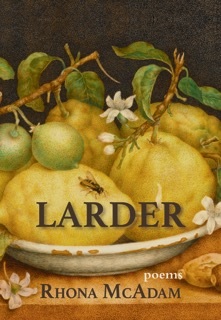
In her latest collection, Rhona McAdam navigates the dark places of human movement through the earth and the exquisite intricacies lingering in backyard gardens and farmlands populated by insects and pollinators, all the while returning to the body, to the tune of staccato beats and the newly discovered symmetries within the human heart.
“…A beautiful, filling collection, Larder is a set of poems to read at the change of the seasons, to appreciate alongside a good meal, and to remind yourself of the beauty in everything, even the things you may not appreciate before opening McAdam’s collection….”
Rhona McAdam is a writer, poet, editor, and Registered Holistic Nutritionist with a Master’s in Food Culture from Italy and a deep-rooted passion for ecology and urban agriculture. Her work spans corporate and technical writing to poetry and creative nonfiction, often exploring the vital links between what we eat and how we live. Based in Victoria, BC, and available via Zoom, Rhona is always open to new writing commissions, readings, or workshops on nutrition and the culinary arts.