-
Carbon footprints
Read Full Post: Carbon footprintsI seem to be shuttling back and forth between cultures so much I am either so far ahead of my current pack or so well behind them that my terminology is incomprehensible to anyone but myself.
One term I heard a lot from my English friends on my pass-through last year is Carbon Footprint – a conveniently packaged phrase that I don’t think was so audible in Canada by the time I left, though perhaps that has changed. It would still be understandable in context of course, it’s just that it didn’t seem to have permeated the public discourse as it had in England.
The Guardian published an article recently which lets you calculate the size of yours (hint: it should be small, and “you live like an American” is not the rating to strive for).
You can also use their handy Climate Care Calculator for a quick look at what your lifestyle costs the environment. While you are cleaning up your act, you can pay your penance directly to a charity called Climate Care. Or if you prefer your calculator American-style, there’s another one at Carbonfund.org.
It’s an interesting and topical area for the food industry which, it seems, leaves not so much a footprint as a crater.
-
Kitchen history and some pics
Read Full Post: Kitchen history and some picsHad a great lecture today by visiting Belgian historian Peter Schollier, about kitchen workers in 19th century Brussels, with more to follow over the next couple of days, on food and identity, changes in food culture in Europe since 1945, and food culture in Italy vs Germany. He talked at first about the professional chef, how the title is bestowed rather than handed over on a piece of paper, having been earned through apprenticeship and observation.
It called to mind for me something said in We Feed the World, about how the industrial-scale food producers are run like cold-blooded corporations because there is no one at the top of these companies who worked their way up from the bottom, who understands farming as a learned skill.
In that context I particularly liked this text quoted in The Omnivore’s Dilemma: “Farming is not adapted to large scale operations because of the following reasons: Farming is concerned with plants and animals that live, grow, and die.”
And – timely, this – we’re looking forward to hearing about kitchen gardens from Antoine Jacobsohn this very week.
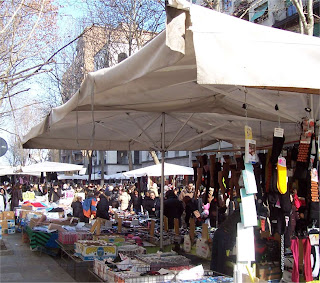
In case you were wondering where everyone was on Saturday.. I found them at the market on via Verdi. All of them. And their socks.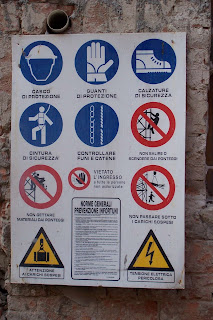
The Italian rule of construction seems to be: never use one sign when you could use eight. Or eleven.
Fido Park, en route to Bologna.
Colorno this evening. Daylight! Waning daylight, but… daylight!!Piazza della Pace, by day…


…and by night. -
Nutella, Faust, wine and cured meats
Read Full Post: Nutella, Faust, wine and cured meatsCorrie passed along the important news about World Nutella Day which is coming up very quickly, on February 6.
Last night a group of us shared a box at the opera to see The Damnation of Faust. Reviews from our company were mixed, but I think it was agreed that overall the second half was better than the first, all beautifully sung of course, by a very large cast, but possibly overwhelmed by some of the visuals that were projected over the proceedings, and the choreography and circus work were a bit much. All in all I enjoyed the evening, though thought I sensed a touch of Lord of the Rings in the depiction of hell, and a lot of loin cloths were used in the making of this opera. Anyway, can’t come to Italy and not see opera, even a French one, so I’ve got that one under my belt.
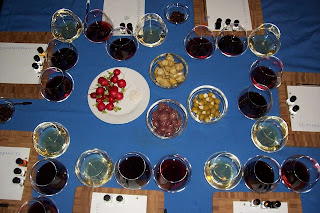
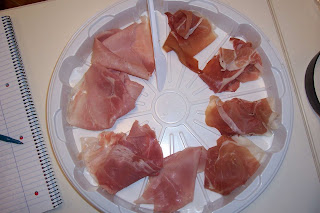
We have been having “sniff parties” chez nous. MJ has a pretty comprehensive wine aromas kit which we’ve been working our way through with some diligence. We sniff 18 different bottles containing everything from acacia to leather to chocolate to mushroom to smoke, and then sample some wines to see what we can detect in them, and then we eat nice food. This week’s menu featured MJ’s gazpacho – an unorthodox version apparently as it lacked bread, but it was beautiful without – and the near unpronounceable kolokythokeftedes (zucchini cakes with feta and mint). Mint was actually the hardest ingredient to find, but I bought a bag from an erborista, which wasn’t quite right so to me it tasted a bit like mint tea, but it went down all right with some tzadziki. Corrie brought an Orange- cheesecakey- moussey- souffle- kind- of- thing, I think that was the official recipe name, and topped with blood oranges it was delightful.We kept our menu quasi-vegetarian because we’d spent the afternoon doing a meat tasting, which was exhaustive and somewhat overwhelming: 21 different meats I think. I’d missed the salami tasting before Christmas, and this time we were doing only cured meats made from whole cuts. So we had prosciutto crudo e cotto (raw cured and cooked hams), some smoked hams and a couple of different kinds of lardo which were surprisingly good, even if we did have to take them without the requisite hot toast.
Some Culatello and Culaccia, Spalla crudo and cotto, Prosciutto di Sauris (a whole smoked prosciutto crudo), Alto Aldige (smoked), Cinta Sinese (Tuscan pig), Jamon Iberico, some black pig prosciutto with flavours of blue cheese; and the lardos came later, which I didn’t photograph.

Many prosciuttos: 16 months, 24 months, crudo and cotto, smoked and salted.


Latest Posts
- (no title)
- Sublime and Twisted Readings coming up!
- Sublime
- Good weather for reading
- The world, the world
- Sublime launch!
Aldeburgh Poetry Festival Barny Haughton BBC BC poets Berkswell blackberries Black Stilt Bologna book launch Borough Market Carlo Petrini Catalonia Cyrus Todiwala dairy Daunt's Books Dijon Edinburgh Fanny Bay Feast of Fields Food and Morality food history food journalism Jenna Butler lardo Malahat Review Michael Pollan Okanagan olive oil tasting olive trees Omnivore's Dilemma Our Food Our Future Oxford Parmigiano-Reggiano Planet Earth Poetry poetry poetry readings Poetry videos prosciutto salumi Sean O'Brien Suffolk ticks Wendy Morton Wired Writing Yvonne Blomer
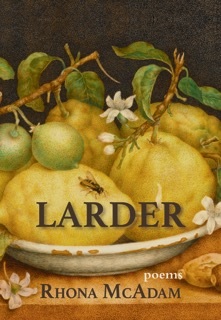
In her latest collection, Rhona McAdam navigates the dark places of human movement through the earth and the exquisite intricacies lingering in backyard gardens and farmlands populated by insects and pollinators, all the while returning to the body, to the tune of staccato beats and the newly discovered symmetries within the human heart.
“…A beautiful, filling collection, Larder is a set of poems to read at the change of the seasons, to appreciate alongside a good meal, and to remind yourself of the beauty in everything, even the things you may not appreciate before opening McAdam’s collection….”
Rhona McAdam is a writer, poet, editor, and Registered Holistic Nutritionist with a Master’s in Food Culture from Italy and a deep-rooted passion for ecology and urban agriculture. Her work spans corporate and technical writing to poetry and creative nonfiction, often exploring the vital links between what we eat and how we live. Based in Victoria, BC, and available via Zoom, Rhona is always open to new writing commissions, readings, or workshops on nutrition and the culinary arts.