-
Seeds and the Future
Read Full Post: Seeds and the Future I’ve just been reading Thor Hanson’s delightful book, Seeds, which delves into the unanswered questions we have about seeds. Why some of them are crazy large and impenetrable, like coconuts or brazil nuts, while others are almost too small to see: petunia seeds, arugula, amaranth. They have touched human evolution in every possible way. No question they have, as the subtitle puts it, “conquered the plant kingdom and shaped human history.”
So, mulling this over and with Victoria Seedy Saturday coming up in less than a week, I’ve been thinking about seeds a lot. Not just the seeds of wisdom I’ll be sharing in my talk (Superfoods in your own backyard) but the overarching importance of seeds in our lives.
One of the most valuable lessons I’ve learned over the years is how important seed-saving is. And like everything in this beautifully complex life, it’s a complex business. Or maybe a simple one. You can take it to any length you’re up to – from isolating and hand-pollinating squash flowers to simply shaking the yield of a leek’s seed head into a paper bag to sort out later.
In our neighbourhood we have a community seed bank. It’s a collection of seeds that we’ve grown for several years in this area, harvested and deposited into containers that a couple of our neighbours hold onto for us. It’s food security for times of disaster. It’s also a living record of seed evolution in this microclimate, which is changing as surely as all the others on this planet. And it’s a bond between those who grow and eat and keep our back yards fertile today with those in generations to come.

So many heritage varieties of garden vegetables and fruits have been lost as the seed companies seek to narrow their offerings down to profitable and popular lines. Our work with the community seed bank helps to maintain and develop our local seed stock. And our gardens help to maintain the soil that nourishes those plants, because that is part of a culture’s heritage too.
For as much as we know our farmland is being steadily lost to development, so are our backyard gardens, as houses are torn down to make way for multi-occupancy dwellings. You’ve seen it as you walk around your own area. The topsoil is scraped off and taken away, and what’s left is clay, gravel and fill. Mostly that’s covered with concrete. That irreplaceable topsoil is sold off, its unique and localized fingerprint lost along with the micro-organisms that give it life and nourish the plants that have grown in it for millennia.
 We can’t do much about the scale of development and population growth, we individual home-owners and gardeners. But we can look after our soil while we have it, and encourage others to do likewise. Some of that wisdom, some of those seeds, will follow us down the years to feed future generations.
 -
Dead Poets, Living Words
Read Full Post: Dead Poets, Living WordsI am looking forward to Sunday’s installment in the Dead Poets Reading Series in Vancouver, when I will have the delightful task of reading Maxine Kumin’s work. Here she was, back in 2008, reading three of her poems, including one of my favourites, Apparition.
-
Food, Fishing, Farming… & Poetry on the Farm
Read Full Post: Food, Fishing, Farming… & Poetry on the Farm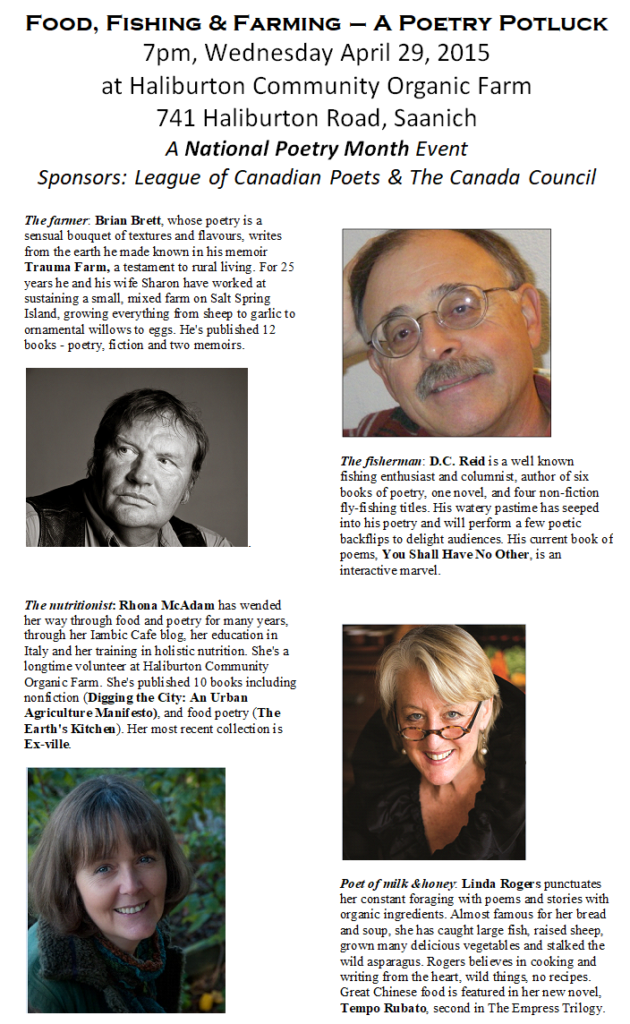


Latest Posts
- Sublime and Twisted Readings coming up!
- Sublime
- Good weather for reading
- The world, the world
- Sublime launch!
- Planet Earth Poetry – Readings by Volunteers, Victoria 2026
Aldeburgh Poetry Festival Barny Haughton BBC BC poets Berkswell blackberries Black Stilt Bologna book launch Borough Market Carlo Petrini Catalonia Cyrus Todiwala dairy Daunt's Books Dijon Edinburgh Fanny Bay Feast of Fields Food and Morality food history food journalism Jenna Butler lardo Malahat Review Michael Pollan Okanagan olive oil tasting olive trees Omnivore's Dilemma Our Food Our Future Oxford Parmigiano-Reggiano Planet Earth Poetry poetry poetry readings Poetry videos prosciutto salumi Sean O'Brien Suffolk ticks Wendy Morton Wired Writing Yvonne Blomer
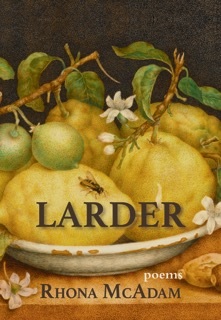
In her latest collection, Rhona McAdam navigates the dark places of human movement through the earth and the exquisite intricacies lingering in backyard gardens and farmlands populated by insects and pollinators, all the while returning to the body, to the tune of staccato beats and the newly discovered symmetries within the human heart.
“…A beautiful, filling collection, Larder is a set of poems to read at the change of the seasons, to appreciate alongside a good meal, and to remind yourself of the beauty in everything, even the things you may not appreciate before opening McAdam’s collection….”
Rhona McAdam is a writer, poet, editor, and Registered Holistic Nutritionist with a Master’s in Food Culture from Italy and a deep-rooted passion for ecology and urban agriculture. Her work spans corporate and technical writing to poetry and creative nonfiction, often exploring the vital links between what we eat and how we live. Based in Victoria, BC, and available via Zoom, Rhona is always open to new writing commissions, readings, or workshops on nutrition and the culinary arts.