-
Time of the stinking rose – with rust
Read Full Post: Time of the stinking rose – with rust I was looking forward to my garlic crop this year: I’d followed farmer Ray’s advice (plant deep, mulch well) and my plants seemed to be thriving. They also appeared to be rust-free, which surprised me since I’d had rust the last couple of years, and we’d heard at a recent GTUF talk by Linda Gilkeson that our area has been infected by a new strain of rust which affects garlic, leeks and other members of the allium family, and that “rust-resistant” leeks are not resistant to this one. So last Sunday, there were the first tell-tale spots, and I decided to go ahead and pull it anyway, as it was only a couple of weeks away from harvest.
At a potluck last weekend, Kate had been demonstrating how to harvest, peel,
and braid garlic:
Even hardneck garlic can be braided, if it’s done when the garlic is fresh from the ground, as it takes a bit of time for the neck to dry and stiffen. The idea is to place the bulbs, as far as possible, so they aren’t touching. After braiding the garlic should be hung in a dry, airy place out of the sun for at least two weeks to cure for long storage. Any damaged bulbs – or ones where too much of the protective wrapping was removed, can be eaten fresh, without curing. I’ll try curing the insect-damaged ones, but those I clipped with my digging fork (the hazards of deep planting in compacted soil!) will be most welcome in a bowl of delicious garlic soup.


I found rust spots (as well as insect damage – slugs, leatherjackets and wireworm run rampant in my beds which are next to grass) on the stems and bulbs of some of mine, even where it wasn’t showing in the leaves. Fingers crossed for my winter leeks, which are growing in a raised bed nearby.
To reduce the spread of garlic rust, infected leaves should be snipped off – whether live or harvested plants – and disposed of in the garbage, not composted. Rust won’t affect the taste of the garlic and in most cases won’t reach the bulb,
 but if it does it looks unsightly and garlic producers can’t sell it. If you let it go, it will affect the size of the bulb and eventually cause it to rot. It’s a particular hazard in community gardens where it can spread quickly from bed to bed, so community gardeners need to have agreements in place to control it. I saw this lot in a James Bay garden last year and suspect all the garlic there will be infected this year.
 -
Ecovillage tour & Canada Day
Read Full Post: Ecovillage tour & Canada Day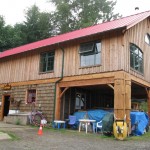 Another place I’d long wanted to see was O.U.R. Ecovillage, near Shawnigan Lake on Vancouver Island. A haven for green builders, permaculture designers, and people in search of collaborative and sustainable lifestyles, it’s a half-finished dream with a population that ebbs and flows through the seasons.
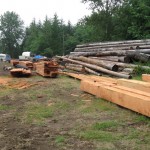
The root cellar was the subject of a green building workshop last year, and progress was documented on this Youtube video. Like many of the other buildings it uses recycled materials in its construction: car tires and styrofoam blocks are part of its structure. Like everything that happens at the Ecovillage, the decision to use these materials was taken after lengthy thought and discussion, and the feeling is that it’s better to put them into a structure where they have a purpose and are contained than into a landfill (at best). The styrofoam blocks they use are discarded tree plug trays – available by their millions, an otherwise useless and unsustainable byproduct of reforestation by the lumber industry. The community is also working its way through some 15 truckloads of reclaimed lumber – windfall timber that would otherwise have been sold as firewood or burned as slash.
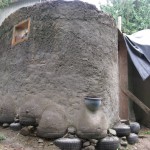

Permaculture has always been part of the ideals of the Ecovillage; the Permaculture Design courses that are offered here result in projects of many kinds – garden, water reclamation and food forestry among others.
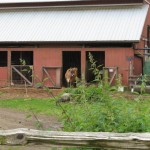
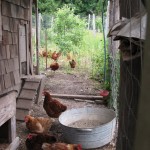
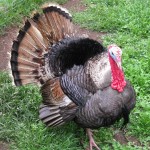
Food is a major preoccupation – it grows in various ways and places: in a deer-fenced garden and a new food forest that’s under development around the property; pigs, chickens, cows and a rather majestic turkey are part of the scene, producing food and fertilizer. This greenhouse recirculates water, heating it for a shower stall that’s in the greenhouse itself.
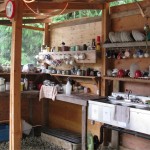
The kitchen has been recently expanded so that it could accommodate the large and small mealtimes. During our visit a Zimbabwean music camp – Nhemamusasa North – was on, and there were 130 people for meals… all of them washing their own dishes in the wash station. Grey water gets filtered and reused, of course.
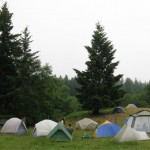
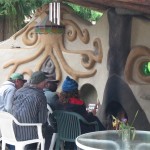
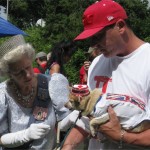
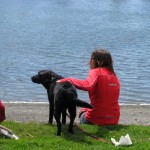
After that it was time for Canada Day celebrations. Here on the Gorge we have a street party that this year was graced by the queen, who also deigned to have her picture taken with neighbourhood dogs, and was then whisked away by canoe. There was of course food, music and a little dancing.




-
Terra Nossa Farm tour
Read Full Post: Terra Nossa Farm tour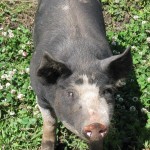 Last Sunday I got down and dirty with the Victoria Horticultural Society’s Fruit & Vegetable Group, whose monthly meeting was a tour of Terra Nossa Farm. I’d often bought eggs or sausages or chicken from Evelyn, who commands a loyal queue each Saturday at Moss Street Market, so I was delighted to have a chance to see the farm she runs with her husband Jesse.
Labour of love about sums it up here. Jesse says of their pigs that they live their lives in
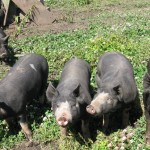 heaven, and then they die. They’re fed organic grain, fresh greens and roast sweet potatoes grown on the farm. Ten of their Berkshires, purchased as piglets from Tom Henry (there are very few organic pig breeders, Evelyn remarked), were nearing their slaughter date, and were out frolicking in a field of greens. They came to greet us, flapping their enormous eyelashes and making us question who was looking at whom. I’ve been on pig farms before, and never have I been to one where there was not a whiff of stink: they have plenty of room to run and play, and shelters provided for both summer and winter comfort.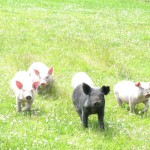
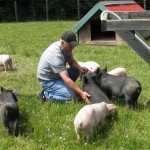
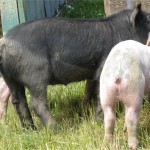
There were some piglets in another field: two varieties, black mule pigs (sourced from Lasqueti Island) and some Tamworth cross pigs bought from a commercial operation in Alberta. The white pigs were very skittish at first and prone to scattering when Jesse approached, but with patience he has been able to get them to become a bit more pig-like, curious and friendly. The white ones’ tails had been docked by the breeder, a common practice where they are kept in such overcrowded conditions they are likely to gnaw on their neighbours out of stress or for lack of anything better to do. Evelyn said they hadn’t checked their teeth but these were likely clipped as well, for similar reasons.
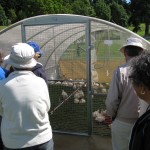 The chickens are treated kindly at Terra Nossa as well, although in the case of the meat birds, this happy life is a short one. They are purchased as chicks from a commercial breeder, so they have, as Evelyn put it, had most of the chickenness bred out of them. They’re sent to slaughter at around 8-9 weeks (commercial operations only keep them half that time); they can’t be allowed to get any bigger because the way they’ve been bred means their bodies become too large for their legs to support them and they start developing painful injuries. Jesse was out scything some fresh vetch for the
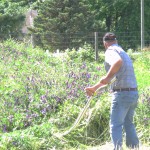 m, which they love, and they seemed to be enjoying the commodious chicken tractor, a top-of-the-line pen that keeps them shaded from the sun and lets them enjoy the view, the breeze, and the tasty snacks being delivered at regular intervals. And the tractor is an easy structure to move, which is the most important feature.
The Perrieras are choosy about where they sell their chickens. They’ve become disillusioned with restaurant sales, having experienced situations where chickens were sold to restaurants who put their farm’s name on the menu and then ceased buying from them. So now they limit their sales to the farm gate, the farmers markets they attend (Moss Street in the summer and the Downtown market in the winter), Ingredients Health Food and local food promoters Share Organics.
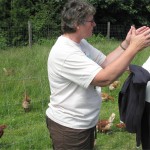 The laying hens have a nice big area to run in, and produce enough eggs to supply Moss Street Market, Origin Bakery, Terra Nossa’s farm shop and Share Organics. I noticed that they still peck one another’s tails – I suppose they are just too numerous, and a few are lost from time to time to the bald eagles we saw circling during our visit. The farm has a license allowing them to keep 399 laying hens (the limit on small producers without such a license is 99 birds) but Evelyn says they won’t be renewing that. New rules are coming in that would mean the small producers with 399 layers would be forced to adopt the same biosecurity measures as industrial producers (meaning no more farm tours, for one thing); would not be allowed to let their chickens run outside on pasture as they do now; would not be allowed to raise meat birds as well as layers; would have to invest in impossibly high-cost equipment and potentially upgrade facilities for inspection. We would not have been allowed access to the farm without suiting up, for example. So the regulatory club is still swinging directly and heavily at small producers and forcing them out of the very markets where they are needed and appreciated.
Evelyn & Jesse are acutely aware of their dependence on imported livestock feed, since
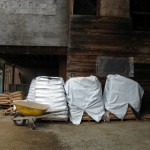 there is no organic feed producer on Vancouver Island, they must have it shipped from the mainland by ferry. Like any Islander who thinks about food security, they are conscious of the fragility of their supply, so they try to keep a reasonable reserve in store. Because organic feed is more expensive than conventional, this means quite a substantial capital outlay, at about $1000 a pallet.
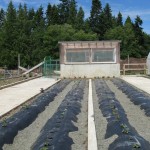 Towards the end of the tour we had a look at the sweet potatoes bravely growing under black plastic mulch. They were planted out in March, but the weather has been so chilly that they are not thriving, although with luck the summer heat should kick in and move them along. At the end of the rows is the winter pig barn, where the porkers can loll about enjoying the roasted sweet potatoes the Perrieras prepare for them (many of the larger sweet potatoes are considered unsaleable, so they go to the lucky pigs).


Latest Posts
- Writers at Word!
- Sublime and Twisted Readings coming up!
- Sublime
- Good weather for reading
- The world, the world
- Sublime launch!
Aldeburgh Poetry Festival Barny Haughton BBC BC poets Berkswell blackberries Black Stilt Bologna book launch Borough Market Carlo Petrini Catalonia Cyrus Todiwala dairy Daunt's Books Dijon Edinburgh Fanny Bay Feast of Fields Food and Morality food history food journalism Jenna Butler lardo Malahat Review Michael Pollan Okanagan olive oil tasting olive trees Omnivore's Dilemma Our Food Our Future Oxford Parmigiano-Reggiano Planet Earth Poetry poetry poetry readings Poetry videos prosciutto salumi Sean O'Brien Suffolk ticks Wendy Morton Wired Writing Yvonne Blomer
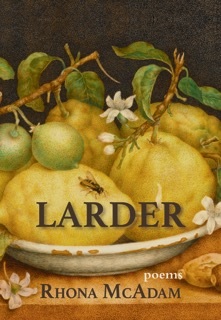
In her latest collection, Rhona McAdam navigates the dark places of human movement through the earth and the exquisite intricacies lingering in backyard gardens and farmlands populated by insects and pollinators, all the while returning to the body, to the tune of staccato beats and the newly discovered symmetries within the human heart.
“…A beautiful, filling collection, Larder is a set of poems to read at the change of the seasons, to appreciate alongside a good meal, and to remind yourself of the beauty in everything, even the things you may not appreciate before opening McAdam’s collection….”
Rhona McAdam is a writer, poet, editor, and Registered Holistic Nutritionist with a Master’s in Food Culture from Italy and a deep-rooted passion for ecology and urban agriculture. Her work spans corporate and technical writing to poetry and creative nonfiction, often exploring the vital links between what we eat and how we live. Based in Victoria, BC, and available via Zoom, Rhona is always open to new writing commissions, readings, or workshops on nutrition and the culinary arts.