-
Kneading Conference West – day 2
Read Full Post: Kneading Conference West – day 2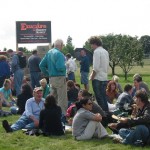 Sun broke out on day 2, causing some basking on the grass at lunchtime.
We began the day with a PowerPoint tour of local and small scale wheat producers from non-wheat areas; wheat breeder and conference organizer Stephen Jones showed maps revealing the transition to commodity scale production, which has redrawn the country’s pattern of wheat production. While almost every state in the US used to produce wheat, now the focus is on large scale production – nothing less than 1000 acres shows on the maps. But there’s a welcome resurgence across the board with small producers from Whidbey Island – where Ebey’s Prairie farmers once held the world record for productivity (119 bushels/acre in 1919 – a figure that dwarfs today’s industrial scale yields of around 45 bushels/acre) to Vermont – where farmer Jack Lazor has dealt with the loss of infrastructure by building his own grain elevator. Here at the Mount Vernon Research & Extension Centre (where the conference is being held) Jones is working on developing varieties that are resistant to local problems – notably rust – and has been working closely with local producers and bakers.
Starting to get hard to choose between sessions. I stopped for a few minutes at various points to watch Seattle baker George DePasquale on Artisan Sourdough for Home Bakers where he had some smooth moves for shaping boules, batards and baguettes,
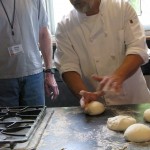
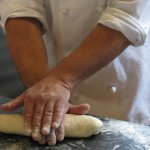
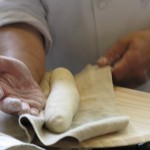
and offered advice on setting each on the couche, as well as transferring from the couche to the peel. He also took his scissors to
 a baguette to demonstrate the making of an épi de blé – remarking it was a tricky one to get in and out of the oven in one piece.
On to a panel discussion: A Question of Scale, where farmers and bakers talked through some issues to do wtih ethics and economics of producing local and organic.
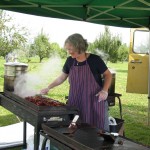
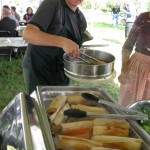
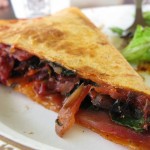
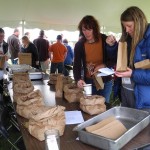
Lunch beckoned aromatically from the tent where the Patty Pan Grill folk were preparing the innards of our meal, which, alongside an excellent salad and three kinds of tamales, offered a spectacular discovery for me: it is possible to enjoy a quesadilla, if it is prepared from beets and other nicely turned veg together with some good cheese.
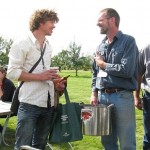
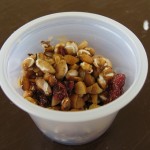
Some Vancouver Island talent: Fol Epi baker/owner Cliff Leir with “beer farmer” Mike Doehnel. Mike walked us through the barley malting process, after an introduction to barley breeding by Patrick Hayes, who set us loose on samples of hull-less and hulled barley, perled barley and even an incredibly good toasted barley snack (with local hazelnuts and cranberries) that’s soon to be marketed.
There was also discussion of something called Bappir, an ancient trail food made with barley, honey and dates which served a dual purpose: it could be soaked in water where it would be colonized by wild yeasts and serve as the foundation to early beers. We were also encouraged to try a barley head thresher – a basic manual model or an automated version – and a barley perler.
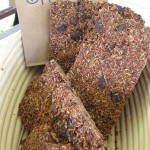
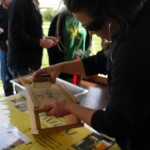
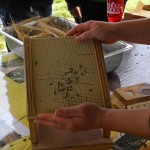
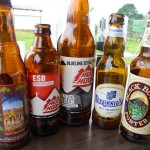
Some beer tasting ensued while Mike managed a demonstration barley mash in the background, eventually offering sips of the wort (if I followed the process correctly) which is the sweet dregs of the washed mash. It can be cooked down into malt extract for baking, or carried through the process and combined with hops to make beer. Of which we’d sampled five versions – four of them local, and some quite excellent. Thus fortified we wandered off to wait for… a beer and cheese tasting.
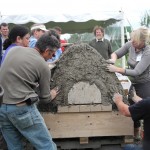
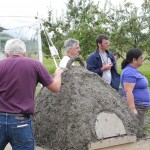
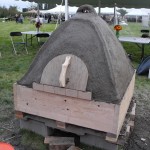
Behind us there was a small commotion of slapping and patting, which was the wood fired oven workshop group putting the finishing touches on their labour of love, which was to be silently auctioned off later in the evening, with proceeds to go towards the next Kneading Conference West – a worthy cause in my view. All you needed was the means to take it home with you…
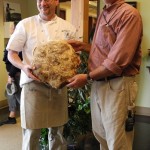
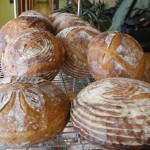
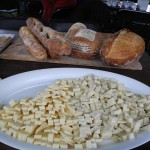
Elsewhere I happened upon Michael Eggebrecht and Stephen Jones wrangling a giant loaf from the Professional Baking workshop – came off a large rack of loaves that were on the way to the food tents where we covered them in more local cheese – a dill/garlic herbed number and an aged gouda style – before settling in to a dinner of barbequed chicken, corn and beans. And that was our Friday.
I retire with trepidation, for tomorrow’s schedule is too tempting and I cannot decide between four simultaneous sessions…
épi de blé -
Kneading Conference West: day 1
Read Full Post: Kneading Conference West: day 1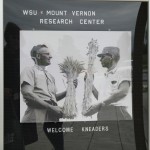 Drove to Mount Vernon, WA yesterday: a long day, but a gorgeous drive through lush northwest Washington. Headed to the first Kneading Conference West, which is modelled on Maine’s long established and hugely popular Kneading Conference. The idea is to bring together bakers, millers, farmers and interested bystanders like myself – writers, home bakers and researchers.
Arrived in time to take a stroll through the orchard and the many lovely gardens at the conference venue, the Mount Vernon Research & Education Centre – herb, vegetable, “water-wise”, Japanese and others. The land is owned by the university but orchard and gardens are managed by volunteers from the Master Gardener program. It was grey and spitty weather and the tables beneath tents in the field looked less than inviting, but we were cheered to learn these were for meals, and most of the workshops are indoors.
As was the first I attended: A Realistic Approach to Making Grain
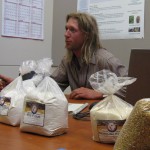 Work – An On-Farm Example. David Mostue turned out to be a riveting speaker: after graduating from architectural studies he returned to a 230 acre family farm and set to repairing and upgrading the century-old infrastructure and rethinking its purpose. It had been started as a pear orchard, but pears are one of the many crops that have become, as he put it, a casualty of international trade and scale: labour is cheaper elsewhere, and they’re a labour-intensive crop.
He spoke well enough to fix a couple of dozen of us to our seats in a very small room for about three hours. He covered the practical issues around making it as a grain farmer, whether large or small scale. He pointed out that grain is a great crop for poor soil and challenging conditions – his farm is in the Rogue Valley in southern Oregon, where temperatures average 95-100 degrees fahrenheit in the summer, and there’s a lot of heavy clay: this means that a crop like winter wheat (so named because it grows through the winter, but is harvested in summer) which can be planted in the fall is a better choice, since clay is sodden all winter and rock hard in summer, so has a small window for planting in spring.
He spoke about the qualities of different wheats – of particular interest to the bakers, and to farmers like him who need to understand the uses to which bakers put their flour. High gluten (protein) content flour, used in industrial baking, needs high soil fertility (often using artificial fertilizer). Artisanal bakers can cope with a lower protein flour (11-12%), because they use fermentation and long risings instead of the large quantities of dry yeast typical of high-speed industrial methods. Long risings, as Andrew Whitley will tell you, give the gluten time to develop and also make the bread more digestible. Lower protein still are soft white wheats (6-10%) that make pastry flour; or rye or alternative wheats (emmer, spelt et al) that are popular in artisanal baking. The highest gluten levels are in durum wheat (his clocked in at nearly 15% last year), used for semolina flour: Mostue had wanted to make his own whole grain pasta, which he found to have an unbeatable flavour and dense texture that made it more fliling than its commercial counterpart.
But of course nothing is simple, and Mostue explained the many other aspects of grain production – preparing the soil (he uses a five year rotation so that he can build soil fertility naturally, rather than using artificial fertilizer), seeding (we learned a lot about seed drills), weeding and harvesting (who knew combines could be so interesting?). He had progressive ideas about marketing the farm and its products, using social media but also building a market by getting people to understand and be interested in the farm; using innovative variations on standard CSA programs (including use of Survey Monkey for ordering), farm dinners… and plenty of wine (which they happen to produce on farm!)
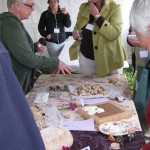 Reluctantly we left for the fruit garden and
 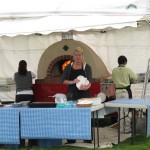 a cider and goat cheese tasting, followed by abundant pizzas fresh from the mobile wood-fired ovens, and salads of wheatberries and donated vegetables – carrots and beets – that were roasted in the ovens, followed in turn by seriously good cookies from the
 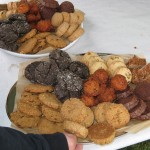 Breadfarm.
 -
Eat Here Now… and we did
Read Full Post: Eat Here Now… and we didA glorious hot Sunday in the middle of Victoria, with food, music and more food. What could be better? The Downtown Public Market Society put on a great day in the interests of furthering interest in a permanent year-round downtown food market. While I don’t know how far that goal is from being realized, the group certainly soldiered on through a bleak winter with regular markets offered in Market Square.
Last weekend it gathered together some fine local food food talent for a sunny celebration that featured food stands from local farms and small producers, including Hilary’s Cheese – promoting his new shop in Victoria – and the usual mob scene around Salt Spring Cheese’s ample samples, and Cottlestone Apiary with their wildflower, raw creamed and orange-infused tastes of heaven.
Baked, canned and hand-filled goods too…


Lots of farmers around, including my Haliburton friends


and City Harvest, Madrona Farm, Sun Trio (with their gorgeous lemon cucumbers) and many more.

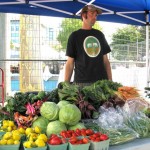

There were food tickets on sale – a very reasonable $1 per ticket gave you a sample from most booths, stocked with everything from “kaleslaw” to cream puffs, and I proved to my own satisfaction that it was possible to eat extremely well for under $10. The barbecued salmon and boiled corn stands were mobbed for most of the time we were there; there were tasty treats from the likes of Canoe Brewpub, Bliss, Relish, Choux-Choux Charcuterie, AJ Organics and others…so after taking in all that with a taste of music and lots of sunshine we finally left, sated and laden with produce.


Latest Posts
- (no title)
- Sublime and Twisted Readings coming up!
- Sublime
- Good weather for reading
- The world, the world
- Sublime launch!
Aldeburgh Poetry Festival Barny Haughton BBC BC poets Berkswell blackberries Black Stilt Bologna book launch Borough Market Carlo Petrini Catalonia Cyrus Todiwala dairy Daunt's Books Dijon Edinburgh Fanny Bay Feast of Fields Food and Morality food history food journalism Jenna Butler lardo Malahat Review Michael Pollan Okanagan olive oil tasting olive trees Omnivore's Dilemma Our Food Our Future Oxford Parmigiano-Reggiano Planet Earth Poetry poetry poetry readings Poetry videos prosciutto salumi Sean O'Brien Suffolk ticks Wendy Morton Wired Writing Yvonne Blomer
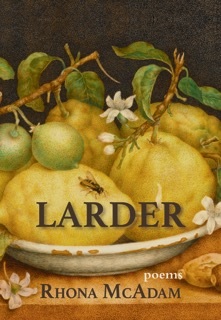
In her latest collection, Rhona McAdam navigates the dark places of human movement through the earth and the exquisite intricacies lingering in backyard gardens and farmlands populated by insects and pollinators, all the while returning to the body, to the tune of staccato beats and the newly discovered symmetries within the human heart.
“…A beautiful, filling collection, Larder is a set of poems to read at the change of the seasons, to appreciate alongside a good meal, and to remind yourself of the beauty in everything, even the things you may not appreciate before opening McAdam’s collection….”
Rhona McAdam is a writer, poet, editor, and Registered Holistic Nutritionist with a Master’s in Food Culture from Italy and a deep-rooted passion for ecology and urban agriculture. Her work spans corporate and technical writing to poetry and creative nonfiction, often exploring the vital links between what we eat and how we live. Based in Victoria, BC, and available via Zoom, Rhona is always open to new writing commissions, readings, or workshops on nutrition and the culinary arts.