-
Skate update, and more on poetry reviewing
Read Full Post: Skate update, and more on poetry reviewingSince my first triumphant experience with skate wings in black butter, back in April, I tried cooking it again and was appalled by a penetrating ammonia odour coming from the fish. What was going on? Had I added too much vinegar, causing some toxic reaction? Delia mentioned nothing about this possibility in the book I was using for my recipe.
So I did a little further research and here’s what I found. Apparently skate, like shark, can become contaminated by the urea both species carry in their skin. Not all pieces of skate will have this: the ammonia odour comes from poor handling when it’s first caught and processed, and you should be able to smell it in the raw fish. Ideally you should sniff the fish before you buy it – impossible to do through a grocery store’s shrink-wrapped packaging of course. Better to make your purchase through a fishmonger if you can find one; and of course they’ll be least likely to sell you improperly prepared fish, so safer all round. (I guess this would be more of our self-inflicted damage from allowing mass-procurement supermarkets to take over food handling from knowledgeable specialists.) However, if you do find yourself with an ammonia-scented morsel, you can rescue the day by soaking it in lemon-infused water for 30 minutes to remove the smell (and taste). I guess that’s one more reason skate is a sadly neglected fish… but try it anyway.
After discussion about the tone of poetry reviewing in Canada, I came across some interesting reading from the archives of Chicago’s venerable Poetry Magazine where they once had a major fisticuffs over poetry reviewing. Plus ca change..
-
What passes for food in airports
Read Full Post: What passes for food in airportsI had some time on Monday evening – a couple of hours right around supper time to be exact – to meditate on the lack of edible food in our public places, in this case the Calgary Airport.
Having disembarked for my stopover – a tiny packet of pretzel-like substance my only sustenance during the four hour flight from Ottawa – I was looking for something freshly cooked or remotely resembling fresh edible food. But what a wasteland it is for the connecting traveller, with most so called food outlets already scraping up their leavings to shut down for the day at 7pm, or already closed. Unless your tastes run to donuts or foul smelling sandwiches, or greasy steamtabled chinese style food, or nasty looking pasta, you will roam the hallways hungry and without so much as a single decent retail outlet to distract you. There was no longer even a Dairy Queen to brighten the horizon.
The one sit-down restaurant – Montana’s last time I was there, but now replaced by Kelsey’s (no real change there since the same American company owns Harvey’s, Swiss Chalet, Second Cup, Milestones, Montana’s, Kelsey’s and Toast Cafe) – served me food and drink so utterly vile on my last visit that I was moved to write a letter of complaint. The response from the company was to offer me a coupon to dine with them again. As if.
Speaking of ownership, I read in the Guardian an article about corporate ownership changes to ethical companies including Green & Black’s (Cadbury), Rachel’s (Dean Foods), Ben & Jerry’s (Unilever) and the subsequent decline in their ethical rankings. Even the Body Shop is no more the lone voice in the cosmetic wilderness, since it’s been sold to L’Oreal! It’s so hard to keep up. Another good reason to try to give your custom to the dwindling number of locally owned operations wherever possible.
-
Ottawent
Read Full Post: OttawentSo, party’s over, and I’m back at the trail’s end/beginning.
League of Poets AGM ended after two more days of meetings and readings and meetings and readings. By the end of Saturday’s banquet I could not have eaten another bite or heard another word.
We had a keynote address on Saturday night by longtime member (indeed present at the founding meeting of the League) Margaret Atwood. She was in droll mood and after a charming and carefully bilingual introduction by Pauline Michel, she launched into a quip-packed 40th anniversary address, on the subject of Why Poetry? (Her lecture will, they tell us, be printed in full in a future issue of Prairie Fire.)
She said she’d joined the League back “when poetry was top dog,” when, like her, many of today’s Canadian novelists were beginning their careers — as poets. Recounting a couple of sweetly sordid anecdotes, she remarked that back then the poets – mostly male – were living in the afterglow of Dylan Thomas and John Berryman, and self-destructive acts were part of the job description. She felt that these days she’d send aspiring poets to plumbing school: there’s always a demand for your services; it’s easier to think about poetry when doing something with your hands; and it’s nice and dark under the sink.
So then she got to her question. Though we no longer think we can conjure rain, or even mildew, or have our heads chopped off for writing poetry, we are in a tamer age than when words were more potent. Why then do we do this poetry thing, whether written or oral, or is it built in?
Instead of providing answers, she offered what she called some potentially interesting sidelights.
1. Reading, writing and speaking are all located in different parts of the brain.
2. If the speaking part of your brain is knocked out, the singing part may still remain.
3. Words have their own address book in our brain: we recognise that John Smith is a different thing from a carrot. Poetry can serve as an aide-memoire (to prove her point, she had us filling in the blanks of Alligator pie; Alligator pie… )
4. Music, poetry and mathematics are more closely related than poetry and prose. There’s a system of pattern recognition at work that’s connected to music and math – and of course she was speaking here of rhymed and metered verse rather than “that which resembles prose”.
5. Fire and grammar are what distinguish humans from other life forms. Only humans cook their food, and having reduced the time we would have spent digesting unprocessed food, we have thus liberated up to five hours per day for other pursuits. And though animals may communicate through noise, they lack grammar. The dog can and does think in past and future tense, but no dog is likely to question where the first dog came from, and where do dogs go when they die.Oral cultures, she went on, swam in a sea of language; but now we live on comparatively dry shores, extruding our brains into other technologies, and so that part of our brain has probably shrunk. Technology and numbers are said to represent ‘the real world’ – as opposed to the obsolete world that poets occupy. But we make what we long for, and destroy what we fear, as we have always done; these things have not changed, and we know this because we have poetry. Human imagination drives the world: it directs what we do without our tools, and poetry is part of the way we sing our being.
There followed the banquet (some very good grilled chicken or cedar-planked salmon) and awards ceremony. I was thrilled that Suzanne Buffam won the Gerald Lampert Award for her wonderful book Past Imperfect. She read the lovely poem Please Take Back the Sparrows.
The winner of the Pat Lowther Award was Sylvia Legris, for Nerve Squall, reviewed with considerable venom in the Globe and Mail earlier that day. A tragic waste of newspaper space for the single review of poetry on offer, and a badly ill-judged match of reviewer to subject, as the reviewer himself admits: “Those who enjoy linguistic foreplay, and the pinball wizardry of caroming words, will favour this book. Those like me will find that it all adds up to narcissistic inconsequence.” Well, it’s not my cup of tea either, but if it was good enough to engage the not inconsiderable intellects of the juries of both the Griffin and the Lowther awards, and prove itself the stand-out over hundreds of other collections, it can’t be as bad as all that. It would have been far more useful to hear from a critic able to explain just what that power was, in the context of all its competitors. Surely the Globe could have scraped the barrel a bit harder and found a reviewer who could deal with the book in its own terms?
A more interesting article in the Globe and Mail about the origins of ABE, the online treasure trove for book lovers.


Latest Posts
- (no title)
- Sublime and Twisted Readings coming up!
- Sublime
- Good weather for reading
- The world, the world
- Sublime launch!
Aldeburgh Poetry Festival Barny Haughton BBC BC poets Berkswell blackberries Black Stilt Bologna book launch Borough Market Carlo Petrini Catalonia Cyrus Todiwala dairy Daunt's Books Dijon Edinburgh Fanny Bay Feast of Fields Food and Morality food history food journalism Jenna Butler lardo Malahat Review Michael Pollan Okanagan olive oil tasting olive trees Omnivore's Dilemma Our Food Our Future Oxford Parmigiano-Reggiano Planet Earth Poetry poetry poetry readings Poetry videos prosciutto salumi Sean O'Brien Suffolk ticks Wendy Morton Wired Writing Yvonne Blomer
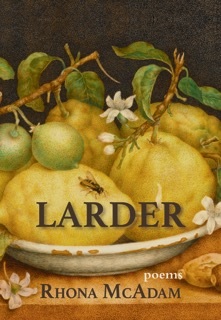
In her latest collection, Rhona McAdam navigates the dark places of human movement through the earth and the exquisite intricacies lingering in backyard gardens and farmlands populated by insects and pollinators, all the while returning to the body, to the tune of staccato beats and the newly discovered symmetries within the human heart.
“…A beautiful, filling collection, Larder is a set of poems to read at the change of the seasons, to appreciate alongside a good meal, and to remind yourself of the beauty in everything, even the things you may not appreciate before opening McAdam’s collection….”
Rhona McAdam is a writer, poet, editor, and Registered Holistic Nutritionist with a Master’s in Food Culture from Italy and a deep-rooted passion for ecology and urban agriculture. Her work spans corporate and technical writing to poetry and creative nonfiction, often exploring the vital links between what we eat and how we live. Based in Victoria, BC, and available via Zoom, Rhona is always open to new writing commissions, readings, or workshops on nutrition and the culinary arts.