-
Puglia Wednesday: wine and white cities
Read Full Post: Puglia Wednesday: wine and white citiesWednesday’s schedule included a trip to la Riserva di Torre Guaceto where olive trees and other growing things are being protected. The olive trees we saw were at least 500 years old, and were part of a scheme to involve farmers in organic production methods by creating a co-op to produce and market organic extra-virgin olive oil.
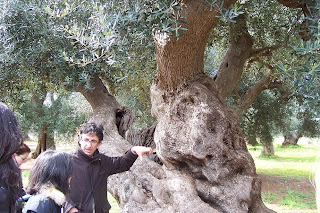
There is also a marine park which includes the beach below, which we were told accommodates as many as 5000 visitors a day in the summer.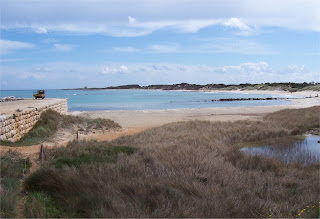
Although Italian marine parks like this one are off-limits to commercial fishermen, it seems that, through its conservation efforts, the reserve has enabled a 400% increase in fish stocks, and now a small local fishing enterprise is permitted, under strict scrutiny by the University of Lecce which monitors the size and type of fish that are caught.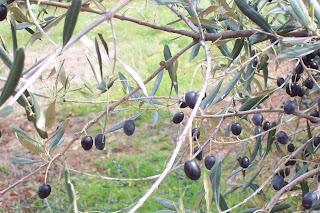
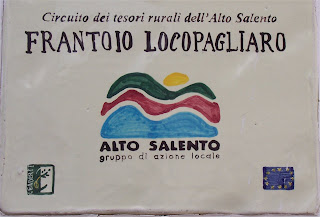
We travelled next to a restored olive mill, Frantoio Locopagliaro, in the midst of a large olive grove. Underground mills were once the norm in this area, because they were practical to build – aboveground constructions required specialised labour – and their rock ceilings could withstand the pressure exerted by manual presses. The underground setting also maintained the oil and processing at optimal temperatures.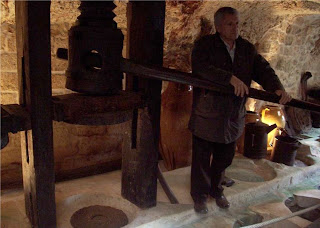
The press itself: after the olives and their stones were ground to a paste beneath horse-powered millstones, the paste was put in round woven baskets that were stacked and placed beneath the wooden screw which was turned by human effort. The oil was then separated from the rest of the liquid, and the paste was transferred for further pressing.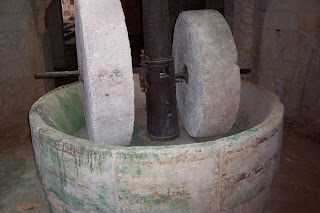
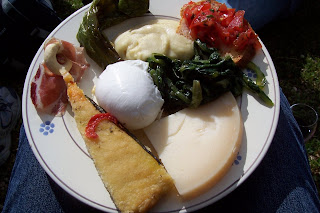
This olive crusher was used for the second crushing, to reduce the olive paste residue further for processing into lamp oil or other industrial use.After a tasting of Puglian extra-virgin olive oils, we sat in intermittent sunshine to enjoy a terrific lunch which included such local novelties as chicory (a kind of spinach-like green) with pureed fava beans and roasted green peppers, a bit of burrata, some cacciocavallo, and a nice piece of capocollo tucked into an addictive little biscuit called taralli. And some lovely oily bread. And a glass of wine.
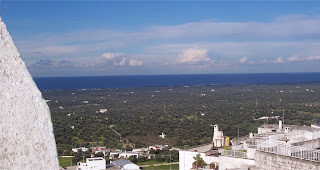
After this, we were whisked off to Ostuni – la Città Bianca – where we ascended to the summit for a quick look over the forests of olive trees below.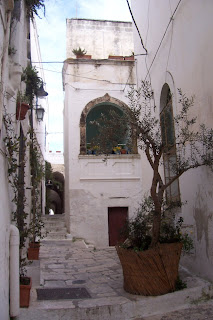
Then a speedy and very chilly visit to the vineyards, just starting to leaf, of Lomazzi & Sarli, who’d provided our previous night’s wines – including Dimastrodonato, a particularly good dessert wine made from a characteristic Pugliese grape (Aleatico) – and back we went to the hotel to rest up for supper.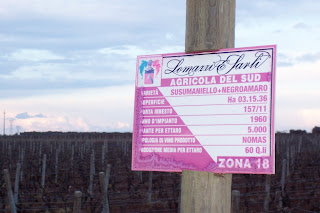
-
Pausing in Puglia
Read Full Post: Pausing in PugliaGreetings from Puglia, where pigs fly.
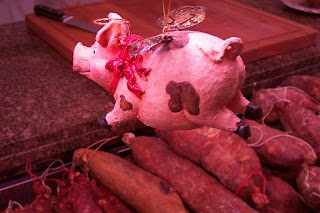
Here in the heel of Italy, the weather has turned wet and cold and I have passed on a trip to Lecce to catch up with a few things. Naturally now that I have made that decision the rain has lifted and the sun has come out… Ah well.We arrived in Brindisi yesterday at a desperately early hour and carried on to IAMB, the Bari centre of the Mediterranean Agronomic Institute: we will be visiting the institute’s Chania centre when we visit Crete next month.
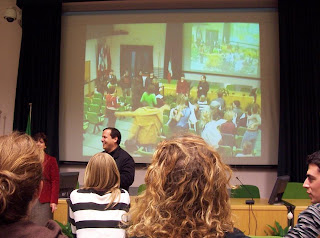
Our Escher moment at IAMB.They offer research training to agronomists from Mediterranean countries to study such issues as irrigation and water management, aspects of organic agronomy, and methods of managing endemic insects such as the olive fly.
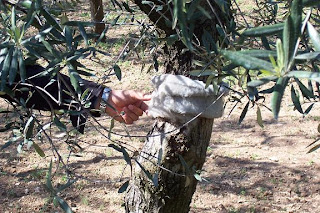
Clever way to catch crawly insects on an olive tree: a collar of fiberglass.We had an incredibly good lunch of local dishes, many of them seafood, and then paused for half an hour or so to view the characteristic conical houses, the Trulli, which are found in abundance in the area but particularly in a town called Alberobello.
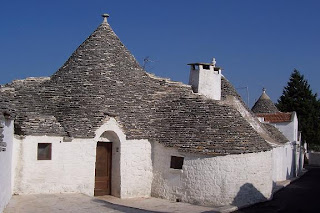
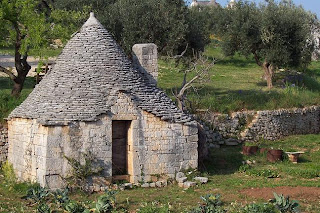
On we sped to our appointment with butchers in Martina Franca where we watched the making of capocollo, another cured meat made of a whole cut of pork.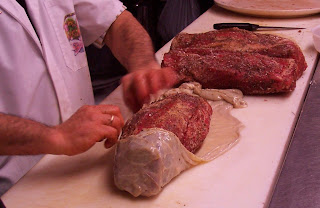
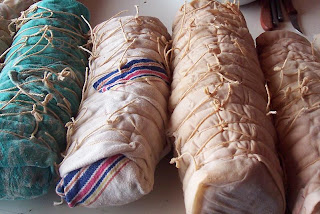
This one is trimmed to size, seasoned and dried for a few days, then marinated in boiled wine must and white wine, then wrapped in pork intestine, tied in a tea towel, dried a bit longer, unwrapped, hung to dry, then briefly smoked, and then hung again until start to finish it has gone through its paces for a total of about 120-150 days. By then it is a firm, sweet, slightly salty and lightly smoky treat, made in small quantities between October and Easter, when the climate is suitable for the cool dry winds it needs over part of the process.After that we had a surprise gift of music and dance from a local folk troupe, then watched a bit of hand-crafting of orecchiette and maccheroni and sat down to another wonderful meal. We had a couple of soups – zuppa verde and zuppa di carciofi – and some pastas including the ones we had seen made. There was, for the strong, a further buffet featuring such specialties as Puglian salumi, raw artichoke and cheese salad, and a kind of risotto made with orzo (barley) and mushrooms. Some pastry and fruit followed, and a merciful sleep.
This morning we had a talk by Gino di Mitri, author of a book on Tarantism, the historic and region-specific ailment of Puglia, attributed to the bite of a spider, and which may have its pagan roots in Dionysian rituals, while its Christian expression took the form of prayers to St. Paul, saint of spiders. Affecting mainly, but not exclusively, women, tarantism was treated by music and a highly energetic dance, in which the sufferer used her body to describe the circumstances of the bite, and which ultimately evoked a trance that would allow the sufferer reconciliation with the spirit of the spider. The musicians – a tambourine player (almost exclusively female), accompanied by violin, guitar and accordion – would diagnose the colour of the spider, which corresponded to the nature of the ailment: for example, a blue spider would express melancholy and disharmony with the community. Homosexuality, we were told, was often entwined with the condition. Women who did not want to marry might claim to have been bitten, and the contaminating nature of the spider bite might in any case render them unmarriageable.
Last week is already a blur, but we had some wonderful people talking to us, including Stuart Franklin who walked us through a fraction of his formidable portfolio and spoke movingly about his latest project and forthcoming book on the changing landscapes of Europe, a depressing tale of overproduction, land-grabbing, overdevelopment and standardisation. We also enjoyed Richard Baudains who led us through some of the issues of wine reviewing: the extreme ends of its readership and the difficulties of communicating subjective analysis of an edible subject. We saw some wonderful films as well, from the Slow Food on Film curator, including a fantastic documentary called Life Running Out of Control which encapsulated the complex issues of genetic engineering, including the contamination of organic seed stocks by GM crops in North America, the risks to the farmers of India of the dubious economics of GM seed developers, and the moral and practical issues of experimental animal development. Shades of Oryx & Crake…
-
Modena: more than vinegar
Read Full Post: Modena: more than vinegarSpent Saturday in Modena; near to Parma and blessed that day with great weather. There was some kind of Ferrari show going on which was a little confusing as I think we came away with a distorted sense of the proportion of Ferraris to centrally located parking spots. We had a nice amble and a nice lunch. Here are some sights…
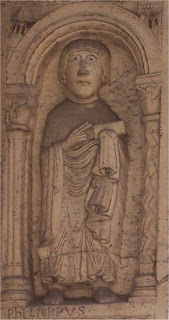

A couple of the carvings on the duomo.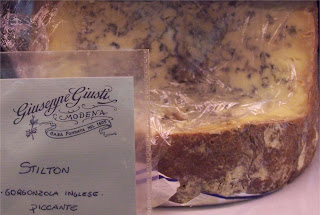
An old English friend makes an appearance in a food shop in Modena.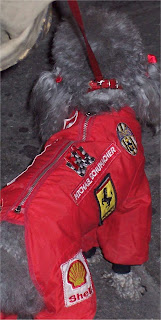
Michael Schumacher – shorter and hairier than I thought he’d be. We were constantly reminded that Modena is cartown as well as vinegarville.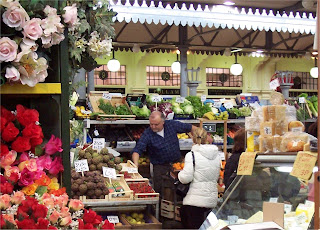
An excellent covered market with lots of my favourite things…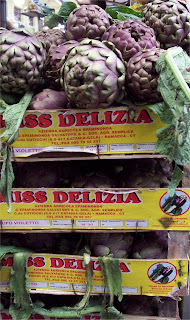
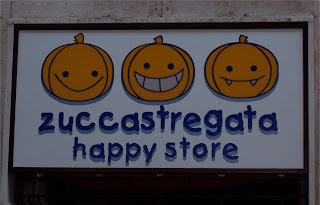
In Modena, the dogs are careful and the pumpkins are haunted (is that why the tortelli di zucca taste so good?):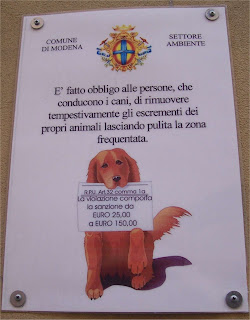


Latest Posts
- (no title)
- Sublime and Twisted Readings coming up!
- Sublime
- Good weather for reading
- The world, the world
- Sublime launch!
Aldeburgh Poetry Festival Barny Haughton BBC BC poets Berkswell blackberries Black Stilt Bologna book launch Borough Market Carlo Petrini Catalonia Cyrus Todiwala dairy Daunt's Books Dijon Edinburgh Fanny Bay Feast of Fields Food and Morality food history food journalism Jenna Butler lardo Malahat Review Michael Pollan Okanagan olive oil tasting olive trees Omnivore's Dilemma Our Food Our Future Oxford Parmigiano-Reggiano Planet Earth Poetry poetry poetry readings Poetry videos prosciutto salumi Sean O'Brien Suffolk ticks Wendy Morton Wired Writing Yvonne Blomer
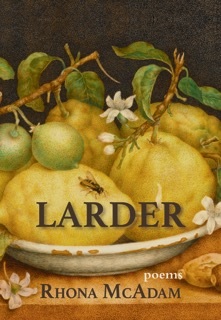
In her latest collection, Rhona McAdam navigates the dark places of human movement through the earth and the exquisite intricacies lingering in backyard gardens and farmlands populated by insects and pollinators, all the while returning to the body, to the tune of staccato beats and the newly discovered symmetries within the human heart.
“…A beautiful, filling collection, Larder is a set of poems to read at the change of the seasons, to appreciate alongside a good meal, and to remind yourself of the beauty in everything, even the things you may not appreciate before opening McAdam’s collection….”
Rhona McAdam is a writer, poet, editor, and Registered Holistic Nutritionist with a Master’s in Food Culture from Italy and a deep-rooted passion for ecology and urban agriculture. Her work spans corporate and technical writing to poetry and creative nonfiction, often exploring the vital links between what we eat and how we live. Based in Victoria, BC, and available via Zoom, Rhona is always open to new writing commissions, readings, or workshops on nutrition and the culinary arts.