-
Money for nothing and your CanLit for free
Read Full Post: Money for nothing and your CanLit for freeI recently fielded a request from Canadian Literature, where I had published (unpaid) a poem a few years ago. They have developed a fine archive featuring poetry they’ve published, together with virtual interviews and biographies. The laudable aim of this enterprise is to make good quality contemporary writing available to Canadian students so they can take inspiration from published works in order to learn to write poetry themselves.
The journal makes its archive available for free, which is lovely for the schools and students who will benefit. But one of the reasons it’s available for free is they’re not paying the writers for what amounts for unlimited use of their creative works, as well as the thought and effort involved in answering questions about their life and process.
There are a hundred tired comparisons I could make: does a teacher or editor or librarian who develops such a database do so without accepting a salary? I doubt it. Should a carpenter be asked to build a house for free because it’s beautiful to look at and inspiring to student builders? Unlikely.
There is, unfortunately, no end to the things writers are asked to do for free, and unfortunately for those who ask, such requests have to go to the bottom of a freelancer’s or wage earner’s task list. Maybe it’s worth it to tenured academics with publication requirements or budding writers with day jobs who are hungry for publicity. But it seems to me that a lot of worthwhile and well-intentioned projects that aim to make information or creative work freely available to a wider public overlook the fact that the people who create those works have a right to expect to make a living from their writing.
And in my experience, the people who initiate these projects seldom make the effort to raise funding to pay those creators, particularly if the projects are from academic or educational institutions. Worse are the folk – like Google for example – who do so with aims of generating revenues of their own, on the backs of creators.
While educational institutions may not be awash with cash themselves, they are no less able than more exemplary folk – some valiant and unpaid editors of magazines and reading series – who fall over backwards to pay the people whose writing they publish and promote. And they are no less able to tell the people they’re asking just why there’s no money to pay them, if they have tried.
After a little prodding, Canadian Literature told me they did try their hardest to get funding for the project, but failed, and decided to proceed anyway, in the interests of having something worthwhile to offer to students, particularly those in remote locations. On the strength of the enthusiasm of the archive’s creators, I will likely participate in this project despite my misgivings, but I can’t help feeling caught in some kind of freebie vortex that sucks me and my ability to earn a living ever downwards. Money may not be why poets write poems, but it’s certainly a consideration in making them public.
And I wonder how keen those students will be to take up poetry if they’re made aware that a good annual income from writing for successful Canadian poets (aside from the blessings of PLR and Access Copyright cheques) seldom exceeds three digits.
-
Couple of local events, where I am and am not, and tribute to Yotam Ottolenghi
Read Full Post: Couple of local events, where I am and am not, and tribute to Yotam OttolenghiFebruary 20-22: Terroir: Identity & Seduction; Saskatoon
A conference about Terroir — in Saskatchewan. Why not? Some interesting speakers and entertainments planned, as the participants toss around ideas of sustainability, gastro-tourism, geographic indications (appelations), ecomuseums and rural development initiatives. I’m expecting some good music, eating & drinking too.February 23-March 8: Fair Trade Fortnight; UK
In England, recent research finds that 70% of British consumers now recognise the Fairtrade Mark, and more than a third of people want to see more Fairtrade produce available in cafes, restaurants and pubs (34%, up from 25% last year). Fairtrade is more than a fair selling price and marketing scheme for goods; it’s a fully audited system of trade that assures that the workers who grow, harvest or work with those goods are fairly treated and that their communities – not just the business owners – reap a benefit (the ‘social premium‘) which goes towards improving health, education and living standards for all. Thousands of producers in poorer countries depend on the system for a fair price for their product, fair trading conditions and market access. Britain celebrates and promotes this work with Fairtrade Fortnight, which this year runs from February 23 through March 8th. Perhaps we smug North Americans could get on this bandwagon a bit more – if British supermarkets like Sainsbury’s can bow to consumer pressure and stock only fairly traded bananas, why do I never see any in Canada? (In Canada, the process is handled by Transfair)Yesterday, at St Peter’s
And one more local event was aperitivo hour at the writers’ colony last night, which featured Yotam Ottolenghi‘s wonderful caramelised garlic tart. Here’s my picture of this food’s horizon of caramelised garlic, golden nugget squash (thanks Jim!) and goat’s cheese:
And here are some Scottish socks complaining in falsetto about Ottolenghi’s pics:
-
Jammy thoughts
Read Full Post: Jammy thoughtsThe other day, I was talking to Jim the gardener who had spent some years in France, and time in Spain, and inevitably therefore the conversation wandered into quince territory. I’d seen quince (mele cotogno) trees growing in Herculaneum. In Spanish it’s known as membrillo, which is also the word used to describe quince paste – a good companion for cheese and which I read here is, itself deriving from melomeli (more about this below) the etymological ancestor of marmelade.
So then I was looking at my beautiful little book about foods of Pompeii which I’m crawling through with my limited Italian. It’s called le stagioni dell’antica pompei: recette farmaci e conserve, and includes a few recipes, including one for preserving quince (Conserva di mele cotogne) and making melomeli – a kind of honey/fruit wine used for its curative powers, to treat fevers and liver, kidney, or urinary ailments; as an astringent, and to facilitate digestion and relieve dysentery.
The basic method used in Pompeii was to pick quince when at their ripest – on a dry day in a waning moon – and then remove their fuzz, layer them in a glass container covered with a woven wicker cover and pour liquid honey to cover. My book says that this also produces melomeli which is used to treat fevers. But the melomeli recipe attributed to Apicius requires adding to the quinces a mixture of defrutum (grape must reduced by half) and honey. And defrutum is thought to be the ancestor of balsamic vinegar.
So food once more ties the past to the present in an edible package. Let’s celebrate on this wintry day with a little Hot Chocolate, courtesy food poet Leslie McGrath.


Latest Posts
- (no title)
- Sublime and Twisted Readings coming up!
- Sublime
- Good weather for reading
- The world, the world
- Sublime launch!
Aldeburgh Poetry Festival Barny Haughton BBC BC poets Berkswell blackberries Black Stilt Bologna book launch Borough Market Carlo Petrini Catalonia Cyrus Todiwala dairy Daunt's Books Dijon Edinburgh Fanny Bay Feast of Fields Food and Morality food history food journalism Jenna Butler lardo Malahat Review Michael Pollan Okanagan olive oil tasting olive trees Omnivore's Dilemma Our Food Our Future Oxford Parmigiano-Reggiano Planet Earth Poetry poetry poetry readings Poetry videos prosciutto salumi Sean O'Brien Suffolk ticks Wendy Morton Wired Writing Yvonne Blomer
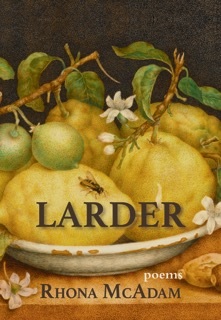
In her latest collection, Rhona McAdam navigates the dark places of human movement through the earth and the exquisite intricacies lingering in backyard gardens and farmlands populated by insects and pollinators, all the while returning to the body, to the tune of staccato beats and the newly discovered symmetries within the human heart.
“…A beautiful, filling collection, Larder is a set of poems to read at the change of the seasons, to appreciate alongside a good meal, and to remind yourself of the beauty in everything, even the things you may not appreciate before opening McAdam’s collection….”
Rhona McAdam is a writer, poet, editor, and Registered Holistic Nutritionist with a Master’s in Food Culture from Italy and a deep-rooted passion for ecology and urban agriculture. Her work spans corporate and technical writing to poetry and creative nonfiction, often exploring the vital links between what we eat and how we live. Based in Victoria, BC, and available via Zoom, Rhona is always open to new writing commissions, readings, or workshops on nutrition and the culinary arts.