-
Local bites
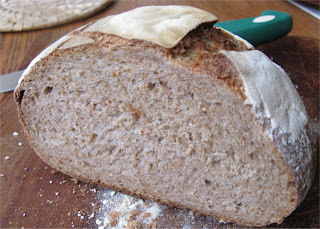
Read Full Post: Local bitesThere’s a new bakery/pizzeria in my neighbourhood, which pleases me greatly as this part of Victoria has been a bit of a quality food desert. B-red Organic Bakery Patisserie & Pizzeria is a tiny place on a busy road, with two slightly dangerous parking spots (you must back out into aforementioned busy road when you leave) and a tiny counter for watching the world go by. Making efficient use of space and time, they bake by day (open for sales 10-3) and pizza by night (5-11 most nights, till 1am Fri & Sat), taking their weekends on Mondays and Tuesdays. Here’s a view of their whole wheat sourdough, called Miche, which was extremely good, with lots of flavour and crunch:
Lots going on right now. I must hurry if I want to catch the Rice is Life show at the art gallery.
GG nominee (announcement tomorrow) and excellent literary chap Fred Stenson is reading in Sidney on November 21st at the Red Brick Cafe, together with local treasure Rachel Wyatt, beloved of many alumni of the Banff Writing Studio.
Next Thursday November 27th there’s a one-day conference in Sidney that aims “to put the farm back in farmland”. The Farmland Conference: Our Foodlands, Our Future runs from 9.00 am till 6.30 pm and features plenary speakers farmer/agrologist Niels Holbek and MLA and agriculture critic Corky Evans.
Saturday 29th I’m tempted by the CRD Parks Magnificent Mushrooms outing. Or I could stay home and study all the ones that are growing in my lawn..?
Weirdness on the water: surprised to see this sight on Sunday morning. A passing dog-walker told me it was only foam from the reversing falls under Tillicum Bridge, but I’ve never seen this on the Gorge in the six years I’ve been looking at it. Something funny going on…


-
Slow Food on film
Read Full Post: Slow Food on filmThe Vancouver Island Slow Food Film Fest was small but tasty. Last night’s premiere was packed out, with excellent nosh


and such a keen audience of eaters that the Oyster Man

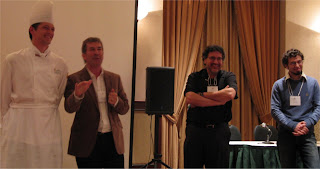
was able to go home oysterless. The screening of Island on the Edge went well and the panel discussion afterwards was lively and showed the keen awareness of the audience about local food issues. As a finale, we got to meet the chef, Michael Minshull, who took a bow with the film’s director Nick Versteeg, writer Don Genova and associate producer Jason Found.
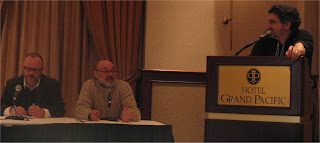
Today’s lineup included Hijacked Future, which covered the issues around seed production and featured a great many Canadian farmers and researchers who spoke well and compellingly about the issues. There was a panel discussion afterwards, hosted by Don Genova, and featuring Sinclair Philip and the film’s producer/director David Springbett.
Gardens of Destiny, featured seed saver, forager and campaigner Dan Jason,

whose Salt Spring Seed Company has been doing a roaring trade in recent years, and who also heads the Seed and Plant Sanctuary for Canada, a network of Canadian gardeners devoted to nurturing plant diversity. The viewing ended with a bitter twist as Jason revealed, after the screening, that he had recently been given the boot from the showcase garden featured in the film by his landlords, and was currently considering his options.
The final feature, The World According to Monsanto, had some technical glitches – scratches on the dvd perhaps, or a tired dvd player (or, as one wag suggested, a Monsanto-engineered dvd player?!) – which cut things a little short. The film can be purchased fairly widely, or for the cheap and patient, it’s available for free viewing on Youtube (in 10 parts), or in 4 parts on LiveVideo.
We saw some previews as well. Here’s Eric Schlosser speaking to CBC, as part of a promo interview about the new documentary Food, Inc.
And Deborah Koons Garcia, director of The Future of Food, spilling the beans about her new film whose subject is, well, dirt:
Here’s a cheerful one for a film – not quite finished yet, I understand (though you can help to make it happen: see their website for more info) – about young farmers, called Greenhorns:
And I end this entry with the useful and appetising suggestion with which Nick Versteeg closed our meeting: invite some people to dinner, serve them some good, local food, and talk about it!
-
Museums and municipal elections
Read Full Post: Museums and municipal electionsLast week I attended the opening ceremonies of the First Nations Collection at the Cowichan Valley Museum in Duncan, which includes paintings, carvings, masks and artifacts from local artists. The ceremonies consisted mainly of some drumming with dancing by local boys


and a couple of mercifully short speeches by the museum curator and the First Nations cultural coordinator, after which the overcrowded room emptied into the rest of the museum – not a huge place – to enjoy a little buffet which featured smoked salmon candy and smoked salmon & cream cheese wraps with capers and dill, and lots of sweets.


It’s local election time here, so I went to an all-candidates meeting last night, curious to hear the talk and see the one candidate (for mayor) who thought food was worth mentioning. His platform is built on the ideas of self-sufficiency and local autonomy that heated up a room in the downtown library last summer, at a town hall meeting on food security. Aside from Harald Wolf’s comments, there was no discussion of food, and no questions from the floor or the organisers. The closest they came was to talk about the berming of Panama Flats (sounds like a Woody Guthrie song title?) which all candidates who answered the question agreed was suspect activity, said they doubted the agricultural purpose of the berm, expressed concern about environmental consequences of messing with the drainage of these fields, and affirmed they planned to fight to keep the land in the much-abused Agricultural Land Reserve. In terms of what could be inferred about the 13 candidates from their appearance, one point I noticed was that only two candidates (Wolf and Brownoff) brought their own water in re-usable water bottles; 12 of the 13 had bottled water sitting in front of them – it appears only Wolf had had declined it.

Most of the talk was about better public transport, more affordable housing and methods of coping with climate change (answers to the latter were all, except Wolf, pretty much limited to better public transport!). Not a whisper about cultural issues…
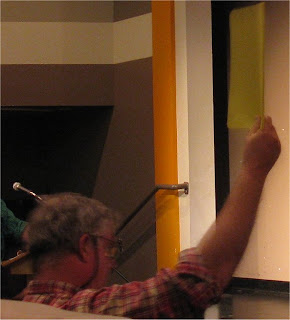
One thing I enjoyed about the meeting was the timekeeping. Organisers used a yellow/red card system: a yellow card was a warning the time was nearly up; a red card meant stop talking and sit down. How I wish this had been in use in some of the poetry readings I’ve been to in my day.


Latest Posts
- Writers at Word!
- Sublime and Twisted Readings coming up!
- Sublime
- Good weather for reading
- The world, the world
- Sublime launch!
Aldeburgh Poetry Festival Barny Haughton BBC BC poets Berkswell blackberries Black Stilt Bologna book launch Borough Market Carlo Petrini Catalonia Cyrus Todiwala dairy Daunt's Books Dijon Edinburgh Fanny Bay Feast of Fields Food and Morality food history food journalism Jenna Butler lardo Malahat Review Michael Pollan Okanagan olive oil tasting olive trees Omnivore's Dilemma Our Food Our Future Oxford Parmigiano-Reggiano Planet Earth Poetry poetry poetry readings Poetry videos prosciutto salumi Sean O'Brien Suffolk ticks Wendy Morton Wired Writing Yvonne Blomer
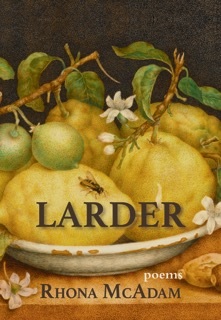
In her latest collection, Rhona McAdam navigates the dark places of human movement through the earth and the exquisite intricacies lingering in backyard gardens and farmlands populated by insects and pollinators, all the while returning to the body, to the tune of staccato beats and the newly discovered symmetries within the human heart.
“…A beautiful, filling collection, Larder is a set of poems to read at the change of the seasons, to appreciate alongside a good meal, and to remind yourself of the beauty in everything, even the things you may not appreciate before opening McAdam’s collection….”
Rhona McAdam is a writer, poet, editor, and Registered Holistic Nutritionist with a Master’s in Food Culture from Italy and a deep-rooted passion for ecology and urban agriculture. Her work spans corporate and technical writing to poetry and creative nonfiction, often exploring the vital links between what we eat and how we live. Based in Victoria, BC, and available via Zoom, Rhona is always open to new writing commissions, readings, or workshops on nutrition and the culinary arts.