-
Wendell Berry: “It All Turns on Affection”
By now all thoughtful people have begun to feel our eligibility to be instructed by ecological disaster and mortal need. But we endangered ourselves first of all by dismissing affection as an honourable and necessary motive.
Our decision in the middle of the last century to reduce the farm population, eliminating the allegedly inefficient small farmers was enabled by the discounting of affection. As a result, we now have barely enough farmers to keep the land in production with the help of increasingly expensive industrial technology and at an increasingly ecological and social cost.
Wendell Berry is known to many of us in many ways, whether as farmer, poet, novelist, essayist or land activist. I recommend taking the time to listen to his no-holds-barred Jefferson Lecture, in which he urges us to restore affection – for our land, neighbours and community – in order to attend to matters crucial for human survival.
The lecture is a powerful and compassionate analysis of our times. Such words as these struck me:
Now the two great aims of the industrialism, the replacement of people with technology and concentration of wealth into the hands of a small plutocracy, seem close to fulfillment. At the same time, the failures of industrialism have become too great and too dangerous to deny.
Corporate industrialism itself has exposed the falsehood that it ever was inevitable or that it ever has given precedence to the common good. It has failed to sustain the health and stability of human society. Among its characteristic signs are destroyed communities, neighbourhoods, families, small businesses and small farms. It has failed just as conspicuously and more dangerously to sustain the health and wealth of nature.
And these:
The losses and damages characteristic of our present economy certainly cannot be stopped, let alone restored, by liberal or conservative tweakings of corporate industrialism, against which the ancient imperatives of good care, home-making and frugality can have no standing.
The possibility of authentic correction comes I think from two already evident causes.The first is scarcity, and other serious problems arising from industrial abuses of the land community.
A positive cause still little noticed by high officials and the media is the by now well-established effort to build or rebuild local economies, starting with economies of food. This effort to connect cities with their surrounding rural landscapes rests exactly upon the recognition of human limits and the necessity of human scale. Its purpose to the extent possible is to bring producers and consumers, causes and effects, back within the bounds of neighbourhood, which is to say the effective reach of imagination, sympathy, affection and all else, including enough food, that neighbourhood implies.
-
Earth Day: gruesome gorse and wild food
 It was a busy Earth Day weekend. Saturday I spent grubbing around in the undergrowth of Gorge Park where a community cleanup was underway, in an attempt to control the spread of gorse as well as other invasives familiar to me from my own garden: English ivy, Spurge Laurel (a toxic black-berried invasive, what I’ve heard called daphnea but is really Daphne laureola),
 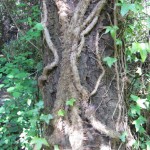 and holly. The Himalayan blackberries were everywhere too but I think we would have needed two or three pairs of the leather gloves they issued the gorse-gatherers to tackle those. Even the ivy had grown to such staggering strength we had to take an axe to some of it to slow its spread. I considered that we were doing invasive species interruption rather than elimination as the problem of escaped garden plants is pretty much out of control. Still, there’s an ongoing series of cleanup parties planned for the Gorge Tillicum parks to try to get a grip on some of it.
 One of the Saanich Parks staff who accompanied us glumly observed at one clearing that he’d been there when they had a gorse removal task ten years ago. But, he said, there’s been no funding since then and it wasn’t a priority. Our mission of the day was to try to keep the spread to a minimum by removing flowering plants before they could set seed, and removing what we could without disturbing the soil too much. We were instructed to pull the smallest gorse seedlings and then tamp the earth back down to slow the replacement through buried seed. Lar
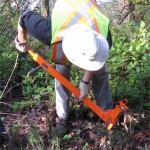 ger plants have strong taproots and as they mature the roots branch outward and new plants sprout from those. So we were told to cut below the first root nodule, or to flag the plant for someone to pull later. The largest plants will be strategically poisoned: there is a pesticide ban in Saanich but it is sometimes the only route available to parks workers trying to contain well-established invasives.
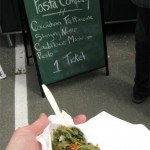 Yesterday’s treat was a trip to the third annual Wild Food Festival in Nanaimo. A gorgeous day for it and a good throng already queued up by 11:30, half an hour after it opened. I was able to control my consumer urges by sagely bringing only a little cash, but I managed some fine sampling for the half dozen food tickets I did purchase.
Later I watched a cooking demo with Francois deJong, from
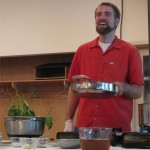 Nanaimo Foodshare, who was whipping up a generous batch of Nettle Polenta with Blackberry Hazelnut Brown Butter, with a side salad of kale and miner’s lettuce. He had brought along a bag of gleaned local hazelnuts which grow wild and cultivated in the area, and another of stinging nettles, which were the most popular food ingredient at the fair. There was nettle soup, nettle in wild food smoothies, nettle gyoza, nettle pasta and nettle ice cream.
It’s
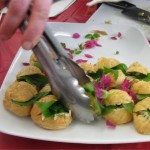 a good food with many health benefits, but I think we need to move on and learn to eat a few other things too. So I was happy to see raw blackberry cheesecake; a lovely gougere filled with wild greens and local cheese and apples; and a wild greens salad (chickweed, miner’s lettuce, sorrel and dead nettle) among the offerings. I came away with a bag of delicious Immuni-tea (made from rose hips, wild ginger, peppermint, catnip, elderflower and yarrow) and a few more ideas about turning my weeds into feeds.
 -
Clay, cordyceps, clams and cucumbers
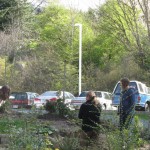 Last weekend’s permaculture course covered soil (with Christina Nikolic of Gaia College, SOUL and The Organic Gardener’s Pantry), fungi and animal husbandry. We started things off with a bit of digging in the garden to collect our soil samples, which we scooped into flat-bottomed jars, topped up with water and commenced agitating to thoroughly break the soil finely enough to settles and show its layers. We were advised to scrape aside the organic matter and just go for the soil. It was going to take some time for everything to settle – but we began to see the surprising truth of Christina’s observation that even where we thought we had hard clay soil, chances were it was simply compacted and the actual clay content would not be that great. The colour of the soil reflects the amount of organic matter, with darker samples being higher in humus, and lighter ones tending towards higher clay content… no bad thing since clay holds water and nutrients better than silt or sand.
Water made up most of the jars, and the layers then settle in this order:
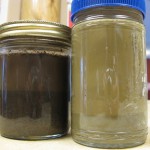
- (small amount of organic matter floating on top)
- water
- clay
- silt
- sand
Christina takes a more benign view of soil than most instructors. Knowing your soil type does not mean you have a problem to manage, she says, and nor is there any point to spending money on soil tests. Instead, focus your energies on building up the organic matter in your soil (even a great soil probably only comprises about 10% organic matter) which makes it more able to absorb and retain water and nutrients.
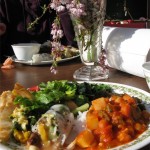
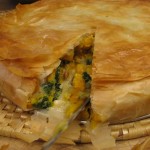
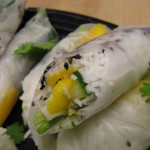
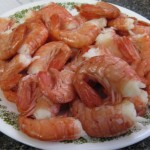
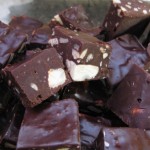
There followed one of our increasingly excellent potluck suppers, which we were delighted to be able to eat on the sunny patio, and which included such local delicacies as steamed nettles with shiitake mushrooms, kale & squash filo pie, mango spring rolls and spot prawns… but the vegan fudge shamelessly stole the show.
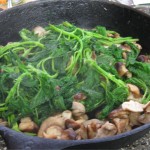
After our giant feed, we talked about different ways of growing mushrooms – from inoculated logs (actually bagged bricks of substrate made from grain or wood chips – these are widely
Mushroom stem butt available here nowadays at farmers’ markets), from spore prints or even stem butts. We were told that mushroom logs can be broken up and used to inoculate mushroom beds made in various ways in the garden, or rehydrated to fruit multiple times, as the mycelium web runs throughout the substrate. By far the most entertaining moment came when Brandon told us about the cordyceps mushroom that infects carpenter ants – compelling them to take to the highest branches of trees, and killing them at the moment their mandibles bite into a leaf, at which point the fungus grows from their bodies. It is a method of pest control (carpenter ants and termites) described by the mushroom guru Paul Stamets whose TED talk also discusses how to use mushrooms to clean industrial waste and for so many other purposes – medicinal, fuel and more – that he proposes preserving old growth forests as a matter of national defense. David Attenborough has documented cordyceps too:
I finished my weekend on Monday evening when I moseyed over to Vancouver Island University to attend a discussion about local food which featured John Ehrlich (of Alderlea Farm) who has a 300-subscriber biodynamic CSA (veg box scheme), and Guy Johnston, who is starting his second year of a Community Supported Fishery offering salmon, prawns and octopus. We
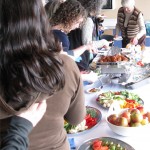 broke for a mid-session snack offering local foods including Natural Pastures cheese – but one of the points earlier made was proved to us: in order to offer us local food, the organizers had to buy it and bring it into the meeting. This college with its cafeteria downstairs and a well-established culinary arts program is tied like many institutions to trade agreements and supplier contracts that do not address the provenance of ingredients. In order to assure a local food supply, local food producers need local consumers, and as has been often said most of our food is made up of cheap imports purchased from off-Island wholesalers.
Farmer John Ehrlich 
Fisherman Guy Johnston
Latest Posts
- Sublime
- Good weather for reading
- The world, the world
- Sublime launch!
- Planet Earth Poetry – Readings by Volunteers, Victoria 2026
- Poetry at the Goldfinch
Aldeburgh Poetry Festival Barny Haughton BBC BC poets Berkswell blackberries Black Stilt Bologna book launch Borough Market Carlo Petrini Catalonia Cyrus Todiwala dairy Daunt's Books Dijon Edinburgh Fanny Bay Feast of Fields Food and Morality food history food journalism Jenna Butler lardo Malahat Review Michael Pollan Okanagan olive oil tasting olive trees Omnivore's Dilemma Our Food Our Future Oxford Parmigiano-Reggiano Planet Earth Poetry poetry poetry readings Poetry videos prosciutto salumi Sean O'Brien Suffolk ticks Wendy Morton Wired Writing Yvonne Blomer
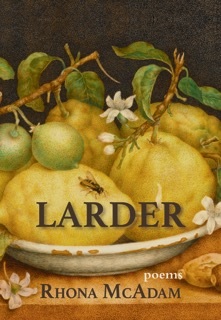
In her latest collection, Rhona McAdam navigates the dark places of human movement through the earth and the exquisite intricacies lingering in backyard gardens and farmlands populated by insects and pollinators, all the while returning to the body, to the tune of staccato beats and the newly discovered symmetries within the human heart.
“…A beautiful, filling collection, Larder is a set of poems to read at the change of the seasons, to appreciate alongside a good meal, and to remind yourself of the beauty in everything, even the things you may not appreciate before opening McAdam’s collection….”
Rhona McAdam is a writer, poet, editor, and Registered Holistic Nutritionist with a Master’s in Food Culture from Italy and a deep-rooted passion for ecology and urban agriculture. Her work spans corporate and technical writing to poetry and creative nonfiction, often exploring the vital links between what we eat and how we live. Based in Victoria, BC, and available via Zoom, Rhona is always open to new writing commissions, readings, or workshops on nutrition and the culinary arts.