-
More seeds

GTUF 2013 seed swap Lost a bit of time to computer troubles, but we seem to be back on our virtual feet again.
This abnormally warm West Coast winter is blending seamlessly into spring with an alarming showing of buds on bushes even as the snowdrops do their seasonal duty. We’re all thinking about seeds just now. The weekend before last the Gorge Tillicum Urban Farmers seed swap attracted around 50 GTUFers and other interested parties. It was a friendly and interesting time, comparing notes on what had grown well in our
 neighbourhood, and enlivened by the arrival of several cases of last year’s seed stock donated by a good neighbourly commercial seller.
Among my trophies, I collected seeds for:
- cucumbers (field and pickling)
- kohlrabi (one can never have too much)
- scarlet runner beans (some unusual & beautiful brown and cream coloured seeds)
- mammoth pot leeks (I have regretfully given up on onions – just don’t have enough sun in my garden)
- a Kashmiri brassica called Haak
- spinach
And I left small quantities of a large number of different plants including broccoli, celery, amaranth, calendula, oca, bulb fennel, black radish and eight different kinds of tomatoes, sugar snap peas and the remains of some unneeded seed packs, like onion (my plant list is here)
On Monday I was invited to speak to the fruit & veg group of the Victoria Horticultural Society. Rather than try to cross secateurs with more seasoned gardeners I chose community seed banks as my topic, and a lively discussion (several in fact) ensued. The GTUF seed bank, like many in these parts, was started after Dan Jason’s inspirational article on the topic. A good way to build goodwill, seed stocks and, ultimately, food security in your neighbourhood!
-
First seeds
 Even here in Lotusland we were reminded it’s still winter with a run of frosty nights, but the chill gave way to a clear sunny day last Saturday in which Haliburton Farm’s friends and neighbours gathered at the farmhouse to buy seeds, plant starts and organic produce and talk about the gardens to come. It was the first Seedy Saturday on Vancouver Island and the beginning of a long season for the seed-sellers who attended: Salt Spring Seeds, Seeds of Victoria and some of the farmers of Haliburton Farm: New Mountain Farm, H&R Veggies and Sunbird Farm II.
Below, Dan Jason – representing Salt Spring Seeds – and farmer Heather – with a tasty selection of organic produce from H&R Veggies – await customers as the day begins. Visitors, board members and farmers alike listen to Dan Jason’s noontime talk about the importance of seed saving and the value to food and community of knowing where your seeds come from. New Mountain farmers Nate and Mike offered seeds and produce.


-
Sweet beginnings
 Obesity and its brethren (diabetes, cancer, GERD etc.) are the latest uninvited guests at the 21st century table. And what they’re eating is sugar.
Or is that all they’re eating? I do think we overdo it with sugar of all kinds, and that we owe it to ourselves to avoid any foods (if we can!) that contain added sugar as well as a host of polysyllables, as part of my campaign against the trend of involuntary consumption. And where stealth campaigns have been led by vested interests – check out this eye-opening article about the sugar industry’s attempt to build its market regardless of cost to human health – my hackles get raised and my consumer dollar goes elsewhere.
But I also think that we humans are obsessed with single solutions, while nature is insanely complex in every possible way: as a species we’re a long way from understanding the difference between ruling the world and knowing our place in the ecosystem. Where food is concerned, we’re no less determined. Michael Pollan wrote about it as nutritionism; David Katz reviles it as the ONNAT fallacy.
So while I absolutely agree we should drastically reduce our consumption of it, I don’t think sugar is the only villain. But it’s been very topical in recent years.
Michael Pollan, in The Omnivore’s Dilemma, explained to a shocked readership back in 2006 the many faces of the number one subsidized crop in the US — in the words of the bookstore clerk who handed my copies across the counter: corn, eh: who knew? Pollan was appalled at what he’d discovered about corn’s new evil incarnation as high fructose corn syrup (HFCS), which is in just about everything these days. Though he recently admitted to being appalled at how his exposé had been turned into marketing leverage by the sugar industry, his book certainly spread the word to a wider public. On food labels, it can be hard to spot HFCS – or many other sugars – as the manufacturers keep adding new names to confuse us, but there are guides out there to help us dodge the bullet.
 Last year’s GMO film, Genetic Roulette, presented the theory that genetically modified corn, impregnated with Bt toxin designed to explode the stomachs of caterpillars, could be implicated in this century’s astonishing increase in food allergies. We have been assured that Bt will not affect humans, but it has been found in the human bloodstream (along with glyphosate/Roundup). What is it doing there? Is GM corn contributing to leaky gut in humans? One theory holds that food allergies can be caused by food particles entering the bloodstream through a weakened intestinal wall (“leaky gut”) and the body sees the food substance as a threat and creates antibodies against it, creating a food allergy or intolerance. A good subject for further study. Meanwhile, I think we should all avoid GM products until they’re proven safe: and that includes anything containing HFCS, since it’s likely made from GM corn. Our own table sugar in Western Canada is made from genetically modified sugar beets, so avoid that too.
Then we had evidence that HFCS caused more weight gain than other sweeteners. But then Marion Nestle trashed the study design. Another weird study emerged: the “Australian paradox” claimed that Australian sugar consumption had gone down, while obesity levels had gone up. Then that study was trashed.
 Then in 2009 we got Robert Lustig’s seminal lecture, The Bitter Truth About Sugar, where we learned in no uncertain terms that sugar of any kind is toxic, addictive and best friend to cancer, arthritis and all manner of inflammation. You can (and should, if you haven’t joined the 3 million viewers to date) watch it for yourself. But discovery is followed by rebuttal, and in 2011 David Katz took issue with the scapegoating of sugar and only sugar and urged the holistic approach to food. He took issue with Lustig’s definition of fructose as an addictive substance, and pointed to its origins in fruit which is not addictive. But the problem is that the fructose we’re being fed is not in fruit any more: it’s been isolated by the food industry and robbed of its accompanying fibre, enzymes and nutrients.
And, the way simplifications go, simply not eating sugar won’t necessarily protect you from cancer. Last year a study found that cancer will turn to other sources of nourishment if it can’t get sugar (glucose): cancer cells feed quite happily on glutamine, which is not a sugar but an amino acid, and the most common one in our bodies.
And now we start the new year with another study that says there is something different about fructose: an imaging study of human brains reveals its effect on appetite. It doesn’t make you feel full (as glucose does). And if you don’t feel full, you don’t know when to stop eating, and round and rounder you go.
Perhaps, then, it’s not so much an addiction as a treadmill. Stay tuned. The story is far from over…


Latest Posts
- Sublime
- Good weather for reading
- The world, the world
- Sublime launch!
- Planet Earth Poetry – Readings by Volunteers, Victoria 2026
- Poetry at the Goldfinch
Aldeburgh Poetry Festival Barny Haughton BBC BC poets Berkswell blackberries Black Stilt Bologna book launch Borough Market Carlo Petrini Catalonia Cyrus Todiwala dairy Daunt's Books Dijon Edinburgh Fanny Bay Feast of Fields Food and Morality food history food journalism Jenna Butler lardo Malahat Review Michael Pollan Okanagan olive oil tasting olive trees Omnivore's Dilemma Our Food Our Future Oxford Parmigiano-Reggiano Planet Earth Poetry poetry poetry readings Poetry videos prosciutto salumi Sean O'Brien Suffolk ticks Wendy Morton Wired Writing Yvonne Blomer
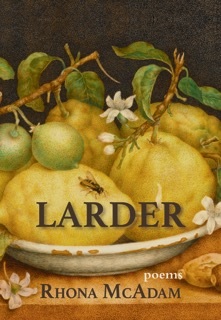
In her latest collection, Rhona McAdam navigates the dark places of human movement through the earth and the exquisite intricacies lingering in backyard gardens and farmlands populated by insects and pollinators, all the while returning to the body, to the tune of staccato beats and the newly discovered symmetries within the human heart.
“…A beautiful, filling collection, Larder is a set of poems to read at the change of the seasons, to appreciate alongside a good meal, and to remind yourself of the beauty in everything, even the things you may not appreciate before opening McAdam’s collection….”
Rhona McAdam is a writer, poet, editor, and Registered Holistic Nutritionist with a Master’s in Food Culture from Italy and a deep-rooted passion for ecology and urban agriculture. Her work spans corporate and technical writing to poetry and creative nonfiction, often exploring the vital links between what we eat and how we live. Based in Victoria, BC, and available via Zoom, Rhona is always open to new writing commissions, readings, or workshops on nutrition and the culinary arts.