-
Liking London
Read Full Post: Liking LondonA week or so ago I attended a reading by Ekstasis authors, in celebration of the Pacific Rim Review of Books. Richard Olafson introduces…
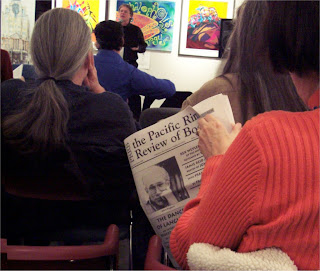
Among others, our excellent Saskatchewanian Glen Sorestad read, and so did the wondrous Yvonne Blomer.
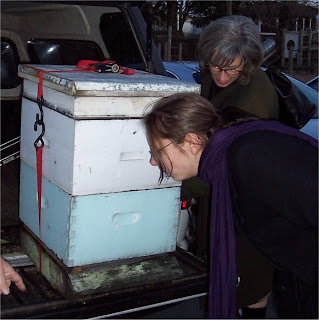
I’m enjoying the bee-keeping course a lot. Here’s how you wrap up your hives and throw them in the back of your truck to take them for a drive. If you listen closely you can hear them hum…
And now, here I am on the other side of the pond once more. I arrived yesterday and after a reviving nap and shower bustled off to the Olivier to catch Much Ado About Nothing, which was nothing short of awesome. Zoe Wanamaker, Simon Russell Beale and everyone — all wonderful. Sets, staging, music, dancing — all wonderful, wonderful, wonderful. I laughed, I cried, and I particularly enjoyed the reaction of the many school kids in the audience, who hooted and hollered and clapped upside down and backwards at the end.
I settled in that evening to a gorgeous box of booty from Ottolenghi – roasted aubergines with braised shallots, coriander, chili and green tahini; roasted beets with sunflower seeds, chard, chervil and maple sherry dressing; some soft, tasty new potatoes in mustard sauce; and a couple of slices of char-grilled fillet of beef with dijon mustard, coriander and honey sauce. With a glass of Barbera to wash it down. Looks like I will just miss the publication of Ottolenghi’s new cookbook, but we can still catch some great recipes in the Guardian.
Carrie has sent forth the challenge to participate in NaPoWriMo over April (National Poetry Month) which sounds like an excellent idea. We poets can show those novelists what’s what, eh?
-
Growth hormones in dairy, and National Poetry Month in Canada
Read Full Post: Growth hormones in dairy, and National Poetry Month in CanadaShocked by a grim if slightly dated tale about rBST – recombinant bovine somatotropin, marketed under the name “Nutrilac” – a synthetic hormone, developed by Monsanto through genetic engineering, that increases a cow’s ability to produce milk – which is allowed in US dairy cattle but banned in Canada and the EU. Despite intense lobbying by Monsanto, and a made-in-Canada whistle-blower scandal, eventually further study showed cause for concern over introducing it to the human food chain: but it is even more harmful to the health of dairy cattle, who suffer greater risk of lameness, infections and sterility when given it.
Bear that in mind when buying anything containing dairy products from the US. I’m not sure if there are any regulations at all that limit the use of US dairy products in this country – the regs only say we can’t give the hormones to our cattle. A number of dairy producers in the US now label their products as hormone-free, which is causing Monsanto to protest that such claims might make consumers think the hormone-free products are in some way ‘better’ than those which are produced with the benefits of Monsanto’s chemicals. Gosh…
More about milk another day. Meanwhile, National Poetry Month looms in Canada, and starting April 1st, the League of Canadian Poets will showcase poems by its members on a blog, whose theme is “Poetry Without Borders.”
-
GM canola and alfalfa, and a little poetry news
Read Full Post: GM canola and alfalfa, and a little poetry newsI’ve been discovering some shocking things about genetically modified foods in Canada this week, and so will all of you with televisions that can be tuned to Global for a documentary on Saturday night, March 23 at 7pm (dunno if it’s the same outside BC). Hijacked Future is about GM foods, but also about the stranglehold that large, profit-driven corporations are securing on the world’s food supply, while we consumers blithely carry on as it it were the most natural thing in the world for farmers to be forced to buy new seeds every year instead of saving and planting their own stocks, developed for local ecosystems and disease resistance.
Stephen Hume‘s article in the Vancouver Sun this week previews it nicely:
“…it’s fascinating to observe how we appear to be collectively sleepwalking toward … a potential catastrophe with that most strategic of all things, a sustainable, secure, equitably distributed global food supply… [Hijacked Future] takes dead aim at the question of whether it’s in our best national interests as informed, intelligent citizens of a global civilization to snooze while a few giant trans-national corporations succeed in their attempt to monopolize food production.”
I learned a bit about organic farming, too, and the loss of Canada’s organic canola crops, both as a commercial crop and as an invaluable rotation crop. It appears that because of the (non-organic) genetically-modified canola in our fields, over 90% of all canola – including organic – has been contaminated now. This has caused a significant loss of livelihood to organic farmers, so two Saskatchewan canola farmers tried to bring a class action suit against Monsanto, on behalf of all certified organic farmers, but our very own supreme court told them in December they couldn’t. The farmers are currently considering their options. Percy Schmeiser is our best documented case of unwanted GM crops intruding on private land against the wishes and intent of a farmer, and our higher courts did a less than heroic job there too. Although he’s just won – wait for it – $660 from Monsanto in a small claims settlement for costs involved in cleaning the GM canola off his fields.
Thank heavens for the farmers, consumers, environmentalists and courts of California, who were able to call the USDA on its ill-judged approval of genetically modified alfalfa. Alfalfa is hardly a glamour crop, being mostly known as animal feed, but it is also a crucial rotation crop for organic farmers. In both these roles, it sits at the bottom of our food chain, and we should – must – pay attention to what happens to it, or risk losing organic farming forever.
And on the poetry side of things, if you want a little extra CanLit reading you can sign up for The New Quarterly‘s new e-newsletter.


Latest Posts
- (no title)
- Sublime and Twisted Readings coming up!
- Sublime
- Good weather for reading
- The world, the world
- Sublime launch!
Aldeburgh Poetry Festival Barny Haughton BBC BC poets Berkswell blackberries Black Stilt Bologna book launch Borough Market Carlo Petrini Catalonia Cyrus Todiwala dairy Daunt's Books Dijon Edinburgh Fanny Bay Feast of Fields Food and Morality food history food journalism Jenna Butler lardo Malahat Review Michael Pollan Okanagan olive oil tasting olive trees Omnivore's Dilemma Our Food Our Future Oxford Parmigiano-Reggiano Planet Earth Poetry poetry poetry readings Poetry videos prosciutto salumi Sean O'Brien Suffolk ticks Wendy Morton Wired Writing Yvonne Blomer
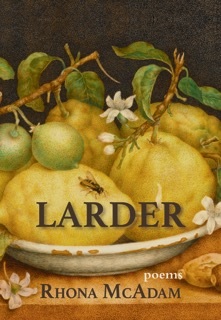
In her latest collection, Rhona McAdam navigates the dark places of human movement through the earth and the exquisite intricacies lingering in backyard gardens and farmlands populated by insects and pollinators, all the while returning to the body, to the tune of staccato beats and the newly discovered symmetries within the human heart.
“…A beautiful, filling collection, Larder is a set of poems to read at the change of the seasons, to appreciate alongside a good meal, and to remind yourself of the beauty in everything, even the things you may not appreciate before opening McAdam’s collection….”
Rhona McAdam is a writer, poet, editor, and Registered Holistic Nutritionist with a Master’s in Food Culture from Italy and a deep-rooted passion for ecology and urban agriculture. Her work spans corporate and technical writing to poetry and creative nonfiction, often exploring the vital links between what we eat and how we live. Based in Victoria, BC, and available via Zoom, Rhona is always open to new writing commissions, readings, or workshops on nutrition and the culinary arts.