-
Democratic poetry contest
Read Full Post: Democratic poetry contestAny of you out there seething with feelings of helplessness and impotent rage against competition judging… here’s your chance to set the world to rights. ChapterOnePromotions has an open poetry competition that you the voting public can judge. Just click on the ‘Open Poetry Competition’ link on the home page and make someone’s day, in the best possible way. Deadline for votes is July 15.
-
Festival and farmers’ market on World Cup weekend
Read Full Post: Festival and farmers’ market on World Cup weekendA little more on the festival weekend. Every Saturday morning there is an excellent Farmers’ Market in Courtenay/Comox, conveniently placed right next door to the festival. So the minute we’d staked our tarp we marched ourselves over there to see what was on offer. There was a looong line snaking towards one of the several bakery stalls and I later heard it was all about the cinnamon buns. But I went elsewhere, and bought some incredibly good cheese bread, a fantastic pumpkin muffin and some durable vegetables for snacking on, including peas in the shell and cauliflower florets. This morning I came upon a clipping that’s been floating around my office for a while that says certain vegetables, particularly broccoli and cauliflower, are naturally abundant in the compound sulforaphane (SFN) which is believed to reduce the risk of developing hereditary cancers.
Back at the site, I was greatly amused by Todd Butler who hosted a Sunday morning workshop. Acknowledging they were up against the gospel hour on the big stage he said, thank God for atheists or we’d have no audience… Paul Reddick’s concert was well attended by a well baked Sunday afternoon crowd. One of them in a mellow stupour in front of me piped up at the end of Villanelle. Hey, he said, did you write that one? Yes I did, said Paul. Man, that was beautiful, said the listener… Sunday afternoon in the barn was hot in oh so many ways when the giant talents of the Campbell Brothers shook the pigeons loose from the rafters. As this musical mayhem was immediately followed by epic and ecstatic helpings of Los Rastrillos, the birds didn’t get much rest till much later… Crankiest moment of the festival came courtesy Jamaica-based Anglo-German punker Ari Up who dropped out of her scheduled workshop to feature herself in another and then tried to run overtime, and when that didn’t work she — um… the polite word is remonstrated I think, although her arguments appeared to have far fewer syllables than that — with the beleaguered organizers. I suspect she’s not getting a repeat invitation. Even if her mom did marry Johnny Rotten. (Well ya didn’t see Peter Yarrow‘s daughter or Joe Fafard‘s son behave that way. )
Charlotte and I slipped away midday to cheer with the Italians and weep with the French in the air conditioned comfort of the bar at the local golf club. It was harder than it should have been to find ourselves a World Cup venue (shockingly, we were two of only six footie supporters in the pub) and near impossible to find an authoritative start time for the match: there was not a newspaper in sight and I must have asked at least a dozen people at the festival (including the Information booth, the First Aid booth and a pair of homesick Ozzies working the Mediterranean BBQ kiosk) before a man at the Security booth said he’d heard from a dedicated soccer fan that the start time was 11:00 (PST). Cut no ice with the bartender who had looked it up and decided it started at noon, so we missed the first 21 minutes before he got around to switching it on. And of course with two goals in the first 19 minutes, that was tragically poor timing. Since it all ended I’m tapering off by checking at intervals for breaking news of What Materazzi Said To Zidane To Make Him Do It.
-
Festivalia on the Island
Read Full Post: Festivalia on the IslandJust back from a weekend sitting on the cold hard ground, alternately sheltering beneath waterproofs or burning under a too-hot sun, having my eardrums blasted by massive speakers, my sensibilities overwhelmed by fried foods, cold drinks and new music. Yes, it’s festival time again. I was drawn to hear our local wonder Eugene Smith, poetical blues guy Paul Reddick and the always interesting Steve Earle, but a couple of new (to me) standouts this year included a ten-man Mexican reggae epiphany, Los Rastrillos, and Jon Voigt’s musical brother Chip Taylor (songwriter of Wild Thing and Angel of the Morning) with fiddlin’ singer Carrie Rodriguez. Favourite festival food was cheese and potato taquitos from Tita’s – served with Oliva’s salsa (smooth and dangerous: tomatillos, avocado, sour cream, jalapenos).
Eugene Smith
Chip ‘n Carrie
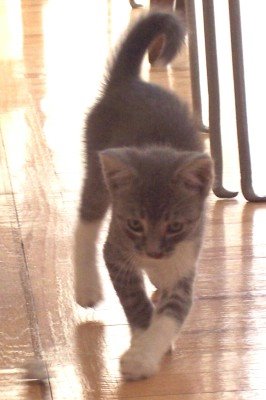
Los RastrillosPrior to departure I had to say a sad farewell to my fluffy lodger Boris who has gone back to hang out with his fellow furbies at Animals for Life, dreaming no doubt of the pleasures he found in Anton’s dog dish (and Anton well pleased to be rid of him). With his charming white socks and endless frisk I’m sure he’ll be among the first to find a new home.



Latest Posts
- Writers at Word!
- Sublime and Twisted Readings coming up!
- Sublime
- Good weather for reading
- The world, the world
- Sublime launch!
Aldeburgh Poetry Festival Barny Haughton BBC BC poets Berkswell blackberries Black Stilt Bologna book launch Borough Market Carlo Petrini Catalonia Cyrus Todiwala dairy Daunt's Books Dijon Edinburgh Fanny Bay Feast of Fields Food and Morality food history food journalism Jenna Butler lardo Malahat Review Michael Pollan Okanagan olive oil tasting olive trees Omnivore's Dilemma Our Food Our Future Oxford Parmigiano-Reggiano Planet Earth Poetry poetry poetry readings Poetry videos prosciutto salumi Sean O'Brien Suffolk ticks Wendy Morton Wired Writing Yvonne Blomer
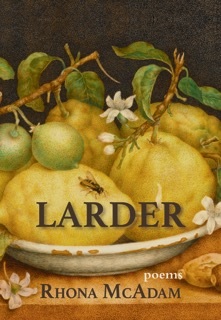
In her latest collection, Rhona McAdam navigates the dark places of human movement through the earth and the exquisite intricacies lingering in backyard gardens and farmlands populated by insects and pollinators, all the while returning to the body, to the tune of staccato beats and the newly discovered symmetries within the human heart.
“…A beautiful, filling collection, Larder is a set of poems to read at the change of the seasons, to appreciate alongside a good meal, and to remind yourself of the beauty in everything, even the things you may not appreciate before opening McAdam’s collection….”
Rhona McAdam is a writer, poet, editor, and Registered Holistic Nutritionist with a Master’s in Food Culture from Italy and a deep-rooted passion for ecology and urban agriculture. Her work spans corporate and technical writing to poetry and creative nonfiction, often exploring the vital links between what we eat and how we live. Based in Victoria, BC, and available via Zoom, Rhona is always open to new writing commissions, readings, or workshops on nutrition and the culinary arts.