-
Dijon continued: more wine, a few smoking barrels and a nice bit of cheese
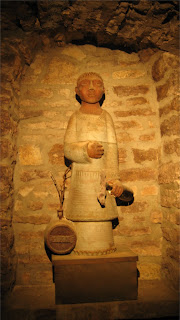
Read Full Post: Dijon continued: more wine, a few smoking barrels and a nice bit of cheeseOn Friday, we visited the Château de Corton-André, to hear about the wines of Pierre André from Christian Ciamos. He told us first about the yellow tiled roof of the chateau, which had come from Bruges and which was one of few in the area, an emblem of nobility dating back to the power days of the dukes of Burgundy. The château itself had been built on Cistercian cellars: the Cistercian monks were the first vintners of the area and established most of the vineyards and techniques still in use in Burgundy wines.

In the fields, he talked about the moves to organic and biodynamic methods of cultivation that he and other winemakers are making. Basically, he said, it’s a question of respecting nature. Hence the roses still grown at the ends of many vineyards: they are prone to the same fungal attacks as vines and will show evidence before the vines do.
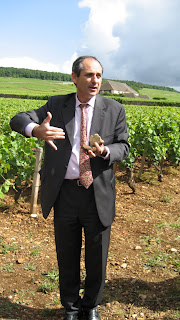
The vines of Pierre André are treated for disease, he said, not the risk of disease, otherwise you kill both the illness and the ecosystem. He and others we’d heard from during the week came back to their incontrovertable truth: that living things that are not routinely treated with chemicals (whether pesticides or antibiotics) are fundamentally more healthy and able to resist disease than those you make dependent on chemical cures. There is again no irrigation in use here: the vines are made healthier by having to sink their roots deep into the soil to find water.
We then retired to the cellar to have a tasting of wines from 2003 and 2004, and picked up an interesting snippet about wine tasting: there are three noses in wine – when it’s just poured in the glass; when it’s been swirled; and when the glass is empty.
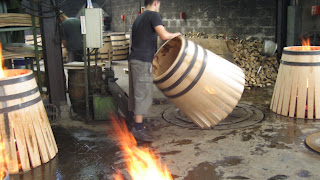
A big excitement later that afternoon was the visit to François Frères Cooperage, where we watched barrels being made. The company makes most of its own staves from lumber purchased at auction, and trims the pieces to size in a small mill on its property. The staves are then aged for two years before being trimmed again and formed into barrels. The most dramatic moment was the toasting, where the half made barrels are placed over fires so that the heat relaxes the wood and flavours it to the specification of the buyer.
Before we knew it, Monday had arrived and it was our last day in France.
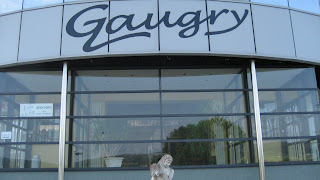
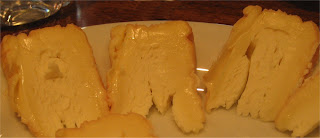
We visited Gaugry, a family-run cheese factory near Dijon, to learn about the making of Epoisses. This is one of the soft smelly French cheeses that I’ve never been wild about, but I enjoyed the tastings, and found my favourite of the three we tried was mild, creamy and firm – a much gentler taste than the aroma suggested. It was nice, though not enough to cause me to risk the aromatic integrity of my fridge in Parma by bringing some back with me, but I will look forward to tasting it again one day.
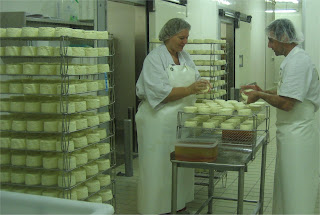
It’s a slow-coagulated, hand-salted cheese that is molded and dried before beginning a month or so of washings several times a week in marc de bourgogne (a wine solution) which gives it the orange colour we know it by.
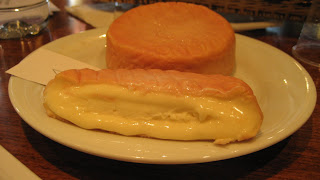
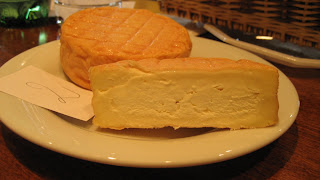
We tried three different versions: two raw milk (one a farmer’s cheese and the other made at the Gaugry factory) and one pasteurised, for markets like the US where raw milk cheeses can’t be sold. A tip for the interested is that pasteurised versions are runnier than raw milk ones, so it’s easy to spot the outsider among these three:
We had a few hours in a very warm room at the top of the Burgundy school of business in Dijon, where Peter Dunn walked us through the massively confusing layers of names and quality marks for Burgundy wines. It was new information to me on the Bordeaux Classification of 1855 and some helpful review of AOC requirements for French wine. It was more on exposure, water, soil, limestone, marl and weather systems, and a bit on pruning and vinification.
But before that, we were subjected to what may be the worst meal ever served (and not, in most cases, eaten): the cafeteria of the business school in Dijon. Curiously, they were offering this abomination during a student recruitment drive. The first photo was an unidentifiable deep fried something that was described as having a ‘bolognese’ filling; it was served on a mystery grain.
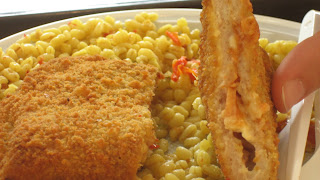
The vegetables had been cooked into some kind of alternate chemical existence; it was as if they had gone beyond their roles as long dead plants into some new and appalling incarnation that could not properly be described as a life form.
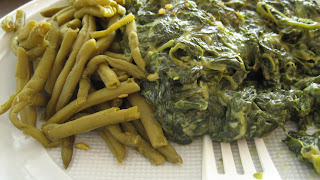
It was puzzling to us: why had we been brought here? Was there a learning point in this mealtime? This was not slow food; but neither was it particularly fast, and it was fairly certainly not even food.
When we had completed our close observation and dissection of the substances, and drunk our cups of water, we were directed to a large bin in the corner where everything – the ‘food’, plastic cutlery, plastic plates, paper cups and napkins – were tipped into a plastic-lined void. A perfect finale: this school doesn’t trouble itself with either edible meals or recycling. I wonder what other lessons the business students take away from this place when they graduate.
-
Burgundy mustard, pork and beaucoup du vin
Read Full Post: Burgundy mustard, pork and beaucoup du vinWednesday was mustard day. We left Lyon and stopped for a couple of hours’ free ramble round Beaune, looking pretty in the sunshine. The wine museum beckoned a couple of us, and we learned many things, including the six different ways one can drive a vine stake into the ground. Who knew??
After lunch we all trooped into the Fallot mustard mill, which still makes its mustard in the traditional way, using stone grinding. We were surprised to hear that 98% of the mustard seed used in French mustard, including Dijon (which is not a geographical designation, so it can be made anywhere). The Fallot mill makes a Burgundy mustard which has nearly achieved its AOC designation, and which uses only locally grown mustard seed, some of that elusive 2%.
After a tour of the interactive museum and a small tasting, we headed off to Dijon, where we dined near the market at Au Bon Pantagruel on some duck in armagnac sauce that did not linger quite long enough in the pan for most, and had to be wrestled onto the fork, followed by a chocolate mousse that left us wanting, well, a better chocolate mousse.
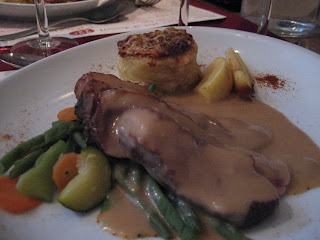
It’s entirely possible one can have a much better meal there if there are not 25 of you with a block dinner order. Let us hope.
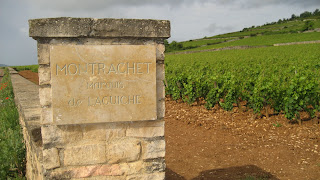
Thursday we went to Volnay, to visit the Chateau de Puligny, where Etienne de Montille took us out to the fields to show us the terroir. His fields are organic, without irrigation, and he looked rather pleased when he said he couldn’t show us any unhealthy plants because they were all doing so well.
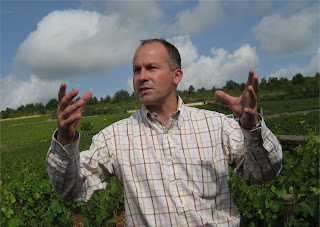
We tasted a small and delightful selection before departing to la Ferme des Levees in Lusigny-sur-Ouche.

Born again pig farmer Jacques Volatier told us he’d given up life as an engineer and town planner in order to do something more socially useful, environmentally sound, and agricultural, serving a local market – in protest against the industrialization of food production and long-haul food transportation. So, he raises pigs year round, outside, without antibiotics, and produces pork products on the farm. He doesn’t breed the pigs himself because that would require conformity with EU hygiene regulations which are so strict (like making the farm a war zone, he remarked) they would make it impossible for him to do what he needs to do, which is to show the people who buy his pork where it comes from.
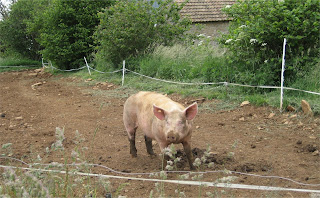
It’s a small scale enterprise, in which he slaughters about three pigs a week, and sells the meat and products at markets and from the farm shop.
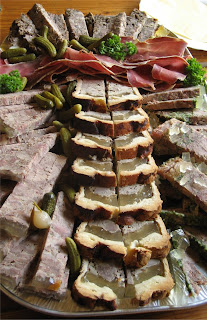
We sampled some jambon persille, jambon a la moutarde, pates en croute, gratons, salad and some home made elderflower cordial (he planted the elderflower as shade for the pigs, and began turning it into a saleable product as a sideline), followed by fromage blanc, a bit like cream cheese, from a farmer up the road, served with thick spooning cream and sugar or salt. Kind of like a do it yourself cheesecake, someone remarked.
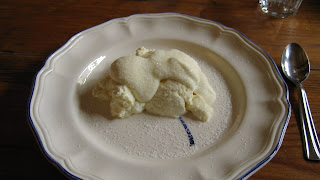
And off we went to another vineyard, this time the Domaine Dujac, where as we dodged spitting rain and thunder, Jeremy Seysses told us about his vines and wines.
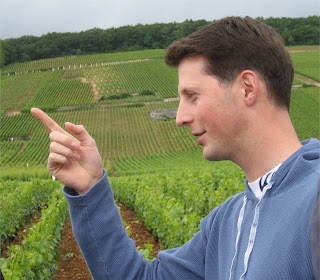
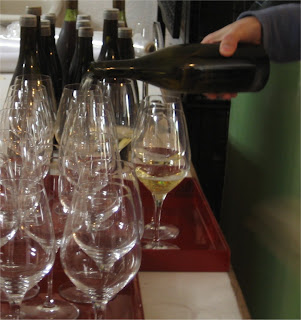
We had a spin round the cave and then he gave us a horizontal tasting of 2001 wines, chardonnay and pinot noir, followed by a special and delectable glass of 1976 pinot.
Thursday night was another free meal, and after a drizzly walk seeing the sights of Dijon, we ended up nearly back at the hotel with our noses pressed to the menu board of Allo Nem, an Asian restaurant – when, like magic, our Taiwanese food guru Andy popped his head out the door and said the magic words: “it’s good!” And he was right.
-
Beef and chicken à la française
Read Full Post: Beef and chicken à la françaiseSo here we are in France. We arrived on Sunday morning, in Lyon, and I for one am rejoicing in the cooler temperatures – Parma was a steamy 35 degrees when we left. We’ve had our customary stage weather – chilly and drizzly with a bit of sun thrown in.
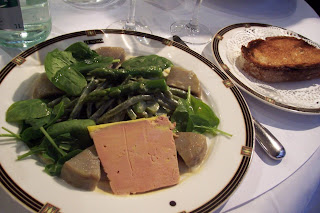
We had a free night in Lyon and headed for Le Nord, one of the Bocuse brasseries, on the expert recommendation of a local (thanks Jeremy). An excellent salad of green beans, artichoke hearts and a silky slab of foie gras de canard, followed by a wholesome waffle with sides of applesauce, warm chocolate and cream. Pas mal, and a good entree to France.
Monday we were up with the birds and off to Bourg-en-Bresse where we met our new friends Philippe Marchenay and Laurence Bérard, researchers in food and bio-ethnology, who talked to us about geographical designations and biodiversity in French food products.
Our first example was Charolais beef, plodding towards AOC/PDO designtion and so widely known already that they have their own museum at la Maison du Charolais, where we had a talk and a tasting.
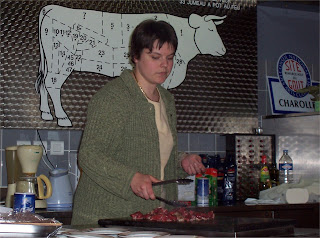
Then onto the bus and off at a Charolais farm.
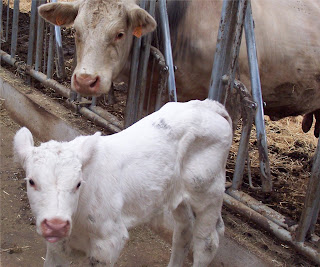
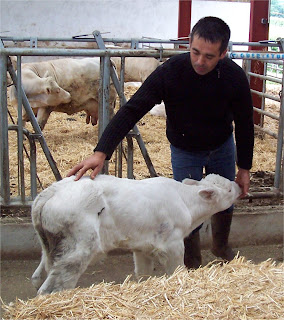
Dominique Gateau, the owner, talked to us about his breeding practices, which involve 24 hour video surveillance during calving, which lasts from January till June. We met a few of the newcomers and were shown some of the qualities that make good beef cattle.
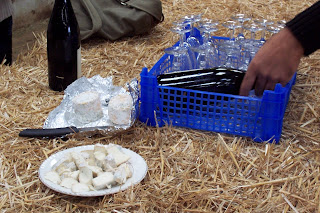
Afterwards, he set up a little wine and cheese party on some hay bales, featuring of his own goat and cow cheese.
And then back to le Maison du Charolais where they also have a restaurant, and we had a Charolais steak before heading off into the night.
Tuesday morning we ambled across the street to Lyon’s excellent food market, les Halles de Lyon, where Philippe and Laurence guided us through the stalls.
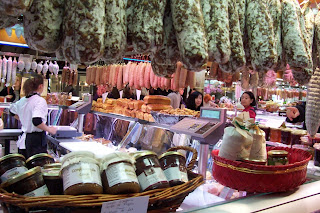
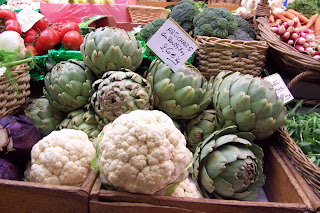
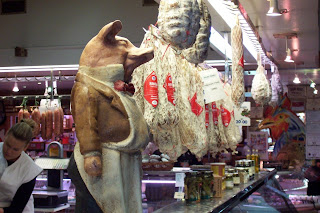
We fetched up at a great cheese stand and bought plenty for lunch which we enjoyed in Philippe and Laurence’s comfortable house in the country.
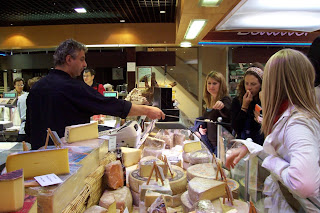
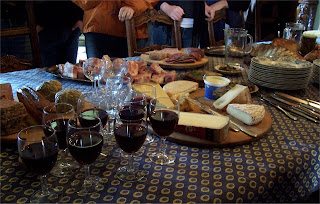
Lots of cheese, wonderful bread, salumi, apple juice, Philippe’s cornichons, a bowl of fresh strawberries, and their neighbour’s wine.
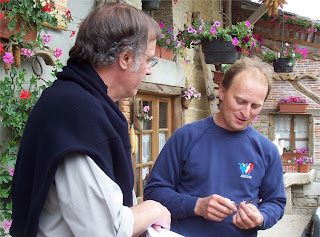
Then to the Bresse Chicken farm owned by Christophe Vuillot, who, at 37, thanks to skills at poultry farming learned from his grandfathers, has a happy life raising his happy chickens who fill the fields around his house, with a small flock of guinea fowl and a grey border collie keeping an eye on them. The birds are long maturing, fed on a mixture of special poultry feed and what they forage in the grasses, and they are given a helping of whey in their feed which works as a natural preventative against worms and parasites. They are also, of course, healthy enough that they don’t need the chronic antibiotics that battery farmed chickens do.
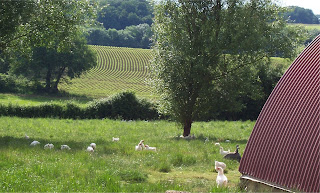
We were given a demonstration of the dressing of these very special and very expensive chickens, which are slaughtered on the farm, their head and neck feathers left on (for aesthetic purposes, the farmer explained) and then sewn into a linen casing that expels air and acts as a secure protection for up to a week. The chickens are prepared this way for competitions and feast day – 150 of them are hand sewn each Christmas at this farm alone.


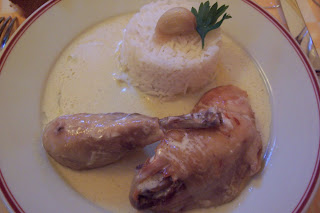
And for supper, we had… chicken.


Latest Posts
- Writers at Word!
- Sublime and Twisted Readings coming up!
- Sublime
- Good weather for reading
- The world, the world
- Sublime launch!
Aldeburgh Poetry Festival Barny Haughton BBC BC poets Berkswell blackberries Black Stilt Bologna book launch Borough Market Carlo Petrini Catalonia Cyrus Todiwala dairy Daunt's Books Dijon Edinburgh Fanny Bay Feast of Fields Food and Morality food history food journalism Jenna Butler lardo Malahat Review Michael Pollan Okanagan olive oil tasting olive trees Omnivore's Dilemma Our Food Our Future Oxford Parmigiano-Reggiano Planet Earth Poetry poetry poetry readings Poetry videos prosciutto salumi Sean O'Brien Suffolk ticks Wendy Morton Wired Writing Yvonne Blomer
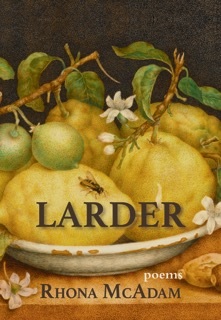
In her latest collection, Rhona McAdam navigates the dark places of human movement through the earth and the exquisite intricacies lingering in backyard gardens and farmlands populated by insects and pollinators, all the while returning to the body, to the tune of staccato beats and the newly discovered symmetries within the human heart.
“…A beautiful, filling collection, Larder is a set of poems to read at the change of the seasons, to appreciate alongside a good meal, and to remind yourself of the beauty in everything, even the things you may not appreciate before opening McAdam’s collection….”
Rhona McAdam is a writer, poet, editor, and Registered Holistic Nutritionist with a Master’s in Food Culture from Italy and a deep-rooted passion for ecology and urban agriculture. Her work spans corporate and technical writing to poetry and creative nonfiction, often exploring the vital links between what we eat and how we live. Based in Victoria, BC, and available via Zoom, Rhona is always open to new writing commissions, readings, or workshops on nutrition and the culinary arts.